Get Full Government Meeting Transcripts, Videos, & Alerts Forever!
Get email alerts on the Statewide Outdoor Recreation Plan topic
No spam. Unsubscribe anytime.
Maine shifts SCORP to 10-year cycle; state seeks public input and explains LWCF rules
Summary
At a May Municipal Planning Assistance webinar, Nicole Lares of the Bureau of Parks and Lands outlined a revised statewide comprehensive outdoor recreation plan (SCORP) timeline, public-input steps and how the plan ties to Land and Water Conservation Fund grants.
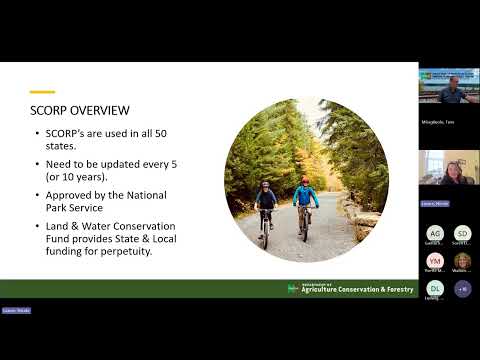
At a May webinar, Nicole Lares, outdoor recreation planner with the Bureau of Parks and Lands at the Maine Department of Agriculture, Conservation and Forestry (DCF), said Maine is moving its Statewide Comprehensive Outdoor Recreation Plan (SCORP) to a 10-year cycle and extended the plan’s deadline to Sept. 26, 2026 while describing the public-input process and how SCORP guides eligibility for Land and Water Conservation Fund (LWCF) grants.
Lares said the primary function of SCORP "is to identify statewide demand for and supply of outdoor recreation" and to set planning priorities municipalities, tribes and other eligible entities use when applying for LWCF money. She told webinar attendees the state has assembled a steering committee and will gather public input through two surveys, focus groups and one-on-one interviews before drafting the plan.
Why it matters: SCORP is used by grant applicants and administrators to demonstrate how local projects tie into statewide recreation priorities. LWCF-funded sites carry long-term use requirements, and the plan helps communities compete for grants and align projects with state strategies.
Key details from the webinar - Timeline and approval: Lares said the National Park Service must approve the SCORP. Maine requested and received an extension tied to a federal decision that made a 10-year update cycle optional; the state’s new target completion date is Sept. 26, 2026. Lares described an internal schedule that includes survey and focus-group work through September, drafting October–December and submission to the National Park Service in July for review. - Public input methods: Two surveys will inform SCORP. A provider survey has been live since March; a recreation user survey was expected to be posted within weeks of the webinar. Lares invited focus-group participation and said some stakeholder interviews already are planned with organizations such as land trusts and trail groups. - Connection to LWCF and grant rules: Lares described LWCF as a primary funding source that requires projects to tie to statewide recreation planning. She said LWCF grants in 2025 have a maximum award of $500,000 and generally fund up to 50% of allowable project costs. Eligible applicants are state agencies, counties, municipalities, school districts and tribal nations; land trusts and other nonprofits are not eligible to apply directly but commonly partner with eligible public entities. - Staffing and review capacity: Lares told attendees the National Park Service review office is reduced compared with prior years and that Maine currently has fewer reviewers handling approvals, which could affect review timing. - New statewide trails plan: Lares said the SCORP process this year will include work toward a statewide trails plan (a requirement for some Maine DOT funding) and that the Bureau expects to contract out work on that component. - Relationship to other state planning: Lares described coordination with the Office of Outdoor Recreation and the 10-year Maine Outdoor Economy Roadmap; she said SCORP is more directly tied to federal LWCF eligibility while the roadmap emphasizes economic impact.
Issues and local concerns discussed Webinar participants raised recurring local concerns Lares said the SCORP will consider: loss of informal access to privately owned recreation lands, overcrowding at well-known sites, seasonal changes driven by climate, gaps in local stewardship capacity, transportation and housing shortages that affect seasonal and permanent staffing for recreation-related businesses, and the need for improved wayfinding and equipment-sharing programs to broaden access.
Quotations from the webinar - "The primary function of SCORP is to identify statewide demand for and supply of outdoor recreation," Nicole Lares, outdoor recreation planner, Bureau of Parks and Lands, Department of Agriculture, Conservation and Forestry, said during her presentation. - "So our SCORP is actually now going to be due to September 26," Lares said when discussing the revised timeline.
Next steps and how to participate Lares asked attendees to join focus groups or interviews and to complete surveys when available. She said the provider survey is already live and that both surveys will remain open through September. Lares said a draft will be posted for public comment after the steering committee develops themes and strategies and invited attendees to contact her with questions.
Ending Lares closed by encouraging municipal planners, land managers, user groups and others to participate in the SCORP input process and watch for posted links to survey materials and the draft plan once it is released.