Get Full Government Meeting Transcripts, Videos, & Alerts Forever!
Get email alerts on the Arpa Forestry Grants topic
No spam. Unsubscribe anytime.
ARPA forestry grants kept Maine forest businesses afloat, MTI presentation finds
Summary
Maine Technology Institute told the Working Lands advisory board that two ARPA-funded forestry programs issued grants that helped retain workers, supported local vendors and highlighted the need for simple applications and technical assistance for small operators.
Matt Hoffner, representing Maine Technology Institute (MTI), told the Maine Working Lands Enterprise Advisory Board on April 30 that MTI’s administration of American Rescue Plan Act (ARPA) forestry funds delivered rapid, measurable benefits to small forest businesses.
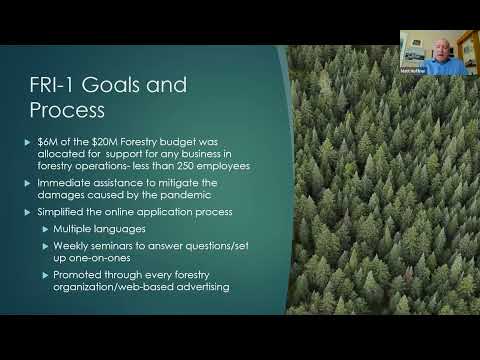
MTI managed multiple ARPA forestry programs after the legislature directed federal ARPA dollars into the Maine Jobs and Recovery Program (MJRP) under LD 1733. Hoffner said one early program, Forest Recovery Initiative Phase 1 (FRI 1), provided broad, small-dollar relief: MTI received 217 applications and made 215 awards with an average award of about $27,500, distributing roughly $6,000,000. He said requests exceeded available funds by roughly three times.
The grants helped retain employees and circulate money in-state, Hoffner said. MTI’s follow-up survey, about 15 months after the awards, found that awardees reported 38% of employees who otherwise might have been laid off were retained. About half the money was spent on equipment, supplies and parts; 83% of those purchases were from Maine vendors, amplifying local economic impact. Hoffner said MTI used automated text analysis to categorize projects; the largest shares of spending were on parts (about 32%), increased wages/benefits (about 30%), and truck/equipment maintenance (about 23%), with roughly 10% for fuel-efficiency investments and the remainder for pandemic safety gear.
Hoffner also described a second, competitive round, FRI 2, which targeted larger, productivity-raising investments. MTI received 48 applications and awarded 23 grants, with the awards averaging about $687,000 and totaling nearly $16,000,000. Those larger awards were concentrated in projects such as biorefineries and biochar plants; Hoffner said FRI 2 recipients averaged about 32 full-time employees and the cohort affected more than 3,000 workers in total.
Hoffner described MTI’s broader grantmaking and match history: over 25 years MTI has distributed about $372,000,000 and — because most programs require at least a 1:1 match — that spending mobilized roughly $2,200,000,000 in private capital. He also described operational choices that enabled quick disbursement in 2022: a noncompetitive, low‑friction online application, published in multiple languages; weekly seminars and one-on-one help for applicants; and outreach by forestry organizations to their members.
Hoffner summarized MTI’s lessons learned for future state-sponsored funds. Rising interest rates were the top ongoing concern reported by awardees, so MTI has kept a 5% loan rate and flexible terms for its loan products. He emphasized that many small forestry and agricultural firms lack administrative capacity and technical sophistication; simple applications and proactive applicant support were necessary to get funds to the intended recipients. MTI also found value in providing or subsidizing technical assistance: MTI’s entrepreneur-in-residence and Maine Entrepreneurial Resource Corps programs (which pay half the cost of consultants) helped businesses convert grant awards into durable outcomes. Finally, MTI conducted economic‑impact surveys about a year after funding to measure outcomes and refine future programs.
Board members asked questions about eligibility (Hoffner said MTI funds go to businesses in MTI’s seven sectors and to organizations that support those sectors; profitability is not a prerequisite) and the balance between simplicity and multi-stage application processes. Hoffner said MTI balances speed with rigor by using simpler intake for broad relief (FRI 1) and competitive review for larger transformational projects (FRI 2).
Hoffner summarized the qualitative tone of recipient responses: “the grant served as a lifeline,” a phrase he said appeared repeatedly in awardee comments and in MTI’s post-award analysis.
MTI’s data and operational takeaways will inform the advisory board’s development of a Maine working‑lands fund, particularly on application design, the role of technical assistance, and calibrating grant size to expected administrative capacity.
Ending: Hoffner concluded by opening the floor for questions; MTI’s findings will be included in the advisory board’s packet and used in subsequent deliberations about fund design and implementation.