Get Full Government Meeting Transcripts, Videos, & Alerts Forever!
Get email alerts on the Growth And Development topic
No spam. Unsubscribe anytime.
Baltimore County planning staff present 2024 annual growth report; planning board to vote May 15
Summary
Department of Planning staff summarized residential and nonresidential permitting, development‑capacity modeling and infrastructure constraints in the 2024 Annual Growth Report; the planning board received the staff report and will vote on it at its May 15 meeting.
The Baltimore County Department of Planning presented its 2024 Annual Growth Report at the Planning Board’s May 1 meeting, summarizing residential and nonresidential approvals, development‑capacity modeling and infrastructure status. The board received the staff report; a formal vote is scheduled for the board’s May 15 meeting.
The report, presented by Chris Weaver of the Research, Analysis and Design Division, reviews last year’s approvals and projects county compliance with state growth‑management principles. “The land use article of the Annotated Code of Maryland requires that charter counties prepare an annual report on growth,” Weaver said. He told the board the report is due to the Maryland Department of Planning by July 1, 2025.
Why it matters: the report compiles where new housing and commercial space were permitted in 2024, how much existing undeveloped land remains inside the county’s Urban‑Rural Demarcation Line (URDL), and whether school and utility capacity could constrain future projects.
Key findings reported to the board included: - The county approved 23 residential development plans in 2024 (including nine major development plans, seven minor subdivisions, three planned unit developments and four limited subdivisions), representing 450 residential units. Weaver reported unit mix as 60.8% multifamily, 27% single‑family attached and 12% single‑family detached. - Weaver reported that roughly 91% of the proposed residential units and about 93% of nonresidential permitted square footage were located inside the URDL. - The county recorded 889 residential units permitted for occupancy in 2024; Weaver said that number was similar to 2023 (871 permits) and lower than 2022 (1,230 permits). - For nonresidential development, the report listed 42 plans approved in 2024 totaling approximately 2,000,785 square feet of approved space (the report compares that to 4,170,173 square feet approved in 2023). - A GIS‑based development capacity model estimated potential additional residential units on vacant or underdeveloped parcels inside the priority funding area at between about 8,857 units under a moderate scenario and 23,453 units under a full‑build‑out scenario; the report noted redevelopment and densification of commercially zoned lands were not included in those figures. - Based on recent average annual construction, staff estimated the URDL could reach build‑out from roughly 9 to 24 years if current trends continued.
Board members asked follow‑up questions on several topics. Emily Profe asked where development capacity details appear in the packet; Weaver pointed to the development capacity discussion in the written report. Board members requested clearer year‑over‑year comparison charts for 2022–24, and Weaver and Director Lafferty said earlier reports and tables contain much of that data and staff could provide comparative tables on request.
School capacity and adequate‑facilities questions were a recurring concern. Weaver said school impact analyses are performed for each residential project under the Baltimore County Code; he noted the report flags that 13 elementary schools and six high schools are at or above 115% of their state‑rated capacities for the 2024–25 school year and projected 2025–27 enrollments. Board members asked whether the development‑capacity model accounts for adequate‑facilities limits; Weaver said it does not — the model examines vacant or underdeveloped land and does not incorporate school capacity or other adequate‑facilities constraints.
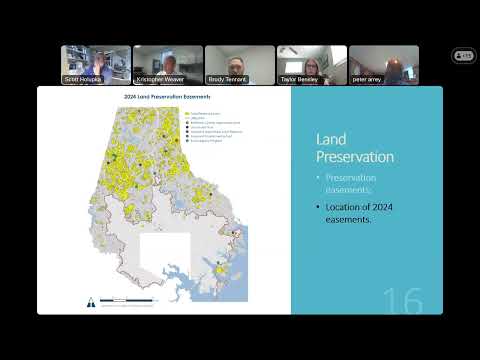
Utility and transportation updates in the report included Department of Public Works and Transportation (DPWT) assessments that no public water deficiencies were known in 2024, ongoing sewer relief metering and monitoring, a list of 10 F‑level and one E‑level intersections identified on the 2024 basic service transportation map, and 42 road projects built, extended or relocated in 2024 totaling about 6.925 miles (all within the URDL). The report also shows 6,98 acres added to preserved land in 2024 (the transcripted figure appears in the packet) and a county total of approximately 71,592 acres preserved, with the largest single addition in 2024 coming through the Maryland Agricultural Land Preservation Program.
Board chair Scott Haloka closed discussion by reminding members the board will vote on the report at its May 15 meeting and encouraged staff to provide the requested comparative charts and any additional school‑capacity clarification prior to the vote.
Notes: staff described the document as a state‑required report and did not present any accompanying zoning or regulatory changes for immediate board action.