Get Full Government Meeting Transcripts, Videos, & Alerts Forever!
Get email alerts on the Capital Financing topic
No spam. Unsubscribe anytime.
Nevada County reviews municipal-bond options as capital projects await funding
Summary
At a special Nevada County Board of Supervisors meeting, staff and municipal advisor KNN Public Finance reviewed debt financing options, current market rates and a list of priority capital projects. Officials were advised to continue design work, tighten project readiness and revisit debt issuance after updated year-end budget numbers.
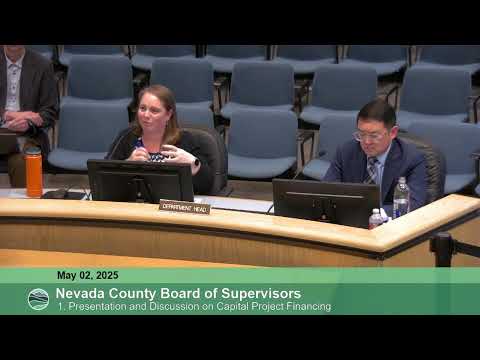
At a special meeting of the Nevada County Board of Supervisors, staff and outside municipal finance advisers reviewed how tax-exempt municipal bonds and other financing tools could be used to pay for a set of county capital projects and maintenance needs.
The workshop, led by Erin Metler, Nevada County deputy county executive officer and chief fiscal officer, and Bobby Chung of KNN Public Finance, covered bond basics, methods of sale, credit-rating considerations and post-issuance obligations. Chung told supervisors "a municipal bond is really a form of a loan" intended to "accelerate and deliver projects" when paying cash is impractical.
The discussion matters because the county is weighing whether to borrow to fund multiple projects — including an animal shelter, a sheriff’s firearms range, correctional facility renovations and a dispatch training facility — while the county’s discretionary budget is tight and the bond market is at higher rates than in previous years.
Chung explained that Nevada County can access tax-exempt borrowing that typically lowers interest costs for public agencies but that federal rules limit private use and require most proceeds to be spent within three years. He also reviewed three sale methods — competitive, negotiated and direct purchase — and noted the county’s 2019 lease revenue bonds carried an approximate blended interest rate of about 3.09% over 20 years. By contrast, Chung said current market yields are higher: about 4.38% for a 20-year term, 4.61% for 25 years and 4.75% for 30 years.
County staff presented the list of projects staff consider the most likely candidates for general-fund support or for inclusion in a financing plan. Key projects discussed and their current statuses or estimates: an animal shelter (conceptual design stage; city partners being consulted), a sheriff’s firearms range (initial estimate ~$15 million; currently seeking earmark/ grant possibilities and further design), correctional facility remodel and medical expansion (rough estimate ~$30 million; feasibility work and expanded scope under review), Summit maintenance/storage facility (site identification and potential build to avoid reliance on leased private storage) and conversion of the former juvenile hall into a dispatch training facility (rough estimate ~$8 million; longer-term project).
Metler emphasized the county’s near-term budget position. The county entered the meeting with an adopted general fund balance shown at roughly $40 million, a projected year-end figure cited at about $45.1 million and a preliminary FY2025–26 general-fund balance estimate of roughly $40.5–$41.5 million. Staff said the preliminary FY2025–26 budget projects about $104.2 million in revenue and matching expenditures, with a planned use of fund balance of approximately $3.6 million (largely ARPA-committed dollars). Metler said that, as presented, the proposed FY2025–26 budget leaves little room in the general fund for new ongoing debt service in that fiscal year.
Board members pressed staff on timing, market risk and project readiness. Supervisors asked whether the county should wait for rates to decline or for construction costs to moderate. Chung and staff responded that jurisdictions with projects already at bid would often proceed, and that KNN’s role includes advising on market timing; he said the recent market volatility had moderated but warned conditions change with economic data. Staff noted that bond proceeds generally must be spent within IRS timelines, and post-issuance reporting and arbitrage rules apply.
Supervisors also asked whether ongoing operations such as vegetation management are suitable for borrowing. Staff said routine, recurring maintenance is not considered capital and generally is not recommended for debt financing. Several supervisors reiterated a conservative approach to borrowing and recommended treating federal earmarks as contingent, not guaranteed, when modeling financing plans.
Metler recommended next steps: continue design and project development through June, have the budget subcommittee (chair and vice chair) evaluate available funds during budget adoption, convene the county’s debt financing advisory committee between October and December to review options and aim to present a more specific financing proposal at a January board meeting. Staff said they did not expect to carry new debt service in FY2025–26 and that any debt service would likely begin in FY2026–27 if the board chooses to proceed.
Public comment during the item included Michael Taylor (District 1), who urged postponing borrowing until there is clearer fiscal and market stability.
The workshop produced no formal votes. Staff will return with more detailed project sheets, updated budget figures and a convening of the advisory committee for additional direction.