Get Full Government Meeting Transcripts, Videos, & Alerts Forever!
Get email alerts on the Homelessness Budget topic
No spam. Unsubscribe anytime.
Office of Homeless Services defends FY26 budget while council presses for data, shelter fixes
Summary
The Office of Homeless Services presented its FY26 proposed general fund budget of $84,188,038 and defended program continuity despite a $5,055,830 decrease from FY25 estimated obligations; council members pressed for contract detail, provider lists and clearer accounting of shifted funds.
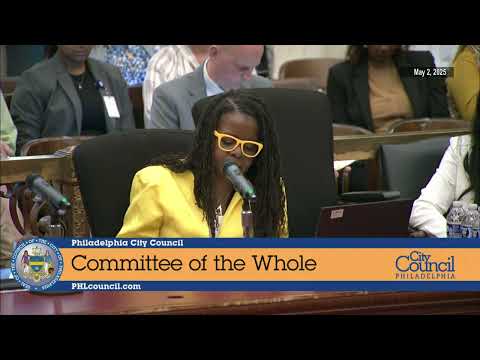
The Office of Homeless Services presented its proposed fiscal year 2026 operating budget and program priorities to the Philadelphia City Council Committee of the Whole, describing new steps to accelerate housing placements, expand shelter oversight and pilot shorter shelter stays while defending a $5.06 million decrease from FY25 estimated obligations.
“My name is Cheryl Hill, Executive Director of the Office of Homeless Services,” Hill said in opening testimony, which outlined a $84,188,038 FY26 general fund request and said the administration had established a $4.7 million reserve in FY25 to cover unanticipated costs, including enhanced Code Blue operations and provider wage increases.
Hill told the committee the decrease in OHS’s FY26 general fund total does not reflect program cuts because some funding authority shifted to other departments. “Everything that we set out to do has been funded this year,” she said, noting vouchers and wellness funding administered through the Managing Director’s office will be run by OHS operationally.
Why it matters: Council members repeatedly told OHS they see homelessness rising locally while the agency’s line‑item general fund total falls. Members pressed agency leaders for verifiable contract detail, monitoring results and lists of providers and units so council can assess capacity, equity and whether one‑time allocations should become recurring.
Major themes and details from the hearing
Budget totals, reserves and re‑allocations - OHS proposed a FY26 general fund budget of $84,188,038, which Hill said is $5,055,830 below FY25 estimated obligations; OHS attributed the decrease primarily to FY25 one‑time allocations and to budget authority moved to other city offices for functions previously managed by OHS (for example, facility management and security at Philly Home at Girard). - Hill said a $4.7 million FY25 reserve was created and used for enhanced Code Blue operations, provider wage increases and additional prevention assistance and facility maintenance.
Shelter operations, oversight and corrective actions - OHS said it has implemented increased monitoring of shelters and a new shelter monitoring process intended to ensure sites provide safe, decent and sanitary conditions and sufficient case management. - Agency staff reported monitoring 28 sites so far. According to OHS testimony, initial monitoring produced multiple findings: 11 sites failed on-site visits; 4 failed to meet shelter policy standards; several providers remain on corrective action plans and some cases remain pending. Providers that fail to remedy deficiencies face progressive enforcement up to potential contract termination. - Hill said inspectors and a fiscal review consultant are helping the agency strengthen internal controls and fiscal practices; OHS will share the consultant’s draft recommendations with council before the scheduled callback.
Capacity, utilization and the Philly Home at Girard site - OHS said the system operates roughly 3,000 shelter beds with about 90–95% average daily utilization and that census fluctuates day to day. - Philly Home at Girard was described as a low‑barrier site with 132 beds on OHS‑run floors; some floors in the building are run by the Department of Behavioral Health and Intellectual disABILITIES (DBHIDS).
Code Blue and year‑round winter beds - Hill told council the cost to operate the extra Code Blue beds year round would be roughly $6.1 million annually. OHS said it formalized an enhanced Code Blue protocol piloted during winter and will use some reserve funds for expanded winter services.
Housing placements, permanent supportive housing and lost HUD funding - OHS said it is pursuing measures to shorten shelter stays and increase referrals to permanent housing, including pilot changes to assessment and referral practices and a landlord engagement effort. - Agency testimony described a recent loss of some Continuum of Care (CoC) HUD renewals that affected approximately $3 million in funding tied to about 250 units. Hill said the CoC ranking and national competition process at HUD led to some awards falling into the national pool; OHS issued an RFP to bridge the gap for providers whose federal renewals were not guaranteed and said another permanent supportive housing RFP is open to expand capacity.
Prevention and veterans/youth/families - OHS said prevention, diversion and intake (PDNI) remain a central strategy; the agency said grant funding pays much prevention activity and that FY25 prevention demand was high—the agency reported about 4,000 requests for assistance in a recent period and added one‑time and other funds to cover overflow. - Council members asked about targeted strategies for youth aging out of foster care, veterans, women with children, people living with disabilities, and people with pets. OHS said it funds youth‑focused HUD demonstration programs and has prioritized pet‑friendly shelter responses in its latest RFP.
Technology, data and HMIS - OHS said it has an RFP out to modernize its Homeless Management Information System (HMIS) to improve intake, bed availability data, case tracking and reporting. The agency said part of that project is federally funded and part general fund; the goal is to provide more visible, timely data (daily census, bed availability, service maps) to council and the public.
Case management and workforce - OHS testified to current case manager staffing targets—about one case manager per 25 families or one per 35 individual participants in some program models—and said roughly 80% of case management funding comes from state and federal grants with the remaining share from the general fund. Hill and staff said qualifications and ratios vary by program and population and that training and supervision depend on services offered at each site.
Provider wage increases, maintenance and contracting questions - Hill said the FY26 budget accounts for higher wages for nonprofit providers and one‑time maintenance costs used in FY25 to address immediate facility needs; the agency also said some contracts were reallocated or ended and are now out for RFP, which changed line‑item totals across the budget documents. - Council members asked OHS for lists of FY25 contracts, FY26 contract changes, vendor names, the consultants’ recommendations, and the RFP technical specifications. OHS agreed to provide these items in writing ahead of the scheduled callback.
Follow‑up requests from council and next steps Council members repeatedly asked OHS to provide, in writing and before the callback: - The consultant fiscal review draft and final OIG report when available. - A full list of shelter providers (city‑run and contracted), the number of units served per provider, and the districts where they operate. - Detailed line‑item contract reconciliations showing how FY25 one‑time funds and FY26 embedded costs (wage increases, maintenance) were allocated. - Per‑bed estimates and the total cost to make winter Code Blue beds year‑round. - The RFP language and HMIS technical specifications.
What OHS is proposing and what council wants OHS described several near‑term operational proposals: formalizing the enhanced Code Blue protocol, conducting ADA accessibility assessments at city‑funded emergency shelters, strengthening fiscal controls through FCAM, issuing an RFP to bridge lost HUD renewals, piloting new assessment/referral practices to reduce shelter length of stay, and launching a new HMIS procurement to improve intake and bed‑matching. Council members demanded more precise, auditable numbers (contract-by-contract) and clearer cross‑departmental accounting of vouchers and wellness dollars that the agency says are now managed by the Managing Director’s office but administered by OHS.
Ending Council members closed the hearing by requesting detailed follow‑up documents and provider lists from OHS; the committee scheduled further review (a callback) and asked the agency to supply the consultant draft, contract reconciliations and census/bed data in writing ahead of that session.
(Quotes and attributions are drawn from testimony and exchanges during the Committee of the Whole public hearing.)