Get Full Government Meeting Transcripts, Videos, & Alerts Forever!
Get email alerts on the Municipal Budget topic
No spam. Unsubscribe anytime.
Brigham City mayor presents $110 million proposed budget, proposes property tax and fee adjustments to cover fleet and service costs
Summary
Brigham City Mayor (name not specified) presented the proposed fiscal year 2025-26 budget to the Brigham City Council, outlining a $110,000,000 plan that includes $33,000,000 in capital projects, $19,000,000 in overpass and corridor preservation projects funded by the state legislature, a proposed $450,000 increase in property tax revenue (the city’s financial director estimates roughly a 15% rise in Brigham City’s portion), and a $1.75-per-month increase in the residential recycling (“blue cans”) fee.
Brigham City Mayor (name not specified) presented the proposed fiscal year 2025-26 budget to the Brigham City Council, outlining a $110,000,000 plan that includes $33,000,000 in capital projects, $19,000,000 in overpass and corridor preservation projects funded by the state legislature, a proposed $450,000 increase in property tax revenue (the city’s financial director estimates roughly a 15% rise in Brigham City’s portion), and a $1.75-per-month increase in the residential recycling (“blue cans”) fee.
The proposed budget matters because it would fund long-term infrastructure projects and rising operating costs while relying on the city’s utility fund and a property-tax increase that would affect local taxpayers. The mayor framed the budget as fiscally responsible and said it balances generational capital work with maintaining city services.
Key items in the proposal include a multi-year Fourth Street overpass project (work began in late 2024), continued work on a two-pipe penstock in the canyon (one of two pipes already completed), construction of a substation near Watery Lane to serve a growing Nucor campus, relocation of power lines above the Staker Parsons gravel pit per a longstanding contract, upgrades and relocation of the X20 substation, completion of a KV loop line for redundancy in the city’s electric grid, and a West Forest power line extension to serve new developments west of the Bear River Bird Refuge. The budget also anticipates completing the 100 South roadway and associated utilities this year.
On utility rates and power purchasing, the mayor said the city’s rate stabilization fund has improved and the proposed budget sets the power purchasing adjustment (referred to in the presentation as the PPAC) at 0 for 2025-26. The budget includes a new electric rate study to be completed after July 2026. The mayor said wholesale power market forecasts look stabilizing but upward and noted federal policy changes can affect power markets.
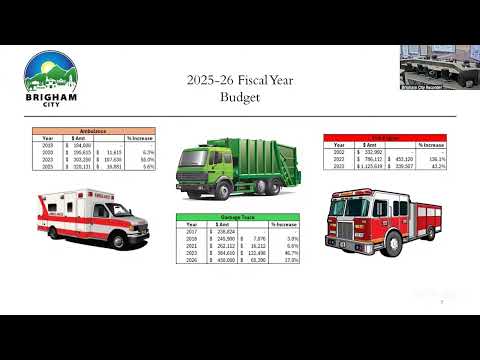
The city’s fleet fund — an internal service fund that purchases vehicles and recovers costs from departments via annual lease charges — is under strain from higher replacement costs caused by inflation. The mayor said the budget applies a 2% inflation factor to future replacement calculations but acknowledged recent fleet cost increases drove an estimated $450,000 shortfall in the general fund. To cover that cost the budget proposes a property tax increase that the city’s finance director, Tom Cotter, estimated would raise Brigham City’s portion of property taxes by roughly 15% (county final numbers were expected in early June, the mayor said).
Public safety spending is another major driver. The mayor presented historical figures showing public safety costs rising from about $5.1 million in 2016 to a proposed $12.5 million for 2025-26, a change he characterized as roughly a 48% increase over that period. He said both the fire and police departments are fully staffed for the first time in years and credited police Chief Reyes and fire Chief Thuissen for leadership in recruitment and operations.
Other budget mechanics described: the mayor proposed keeping the transfer from the utility fund to the general fund at 12% (down from historical levels around 15%), projected $5.5 million in sales tax revenue (same as the prior year), and noted the state legislature’s allocation for the Fourth Street bridge was deposited in an interest-bearing account and is not local taxpayer money. He also said the rate stabilization fund information will be posted on the city website in a few days.
The mayor invited the council to schedule work sessions on the property tax proposal and other items, and then turned the 2025-26 budget over to Mayor Pro Tem Smith for council consideration. No formal council vote or adoption occurred during the presentation.
Mayor (name not specified) said: “Because of the rate stabilization fund’s growth ... I’m proposing that the PPAC ... be set to 0 for the upcoming year.” He also said the budget is “fiscally responsible” and described the capital projects as “generational” work meant to last decades.
The presentation included several references to external agreements and dependencies (a contract with Staker Parsons regarding line relocation, state legislative funding for the bridge, and coordination with Union Pacific on easements for undergrounding infrastructure). The mayor also noted a proposed new substation to support Nucor’s planned expansion and the need for continued investments to maintain redundancy in the electric system.
Council members and staff were invited to schedule public work sessions; the mayor recommended transparent, public meetings for discussions leading to any decision. The budget presentation did not include any formal votes, ordinance readings, or final authorizations during the session.