Get Full Government Meeting Transcripts, Videos, & Alerts Forever!
Get email alerts on the Land Use topic
No spam. Unsubscribe anytime.
City Council adopts University Place subarea plan to guide Northeast Lincoln revitalization
Summary
The Lincoln City Council voted 7-0 to adopt the University Place subarea plan, which lays out traffic-calming, streetscape, housing and historic-preservation recommendations for the North 40th Street commercial corridor and adjacent blocks.
The Lincoln City Council on Monday adopted the University Place subarea plan, a neighborhood-focused update to the city-county comprehensive plan that aims to encourage redevelopment, traffic calming and historic preservation in the University Place area.
The plan, presented by Paul Barnes of the Planning Department, covers an area bounded roughly by Holdrege Street on the south, North 50th on the east, Cornhusker Highway on the north and North 30th on the west. Barnes said the planning team conducted extensive outreach including two in-person open houses, stakeholder committees and targeted outreach to Nebraska Wesleyan University. "We come before you this afternoon with a very exciting project, known as the University Place sub area plan," Barnes told the council.
Barnes said the plan’s priorities include converting the existing four-lane configuration on North 40th Street to a one-lane-each-way cross-section with a center turn lane and on-street parking to create a more pedestrian-oriented “Main Street” environment; longer-term consideration of roundabouts at key entry points; targeted redevelopment sites to support mixed-use projects; placemaking such as murals and lighting; and options for pursuing a local or National Register historic district to make property owners eligible for tax credits and help preserve older buildings.
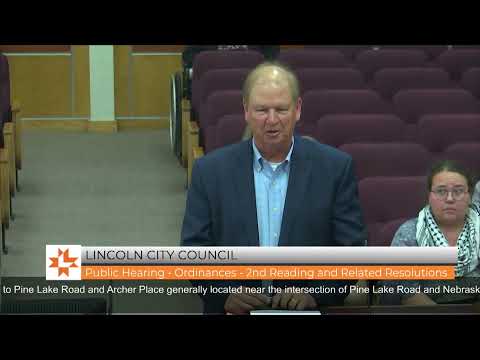
Lindsay Clausen, owner of Archway Studios and a neighborhood business owner, urged adoption, saying the plan would help the community recover from disruptions and make the area safer and more inviting. "The Lincoln planning department listened to all of the neighborhood stakeholders and residents when developing this plan," Clausen said during public comment. Council members who spoke during the debate praised the planning process and emphasized the need to remain responsive to areas outside the study boundary; Barnes said staff reached out to stakeholders beyond the study area but defined the subarea using arterial and other natural boundaries to keep the project scope manageable.
Council members pressed staff on floodplain concerns for the western portion of the study area, and Barnes said the timing of a separate Dead Man's Run watershed project should remove a substantial number of properties from the floodplain when completed. Council members also asked whether TIF funds could be used for parks or placemaking; Barnes replied that TIF typically funds public benefits and that such uses could be eligible if supported.
The council voted 7-0 to adopt the subarea plan. Supporters said the document provides a framework for near-term streetscape improvements and longer-term redevelopment that could make University Place a stronger creative-arts destination while preserving historic character.
The plan now becomes part of the 2050 Lincoln-Lancaster County comprehensive plan and will be used to inform future neighborhood-level investment and any redevelopment projects linked to TIF or other funding programs.