Get Full Government Meeting Transcripts, Videos, & Alerts Forever!
Get email alerts on the Public Health Budget topic
No spam. Unsubscribe anytime.
Houston health director details $62 million in grant losses, 5% budget cut and staffing impacts
Summary
Houston Health Department Director Steven Williams told council members the department faces about $62 million in grant reductions, a required 5% cut that affects roughly 22.5 positions, and a looming end to funding from a Medicaid 1115 waiver that has supported dozens of jobs and community programs.
Steven Williams, director of the Houston Health Department, told Houston City Council members at a budget briefing that the department faces substantial grant reductions and a required 5% citywide cut that will reduce staff and program capacity.
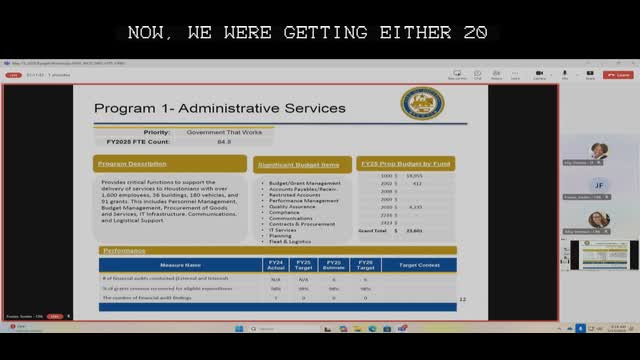
Williams said the department’s proposed budget is about $50 million, of which the department receives roughly $14 million in revenue; he described the city’s net investment in the department as about $35.7 million, with roughly $6.3 million restricted to specific accounts and about $29.4 million available for general-purpose services. “We had lost, about $62,000,000,” Williams said, describing roughly $42 million in grant funds that ended earlier than expected (covering immunization, crisis response, health equity and epidemiology functions) plus a separate $20 million Environmental Protection Agency grant tied to a cancer-cluster project.
The department has been required to identify a 5% budget reduction. Williams said that reduction “primarily impacted about 22.5 people positions,” of which about 7.5 positions were filled at the time of his presentation. He described a mix of vacancies and filled posts across programs and said managers are assessing which core functions must be preserved.
Williams told the council that roughly 62% of the department’s budget is grant-funded overall and that the department has already lost or will lose a substantial number of grant-funded FTEs. He said staff have prepared scenarios for program impacts but that exact outcomes are not yet known. “We don't know specifically,” Williams said when asked which grants remain at risk; he flagged HIV funding as a priority area where losses would force difficult choices.
Much of the department’s programming and services have been sustained by funding from a Medicaid 1115 waiver (referred to in the briefing as the "11 15 waiver"), Williams said. He estimated that about 79 positions in the department are currently paid from that waiver fund and that many prevention and reentry programs — including My Brother’s Keeper, reentry initiatives and workforce-focused efforts such as Urban Scholars — rely on waiver dollars. Williams warned the waiver-funded activities have a limited lifespan and said the city will need to identify replacement funding if it wants those programs to continue.
Council members pressed Williams for specifics. Council member Abby Kamen asked for dollar and personnel clarifications; Williams confirmed the 5% cut represented about $2.5 million in reductions but noted additional savings from a voluntary retirement offer. Williams said the voluntary offer had 245 eligible employees, 83 participants and 39 of those were general fund employees. Council member Julian Ramirez and others asked about increases in FTEs in certain lines of the budget book, including family health and special waste inspection; Williams said many increases reflect using waiver or grant funds to shore up programs and to cover positions that were previously paid from other sources.
Williams described program-level impacts and how limited-time grants have been used to build public-health infrastructure during and after the COVID-19 pandemic, citing investments in disease surveillance, workforce development, IT, communications and outreach to vulnerable populations. He also described efforts to increase lab fees to align with state charges and noted revenue changes tied to inspection activity (for example, fewer pool reinspections reduced fee revenue when inspections were not conducted).
On the EPA cancer-cluster grant for the Fifth Ward, Williams said the grant included community-focused elements such as workforce training and study of solar projects to potentially offset utility costs in the neighborhood; he described the EPA award as an "added value" intended to bring community benefits beyond remediation work. He said that grant funding has been affected and that the department had done preliminary work but that implementation would require coordination with other partners.
Public commenters urged sustained funding and planning. Sara Saeed, policy manager with a Spring Branch–area nonprofit, urged the council to pursue diversified and more stable local and state funding streams so essential services do not depend on unpredictable federal grants. Jack Balinski, who said he is living with HIV, urged the council to increase support for the health department’s frontline work, saying the department provided testing and vaccine access during COVID and continued to serve uninsured residents.
Williams and council staff said they will return with more detailed scenarios and staff analysis of which positions and programs would be prioritized for backfill as grants expire. No formal council votes on budget changes were recorded during the presentation; council members asked staff for further information and scenario planning before decisions are taken.
Williams closed by urging a focus on “back to basics” disease prevention and essential public-health services while the department adjusts to funding changes.