Get Full Government Meeting Transcripts, Videos, & Alerts Forever!
Get email alerts on the Domestic Violence Services topic
No spam. Unsubscribe anytime.
El Paso VA outlines intimate partner violence assistance program and local services
Summary
Ashley Lamail of the El Paso VA described the VHA intimate partner violence assistance program, screening practices, therapy options and referrals, and said services are available to veterans, caregivers, VA employees and non-enrolled veterans.
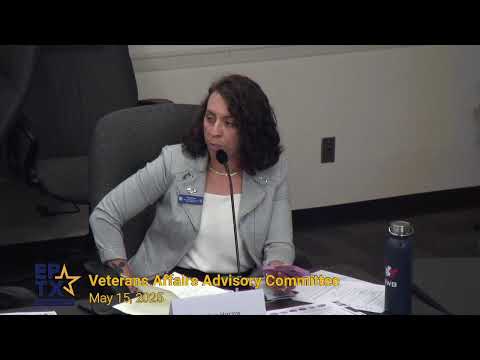
Ashley Lamail, intimate partner violence assistance program coordinator at the El Paso VA, briefed the Veterans Affairs Advisory Committee on May 15 about the VA's intimate partner violence (IPV) program, the VHA policy that governs it and local services available to veterans and others.
Lamail said the VHA directive establishing IPV assistance programs was first published in 2019 and updated in June 2024; the El Paso VA is implementing the directive's requirements locally. "The policy states that all veteran facilities across the VA will have an intimate partner violence assistance program," she said.
She described the program's mission and core principles: veteran- and person-centered care, trauma-informed approaches and recovery-oriented services. Lamail outlined the range of IPV experiences covered by the program, from stalking and emotional abuse to physical violence, and explained that the program serves veterans who experience IPV and those who use IPV.
Services Lamail listed include routine screening, assessments, individual and group therapy, safety planning for veterans who plan to remain in or leave a relationship, and referrals to community partners when appropriate. She highlighted two evidence-based programs available locally: "Recovering from intimate partner violence through strength and empowerment" (a therapy modality for people who experience IPV) and the "Strength at Home" program (a cohort model that addresses trauma among veterans who use IPV).
Lamail said the program conducts routine relationship-health and safety screenings for veterans of any age or gender; results may prompt a warm handoff to the IPV coordinator for follow-up. She also said non-enrolled veterans and VA employees may access certain IPV services through the program.
For crisis access, Lamail cited the Veterans Crisis Line and encouraged listeners to use 988 and press 1 for veteran-specific assistance; she also recommended the MyPlan safety-planning app and noted the national domestic-violence resources and local referral options listed on the handouts she left with the committee.
Ending
Lamail left flyers and contact information with the committee and invited members and community partners to contact her for referrals, resources or program coordination.