Get Full Government Meeting Transcripts, Videos, & Alerts Forever!
Get email alerts on the Rule 62 Stays topic
No spam. Unsubscribe anytime.
Utah Supreme Court Hears Argument Over Whether Stay Pending Appeal Required Bond or Injunctive Standard
Summary
At oral argument in Jenko v. Valdera Land Holdings, attorneys disputed whether the trial court should have used Rule 62(b)’s bond formula for a stay or the discretionary injunctive standard of Rule 62(c), and whether the trial court erred by granting the stay without an evidentiary hearing on damages and security.
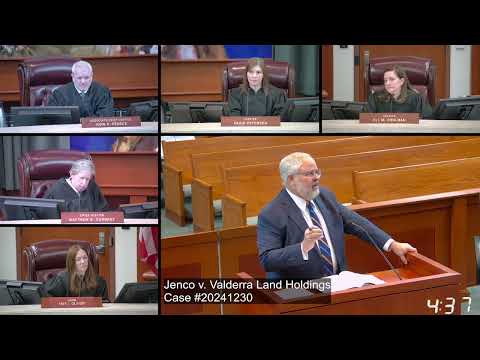
The Utah Supreme Court heard arguments Monday in Jenko v. Valdera Land Holdings over whether the district court erred in granting a stay pending appeal and what legal standard applies when the relief at issue requires or forbids transfer of a trust deed.
At issue is whether the trial court properly granted Jenko’s ex parte motion to stay enforcement of an order that — according to the underlying judgment — required reconveyance of a trustee interest once a monetary tender was made. Louis Rees, counsel for Valdera Land Holdings, told the justices that the order has both monetary and injunctive elements and that, once Valdera tendered funds, only the injunctive component (the obligation to release the trust deed) remained to be performed. Rees argued the trial court applied Rule 62(b)’s presumptive bond calculation when the court should instead have applied the discretionary injunctive standard under Rule 62(c) and held an evidentiary hearing to set any security required to protect Valdera’s rights.
The question matters, Rees told the court, because Valdera contends it has already tendered payment and will suffer substantial development losses while the trustee interest remains on title. Rees cited a damages figure presented in an affidavit stating Valdera could lose "$2,000,000 per annum" if it cannot proceed with development and asked the court to clarify whether the trial court must take evidence before fixing security to protect the nonmoving party during an appeal.
Thomas Burns (joined by Catherine Pappan), who argued on behalf of Jenko LC, defended the district court’s approach and urged the court to uphold the stay. Burns said the order being stayed required payment and that the motion was appropriately characterized under Rule 62(b), which provides a streamlined bond formula. Burns acknowledged some filing irregularities in the trial court (including an ex parte filing) but argued any procedural mislabeling did not amount to an abuse of discretion by the district court.
Several justices pressed both sides on discrete points. The bench questioned whether the trial court in fact considered Valdera’s opposition filings before entering the stay and whether Rule 62(i) (the transcript references a post‑order request for hearing under Rule 62(i)) or other procedural provisions altered the parties’ rights. One justice asked whether, if the court concludes the stay was entered under the wrong subsection, the appropriate remedy would be remand to the trial court to consider a Rule 62(c) application and, if necessary, set conditions to secure the adverse party’s rights.
Jenko’s counsel pointed to federal and out‑of‑state authority that courts have been reluctant to apply routine bond rules to nonmonetary injunctive relief because a bond can be ineffective to protect the nonmoving party’s interest in property subject to an injunction. Valdera’s counsel cited state precedent and argued the district court granted an effectively injunctive stay without taking evidence on damages or what security would be “just” under Rule 62(c).
The record includes an inconsistency in the amount required under the trial court’s order: the order’s text referenced a tenders amount of $1,270,000 at one point, while counsel later described the total tendered to the clerk (including interest and fees) as $1,560,000. Counsel agreed the cashiers/check was tendered to the clerk and discussed whether holding those funds in court protects Valdera’s development interests during appeal. The parties also disputed whether the district court actually considered the opposition filings (Valdera’s memorandum and an affidavit from an expert witness described in briefing) before granting the stay.
No decision was announced. After oral argument, the justices took the matter under advisement and said they would issue an opinion with their reasoning. The court noted Justice Hagen is recused from this matter and that Judge Amy Oliver of the Utah Court of Appeals sat pro tempore on the panel.
Several procedural and substantive issues remain in play: (1) whether a stay that prevents reconveyance of a trust deed is properly analyzed as monetary or injunctive relief under Rule 62; (2) whether the district court’s handling of filings and an ex parte motion deprived Valdera of a fair opportunity to present evidence about damages and security; and (3) whether, if Rule 62(c) applies, the trial court must hold an evidentiary hearing before setting conditions to protect the adverse party’s rights. The court’s forthcoming opinion will determine whether the stay must be vacated or remanded for further proceedings and whether guidance to trial courts on handling similar mixed monetary/injunctive orders is warranted.
The case number and scheduling for issuance of an opinion were not specified at argument.