Get Full Government Meeting Transcripts, Videos, & Alerts Forever!
Get email alerts on the Peacekeeping topic
No spam. Unsubscribe anytime.
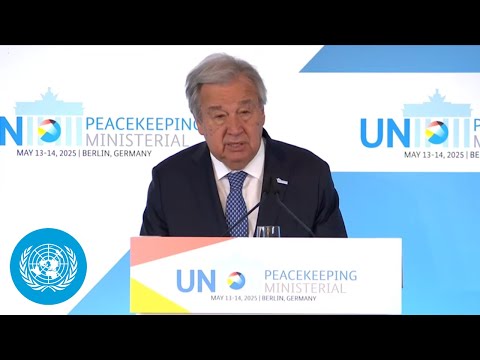
U.N. leaders and German ministers pledge funds, technology and mandate reform for peacekeeping in Berlin
Summary
At a ministerial in Berlin, U.N. Secretary‑General António Guterres and Germany's foreign and defense ministers called for tailored mandates, better funding and new technologies for U.N. peacekeeping; Germany pledged €82,000,000 and delegates made dozens of capability pledges.
U.N. Secretary‑General António Guterres and Germany’s foreign and defense ministers urged deeper political support, targeted mandate reform and new technological and energy investments for U.N. peacekeeping at a ministerial meeting in Berlin, where Germany pledged €82,000,000 and other delegations made dozens of capability pledges.
Guterres said U.N. peacekeeping ‘‘are a cornerstone of the United Nations’’ and warned operations face ‘‘massive challenges,’’ including more conflicts, the targeting of peacekeepers and new threats such as drones and improvised explosive devices. He said about 4,400 peacekeepers have died over the years, and he called on member states to meet financial obligations on time.
The German foreign minister, Johan Watervull, framed the meeting as a chance to press for reforms and pledged German funding, saying, "Germany will make available an additional €82,000,000 for the peacekeeping operations of the United Nations." Watervull outlined three reform priorities: leaner, more precisely defined mandates tailored to specific contexts; more efficient use of funds; and closer cooperation with regional organizations such as the African Union.
Germany’s defense minister, Orest Pistorius, highlighted technological and logistical pledges intended to reduce risk and logistic burdens on missions. He said delegations announced 74 ‘‘substantial pledges’’ of capacities, including aircraft and reconnaissance drones, and described examples of contributions Germany and partners would prioritize: renewable energy systems to reduce dependence on diesel convoys, uncrewed transport vehicles to move supplies without exposing convoys to attack, and counter‑IED equipment and training. "Currently, 90% of electricity in U.N. missions is generated by diesel generators, and the fuel convoys are targets," Pistorius said, arguing renewable systems would improve force protection and operational resilience.
Speakers linked the operational problems to broader political and financial constraints. Guterres said the conference will feed into an ambitious review of peace operations, intended to make missions "more efficient, cost effective, flexible, and resilient, including in contexts where there is no peace to keep." He also said member states will continue work toward a proposed ‘‘pact for the future’’ of U.N. operations.
In a question session, journalists asked whether the U.N. or Germany would send blue‑helmet peacekeepers to Ukraine if a ceasefire were reached. Watervull said Germany supports a ceasefire only as a pathway to a lasting, lawful peace that respects the U.N. Charter and Ukraine’s territorial integrity, and that any U.N. role would depend on agreement by the parties and, where required, Security Council approval. Guterres said the U.N. is ready to provide support ‘‘if the parties agree’’ and that any deployment would depend on political decisions by member states and U.N. bodies.
Participants described a high level of engagement: Watervull said more than 130 delegations attended; Pistorius said about 60 ministers took part and reported 74 pledges were registered. Organizers and speakers said delegations will now take the proposals and pledges back to capitals and to U.N. deliberations in New York for further negotiation and implementation.
The meeting in Berlin focused on short‑term capability commitments and a longer‑term review of how peace operations are mandated, funded and equipped. Delegates said follow‑up work in New York and in regional partnerships will determine which technical pledges and mandate reforms are adopted and funded.