Get Full Government Meeting Transcripts, Videos, & Alerts Forever!
Get email alerts on the Voter Rolls topic
No spam. Unsubscribe anytime.
House Election Integrity Committee hears testimony on voter-roll irregularities and bill to prompt longtime inactive registrants
Summary
The Michigan House Committee on Election Integrity heard testimony from CheckMyVote founder Fani Mantravati about alleged irregularities and transparency problems in the Michigan Qualified Voter File and considered House Bill 4356, which would require outreach to voters with 10 years of no voting activity before moving them to challenge status.
The Michigan House Committee on Election Integrity on an unspecified May date heard testimony alleging widespread irregularities in the state’s qualified voter file (QVF) and considered House Bill 4356, a proposal to require a mailed notice to voters who have not voted in 10 years before their registrations can be placed into challenge status.
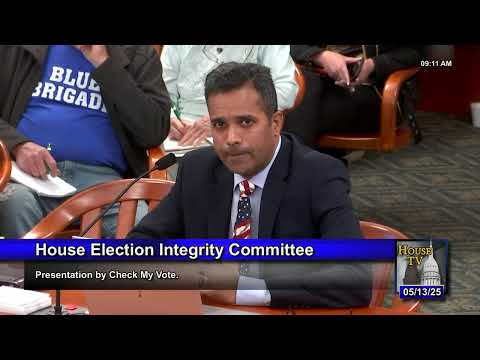
Fani Mantravati, founder of the nonprofit CheckMyVote and the creator of the website checkmyvote.org, testified that his group’s analysis of the May 1, 2025 QVF snapshot shows what he described as “bloated” rolls and a range of anomalies, and urged greater transparency from the Michigan Department of State. “Transparency is crucial for public trust in election outcomes,” Mantravati told the committee, and he cited examples from his site of duplicate records, registrations linked to vacant lots, registrations lacking apartment numbers, and entries with implausible birth years.
Mantravati said his monthly QVF FOIA requests and the tools on checkmyvote.org have identified specific totals and examples he said merit further scrutiny. He told the committee that the May 2025 QVF snapshot shows about 8,190,000 registered records while he compared that to a July 2023 U.S. Census estimate of about 7,900,000 people of voting age. “So where is this bloat coming from?” he asked, and cited a count of 3,483 duplicates found by his group. He also described volunteers using public records and cemetery databases to flag likely deceased registrants and claimed some records appear to be restored in subsequent monthly QVF snapshots after clerks have removed them, a phenomenon he called a “Lazarus effect.”
Mantravati displayed several individual examples from his website, including registrants with a year-of-birth listed as 1850 and cases in which multiple active records with the same name and birth year appear at a single address. He told the committee that his site implements a volunteer workflow that flags questionable registrations and routes verified challenges to county clerks, and he asked lawmakers to restore access to some FOIA fields he said have been redacted and to provide poll-book extracts and QVF database transaction logs to allow reconciliation between precinct poll books and the statewide QVF.
Mantravati also raised concerns about fees and redactions for FOIA requests. He described paying rising fees for absentee ballot report files over recent elections (citing $212, $314.50 and $765 in different requests) and said a quoted fee of $5,316 was sought for communications related to an October 28, 2024 report he referenced. He said the daily absentee report format changed in November 2024 from a single file to five files, which he said increased cost and complicated reconciliation.
Committee members questioned Mantravati at length. Representative Wooden (spelling in transcript varies) asked whether larger absentee voting volumes could explain higher FOIA fees; Mantravati, drawing on his IT experience, said a properly written database extract for millions of records should run quickly and suggested that long extraction times reflected infrastructure or practice issues rather than raw data size. Representative Song and others pressed him about whether he considered recent elections “safe and secure”; Mantravati replied that his testimony was intended to document problems and call for transparency rather than to assert a particular election outcome.
After the presentation, the committee took up House Bill 4356, sponsored by Representative Hoadley. The bill would require the Secretary of State to mail a prepaid, preaddressed confirmation card to registrants who have not voted for 10 years; recipients would be required to return the card at least 15 days before the next election or affirm their address at the polls. Registrants who do not respond would be placed into challenge status and would face the federal NVRA’s multi-election protections before cancellation would occur.
Representative J.D. Boyer, a former county clerk who supported the bill, told the committee that the measure is a “first step” toward improving public confidence in elections and that it creates a mechanism for verifying whether long-inactive registrations still reflect eligible voters. Baldwin Township Clerk Kathy Pittsley described practical problems in small jurisdictions and said local clerks sometimes must send ballots to voters whose identities or residency the clerk could not verify; she said she supported a statewide mechanism that would help clerks validate registrants.
Erin Shore, legislative policy director for the Michigan Department of State, said MDOS favors maintaining accurate voter lists but raised concerns about the bill’s 10-year timeframe and the logistics of having the department prepare mailings that would be returned to roughly 1,800 local jurisdictions. Shore said MDOS had supported prior proposals with longer timeframes (including previously supported legislation and an earlier vetoed measure) and recommended further conversation about timeframes and consistent implementation across local clerks. She said MDOS is not taking an official position on HB 4356 at the hearing but offered to work with sponsors on revisions.
Committee members probed the bill’s interaction with federal law. Representative Song noted that the National Voter Registration Act prohibits cancelling voters solely for failure to vote; proponents and witnesses pointed out that the bill’s procedure is intended to comply with NVRA because it begins with a notice and places registrants in challenge status before any cancellation is final. Members also discussed whether the secretary’s office or local clerks should prepare and process the mailings, workload and cost implications, and whether a 10-year window is appropriate given residency patterns and federal guidance.
No final vote on House Bill 4356 was recorded during the hearing. Earlier in the meeting Representative Fox moved to adopt the minutes from May 6; the motion prevailed by unanimous consent, as noted in the transcript. The committee received brief public-comment cards in support of the bill and then adjourned.
Why this matters: the QVF is the official list used to run elections and produce precinct assignments and absentee-ballot mailings. Witnesses at the hearing described specific examples they say show list-maintenance gaps and urged improved public-records access and reconciliation tools; MDOS said it shares the goal of accurate lists but urged revisions to timeframes and implementation logistics. The committee did not take final action on HB 4356 at the hearing.
What’s next: sponsors and MDOS indicated willingness to continue discussions on bill language and logistics; the committee record includes testimony and public-comment cards supporting the bill and information the committee can use during follow-up work.