Get Full Government Meeting Transcripts, Videos, & Alerts Forever!
Get email alerts on the State Planning Legislation Comp Plan topic
No spam. Unsubscribe anytime.
Spokane Valley planners briefed on new state housing and subdivision laws, comp plan timeline extended
Summary
City planning staff reviewed a package of recent and pending Washington state bills affecting subdivisions, multifamily housing, parking and the housing element, and told the Spokane Valley Planning Commission the city’s comprehensive plan deadline has been extended to Dec. 31, 2026.
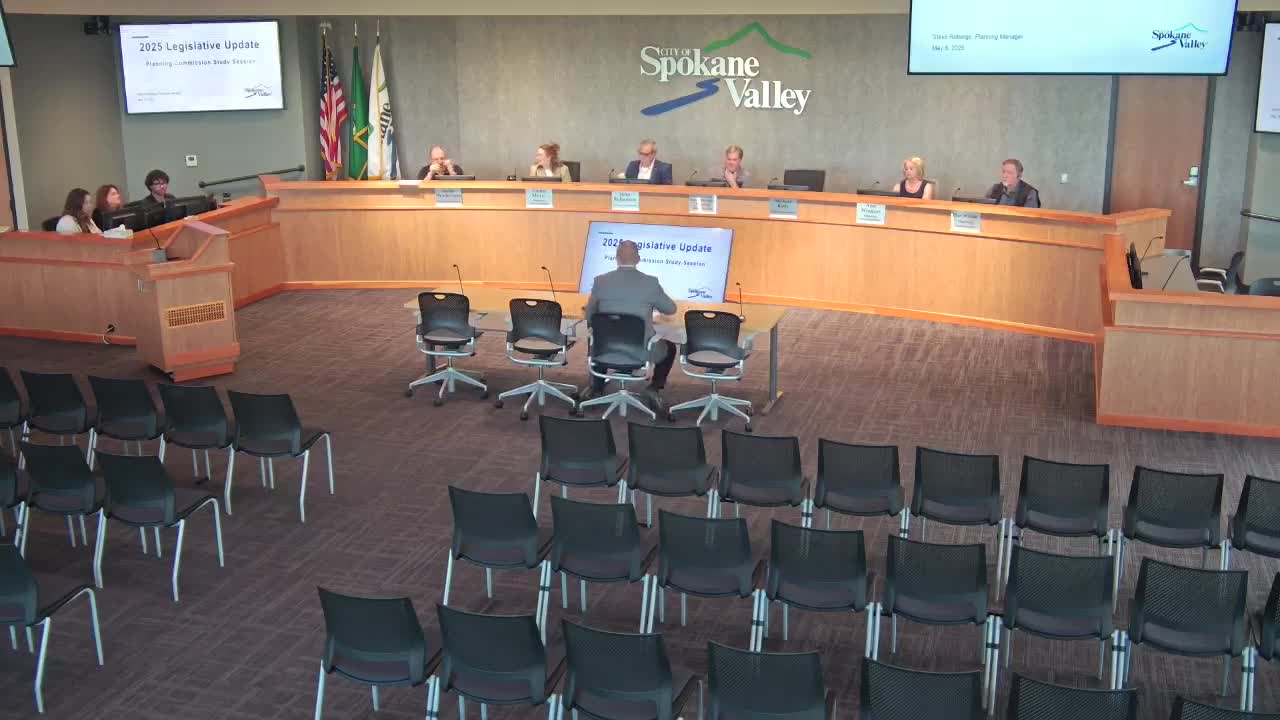
Planning staff on Thursday outlined a series of recent and pending Washington state laws that will require changes to Spokane Valley’s comprehensive plan and development regulations and previewed next steps on public outreach.
The briefing by planning staffer Steve Roberge summarized bills affecting unit-lot subdivision, binding site plans, lot splitting, accessory-dwelling-unit programs, parking minimums and a new Housing Accountability Act that directs state reviews of local housing elements. Roberge told the commission the state extended the comp plan deadline to Dec. 31, 2026, but left the development-regulation deadline unchanged.
Roberge said the package includes bills that are already signed and others still awaiting the governor’s action. “So just to give you, I’m gonna talk about 8, 9 bills tonight,” he said, adding that many measures will require code amendments and phased implementation timelines. He cautioned several measures are “not even technically law yet.”
Why it matters: the measures change what Spokane Valley must allow or review locally — from a new unit-lot subdivision process that allows lots to be divided but remain within a parent parcel, to a law that permits binding site plans for multifamily parcels and a lot-splitting provision that lets a single lot be split once and processed with a building permit. Several bills include multi-year implementation windows; others will take effect more quickly.
Key points from the staff presentation
- Comp plan schedule: Roberge said the Legislature extended the comprehensive-plan deadline to Dec. 31, 2026. The city’s consultant is still on track to deliver a draft by June 30, 2026, which would leave up to six months for adoption and any code changes. Roberge identified Substitute Senate Bill 5558 as the signed measure extending timelines.
- Unit-lot subdivision (listed in the presentation as “Senate Bill 5559”): described as a new administrative subdivision process that, if enacted, would allow creation of additional lots that remain within the parent lot and would not require a local hearing. The bill as presented would have a two-year implementation period after the governor signs it.
- Binding site plans (presented as Engrossed Substitute Senate Bill 5611): currently an exception in subdivision law for commercial/industrial land; the bill would extend that exception to allow multifamily site divisions under an alternative process.
- Lot splitting (presented as Engrossed Substitute House Bill 1096): would allow a single lot to be split once and permit concurrent submittal of a building permit (for single-family or middle housing). The presenter said the state will provide guidance on implementation and that the law includes limits on repeating the split on the same parcel.
- Housing Accountability Act (presented as Engrossed Second Substitute Senate Bill 5148): the bill directs the Washington State Department of Commerce to audit housing elements and associated development regulations (Roberge said the bill directs audits of about 10 jurisdictions per year) and establishes an optional pre-certification process jurisdictions can request to demonstrate compliance with state standards.
- Conversion of existing commercial/mixed-use buildings to housing (presented as House Bill 1757): would require jurisdictions to allow residential conversions in commercial-mixed-use or residential zones and could allow up to 50% more density in qualifying conversions, subject to life-safety code compliance; it also contains limited energy-code exemptions for portions of existing buildings.
- ADU self-certification (presented as Substitute House Bill 1353): a permissive program allowing registered design professionals to self-certify plans so the jurisdiction need not perform a full plan review; the bill would also require the state to maintain a registry of certified professionals and sanctions for noncompliance.
- Parking minimums (presented as Senate Bill 5184, with earlier references to House Bill 1183): the presentation identified a state minimum of 0.5 parking stalls per multifamily unit, one stall per single-family dwelling and two stalls per 1,000 square feet of commercial space, and noted statutory exemptions for small commercial or residential units and qualifying affordable housing. Roberge said the law allows jurisdictions to apply for a state-approved study to justify higher local parking requirements.
Commission discussion and concerns
Commissioners asked how the new laws would interact with local zoning, what local control would remain and whether the changes could affect neighborhood character and on-street parking. Roberge repeatedly noted that local zoning and development standards still apply: “They’re still gonna have to comply with our standards,” he said when asked about density and where new unit lots could be located.
Commissioners raised concerns about potential loss of quality-of-life features, increased curb cuts and reduced on-street parking, and whether affordable-housing goals can coexist with added building requirements that raise construction costs. One commissioner described the tension as a balance between state goals and local choices.
Several commissioners asked about timing and litigation risk. Roberge said litigation is always possible after local regulations are adopted and that many bills contain phased or delayed effective dates — for example, he said several housing and subdivision measures include two-year implementation windows following signature.
County and state roles
Roberge outlined the coordination process with Spokane County and state agencies. He said the county’s Planning Technical Advisory Committee (PTAC) and the Spokane County elected officials group (SCEO) review population and unit allocations and make recommendations to the county commissioners, and that the Department of Commerce and other state agencies (fish and wildlife, ecology, transportation) review local plans for consistency with state requirements. He clarified the city is its own jurisdiction and submits the comprehensive plan to the state for review.
Next steps
Roberge told the commission the next meeting will focus on the public participation plan for the comp plan update and said staff will provide copies or links to the bills once they are signed or finalized. He emphasized many of the measures discussed will require code amendments and public outreach before they are implemented.
Ending note: the commission took no formal action on the bills at Thursday’s meeting; the session closed with administrative items and thanks to long‑time staff member Mary Anne, whose last day was announced.