
Conference committee adopts Article 13 changes on marriage records, guardianship, guardian ad litem and competency services
Get AI-powered insights, summaries, and transcripts
Subscribe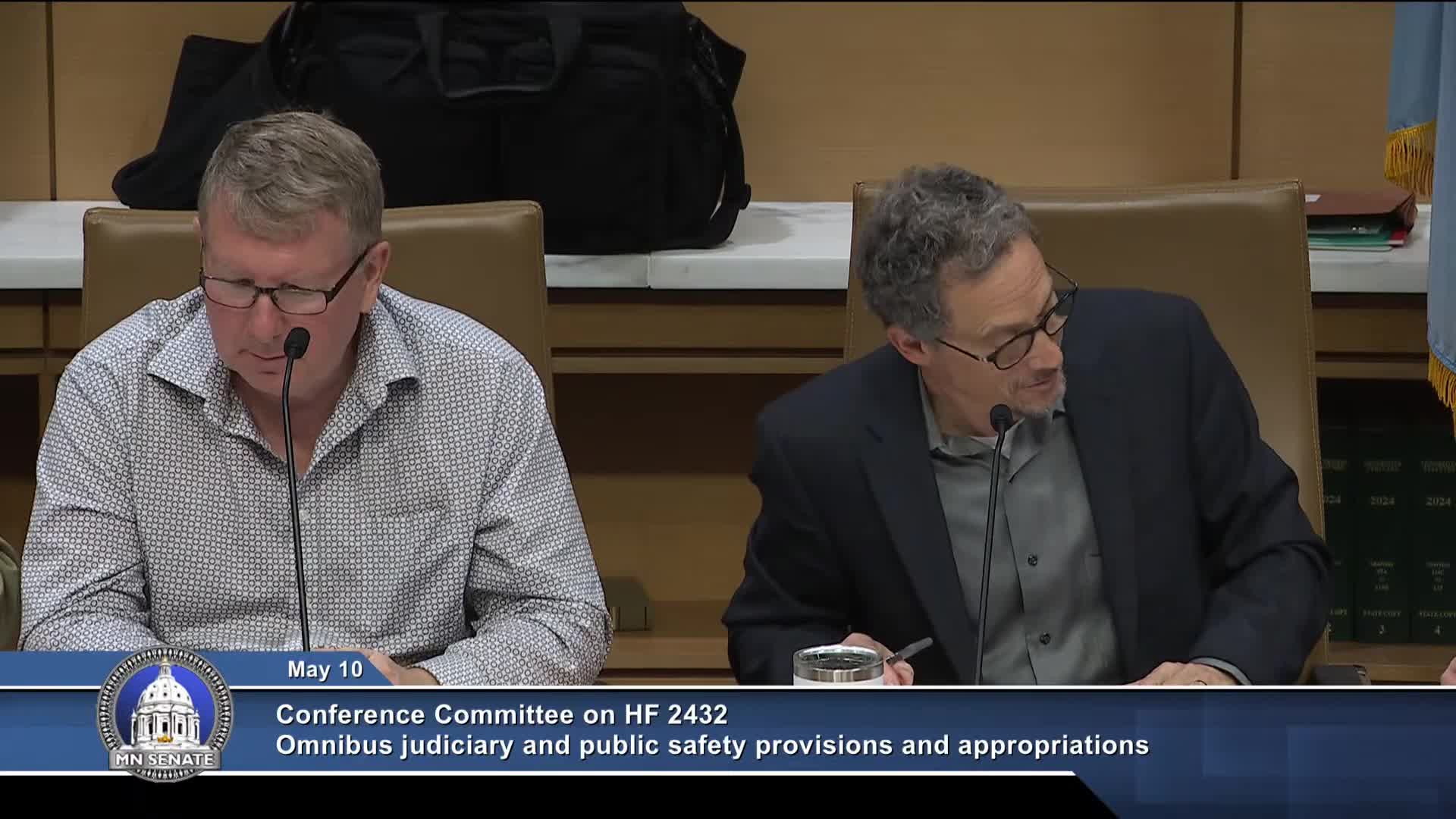
Summary
On May 10 the Public Safety and Judiciary Conference Committee approved multiple Article 13 provisions that update county marriage-record reporting, add reporting for guardian ad litem volunteers, clarify competency attainment board roles for forensic navigators, and change guardianship rules on restrictions and emergency appointment notice.
The Minnesota Public Safety and Judiciary Conference Committee on May 10 adopted multiple measures gathered under Article 13 that change how marriage records are reported, require reporting for guardian ad litem volunteers, clarify the role and contracting for forensic navigators, and tighten notice and standards for certain guardianship restrictions.
The measures were approved by voice vote after members described the policy aims and technical changes. Senator Clark moved the senate package for Article 13; the motion carried. Chair Liebling and Senator Westling also made motions to adopt related house and senate sections; those motions carried.
The marriage-records changes: Senator Clark said the package modernizes county registrar reporting and communication with the state registrar. Under the adopted language, local registrars will no longer be required to transmit specific personal information from marriage certificates to the state registrar; instead, local registrars must report only the number of marriage certificates in a format and frequency determined by the state registrar. The change also codifies several practices enacted in recent years: parties applying for a marriage license must provide dates of birth but not other previously required personal identifiers; a person who was previously married needs provide only the name from their most recent marriage; remote oath-taking or verified statements and acceptance of applications by mail or electronic submission — temporarily authorized in 2020 — are now codified; the provision that allowed a reduced license fee for completing premarital education is removed; and a person may request an amendment of an error in a marriage record directly with the local registrar using an affidavit and supporting documentation.
Guardian ad litem reporting and competency board changes: Chair Liebling moved and the committee adopted house-language reporting requirements for the guardian ad litem program. The new language requires reporting that distinguishes volunteer guardians ad litem from professional staff so legislators and the public can monitor the restart of a volunteer program and associated funding.
Liebling also moved passage of the competency attainment board policy bill. That measure clarifies that forensic navigators perform monitoring functions rather than supervisory ones and should not be treated as probation officers; it removes duplicative reporting that is already collected and reported by the judicial branch; and it authorizes the board to employ navigators rather than rely on contracts when appropriate.
Guardianship restrictions, emergency guardians and notice: Senator Westling moved and the committee adopted senate language revising rights and procedures related to guardianships. Key changes adopted include: - A guardian may restrict communication, visitation, or interactions only when the guardian shows the interaction poses a substantial risk of significant physical, psychological or financial harm and there is no other means to avoid that harm; previously the standard referenced risk of significant harm. - Guardians must attempt limited restrictions whenever possible before imposing broader restrictions. - For any restriction, the guardian must notify the court, the person subject to the guardianship, and that person’s attorney within 48 hours of imposing the restriction; the notice must describe the restriction and any limited alternatives attempted. - Before appointing an emergency guardian without notice, the petitioner must demonstrate good-faith efforts to provide notice to the respondent or the respondent’s lawyer. - The fact that a respondent is a patient in a hospital or resident of a facility alone is insufficient to show a risk of substantial harm.
Committee members stated these changes are intended to increase procedural protections for people subject to guardianship and to align court oversight with actual practice.
What this means: The package includes technical and policy provisions intended to streamline state-local reporting (marriage certificates), improve transparency on guardian ad litem volunteer use, clarify roles and administrative arrangements for competency services, and add procedural safeguards and notice requirements in guardianship cases. The measures as adopted are now part of the conference committee report and will proceed as the committee finalizes its report.
Meeting context: Article 13 items were discussed across several motions and included questions from committee members and brief clarification from staff; no roll-call tallies were recorded in the transcript — motions were approved by voice vote.
The committee recessed subject to further meetings; members indicated additional items will be discussed when the House holds the gavel on Monday.