Get Full Government Meeting Transcripts, Videos, & Alerts Forever!
Get email alerts on the State Grant Budget Parameters topic
No spam. Unsubscribe anytime.
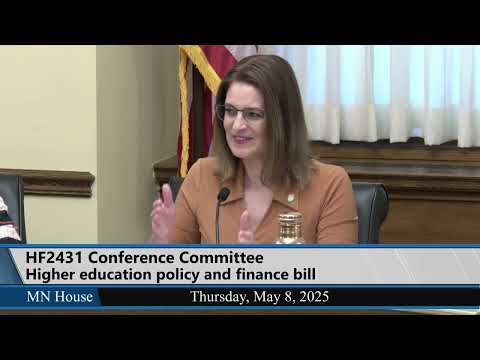
Conference committee begins negotiations to close $239 million state grant gap; House, Senate differ on parameters and tuition cap
Summary
Conference committee members reviewed competing House and Senate higher‑education proposals that leave an estimated $239 million gap in the Minnesota State Grant program for FY2026–27. The bills differ on how to allocate new money, cap tuition increases, and set aid‑calculation rules that determine award size.
Conference committee chairs and nonpartisan analysts on May 6 opened public negotiations on competing House and Senate higher‑education plans to address an estimated $239 million shortfall in the Minnesota State Grant program for fiscal 2026–27.
Nonpartisan fiscal analysts told the committee the gap reflects the difference between the program’s current statutory parameters and projected need. "For reference in the 2627 biennium, there is about a $239,000,000 difference between the base level of state grant program appropriations and projected spending based on the parameters currently in statute," Megan Bursch, nonpartisan fiscal analyst supporting the Senate Higher Education Committee, said.
Why it matters: State grants help low‑ and moderate‑income Minnesotans pay tuition. The committee must combine appropriations, statutory parameter changes and rationing options to prevent deep cuts to awards in 2026–27.
What the bills do: The House and Senate both propose a mix of spending changes and parameter adjustments but take different approaches on key levers.
- Tuition cap: The House bill would limit tuition increases tied to state grant coverage to 1% in a year, a change fiscal staff estimated would save roughly $17 million in the 2026–27 biennium by capping the portion state grants can cover if institutions raise tuition above that level. Chairs debated that cap as a tool for savings.
- Assigned family responsibility (AFR) / Student Aid Index (SAI): The bills differ on how to count parental contribution and how to treat negative SAI values. The Senate would recognize parental contribution at 100% for dependent students; the House retains a 79% AFR. On negative SAI values, the House would treat negative parental or student contributions as zero; the Senate would recognize negative contributions down to a floor of negative $1,500.
- Rationing and surplus rules: The Senate bill would suspend Office of Higher Education surplus‑award procedures to allow carrying unspent grant dollars into FY2029; the House would keep a different set of carryforward and retention rules.
Debate and technical input: Committee members pressed nonpartisan staff for detail and asked the Office of Higher Education to explain fraud concerns raised during discussion. Dennis Olsen, commissioner of the Minnesota Office of Higher Education, told the committee that the agency has not found evidence that the SAI component of the formula has been subject to fraud. "There is really no evidence around the SAI piece of this formula that would suggest ... fraudulent activity," Olsen said, urging the committee to retain flexibility because of rapidly changing federal proposals affecting Pell grants and other federal aid.
Members emphasized they did not want to adopt final parameter changes that would materially change the fiscal note before the conference committee agreed a dollar target. "I don't wanna necessarily put us in a position where we've accepted certain things that we now may want to reconsider accepting once a target has sort of been agreed upon," Sen. Duckworth said.
Next steps: Chairs said they will mark same‑and‑similar policy language tomorrow and will not finalize budget actions until a target is set. The committee scheduled a reconvening the next day to adopt agreed technical language and continue negotiations on the grants gap.
Ending note: Committee members repeatedly cited federal uncertainty — possible Pell changes and other federal proposals — as a reason to pair statutory parameter changes with appropriation adjustments and to preserve flexibility in state law.