Get Full Government Meeting Transcripts, Videos, & Alerts Forever!
Get email alerts on the Municipal Budget topic
No spam. Unsubscribe anytime.
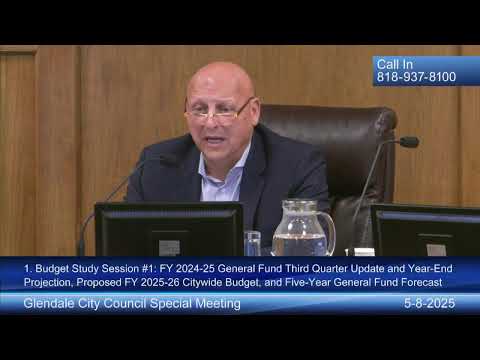
Glendale staff warn of multi‑year general fund shortfall; proposals include fund shifts, hiring pause and new revenue options
Summary
City finance staff told the Glendale City Council on May 8 that a $13.5 million projected deficit for FY 2024–25 and a roughly $34.5 million structural imbalance in FY 2025–26 could threaten charter reserve requirements unless the council approves a mix of one‑time shifts, operating changes and new revenues.
City finance staff told the Glendale City Council at a May 8 special study session that the city faces a projected $13.5 million general‑fund deficit for fiscal year 2024–25 and a structural imbalance that could exceed $34 million in 2025–26 without mitigation.
The presentation by Acting Finance Director John Tetykalian said the city adjusted its expected general‑fund resources from about $330 million to roughly $323 million and now projects expenditures near $336 million, producing the $13.5 million shortfall. After a package of department reductions and short‑term funding shifts proposed by staff, the city would close the current year with an estimated $4.9 million use of the general‑fund reserve.
Tetykalian told the council the gap reflects both lower revenues and higher costs. "Sales tax has taken a significant hit," he said, citing roughly $5 million in reduced sales‑tax receipts tied to weakness in the auto sector. He also identified an almost $3 million decline in landfill tipping‑fee revenues and smaller losses in utility user tax and charges for services. On the expenditure side he cited about $8.3 million of increases as of March 31, 2025, including $2 million for the first phase of Project 300, overtime and windstorm response costs.
Staff described a set of largely one‑time or timing‑based moves to reduce the near‑term deficit to about $4.9 million: a $3.0 million temporary draw down from the workers' compensation fund because claim projections were lower than anticipated; suspending liability insurance deposits to free about $2.8 million this year; reclassifying roughly $1.0 million of general‑fund costs to other funds where legally permissible; reducing a planned midyear transfer to the capital improvement program by about $10 million (netting $1.0 million in the general fund this year) and deferring approximately $800,000 in building maintenance and fleet transfers. Tetykalian cautioned many of those are one‑time or temporary measures.
Councilmembers pressed staff for more detail. Councilmember Brotman said the package looked like "a shell game" that delays costs, and asked that the council be candid about the future impact of moving money between funds. Councilmember Satrian asked for the line‑by‑line budget book and more visibility on department‑level revenue opportunities, saying she wanted the council to focus on generating revenue as well as reducing expenses. Staff committed to provide the detailed spreadsheet and additional backup before the next study session.
Parking fund collapse, vacancies and vacancies savings
Staff proposed folding the separate parking special‑revenue fund into the general fund because the parking fund has operated at a deficit and the general fund effectively backstops it. Tetykalian said the accounting change increases reported general‑fund salaries and maintenance & operations by about $29.6 million (including a $4.1 million parking‑fund salary net) and about $8.8 million in M&O; staff said corresponding reductions will appear in the special‑revenue side when those slides are presented in subsequent sessions.
Staff also said the city has largely exhausted its vacancy‑savings strategy: last year the budget included about $9.6 million of planned vacancy savings but managers filled roughly $7.4 million of those positions, which added net salary cost this year. A temporary hiring pause for vacant general‑fund positions is in effect pending further direction; the administration said it will consider backfilling critical positions case‑by‑case.
Five‑year forecast and reserves
Tetykalian presented a five‑year general‑fund forecast showing the $13.5 million 2024–25 shortfall growing to about $34.5 million in 2025–26 absent policy changes. He noted a city charter minimum reserve requirement equal to no less than 50% of property tax revenue and warned that, without mitigation, the city's fund balance could fall toward that threshold in the 2026–27 period and below it in later years.
Potential revenue and policy options
Staff laid out a non‑exhaustive list of potential revenue options for council consideration, none of which the council has formally adopted: a quarter‑cent sales tax (estimated roughly $9–10 million annually if placed on the ballot and approved), business license tax adjustments (estimated $2.1–4.8 million), a public‑and‑private parking tax (estimated $2.2–4.1 million), transfer‑tax or parcel tax options, ground leases of city property, digital outdoor advertising, varying forms of development‑related fees (including a public‑safety development fee) and revisiting transfers from Glendale Water & Power. Staff also said the city holds about $43 million in a Section 115 trust that could be drawn earlier than planned but noted that would reduce long‑term flexibility.
Staff noted one‑time receipts now included in the picture: Disney paid about $850,000 under protest to settle a communication‑use tax audit; staff warned that litigation remains a possibility. The city has submitted claims to FEMA for storm damage of roughly $4.5 million in total costs, but staff said reimbursements could take two to three years.
Public comment and council direction
Two members of the public spoke. Herbert Milano urged the council to focus on growing police and fire costs and CalPERS obligations, saying pension and public‑safety costs have increased sharply over decades. Beth Brooks urged revenue measures tied to landlords and tenant supports such as a rent registry or modest fee to fund renter legal assistance; staff noted Proposition 26 and Proposition 218 constrain how fee revenue may be used and said they will evaluate options.
What’s next
Council and staff scheduled follow‑up budget study sessions: May 20 for departmental presentations and June 5 for capital improvement plan, fleet and parking‑rate discussion, with final budget adoption hearings planned for June. Staff committed to provide the council with the detailed budget book, line‑item backup and the spreadsheet used in the presentation ahead of the May 20 meeting.
The presentation was descriptive, not a formal adoption of changes; staff are seeking policy direction from council on which of the cuts, transfers or new revenue measures to pursue and to bring specific ordinances, fee amendments or ballot language back for future council action.