Get Full Government Meeting Transcripts, Videos, & Alerts Forever!
Get email alerts on the Water‑utility‑sales topic
No spam. Unsubscribe anytime.
Wyoming commission orders Cheyenne utility to share revenue from Crystal Reservoir water sales
Summary
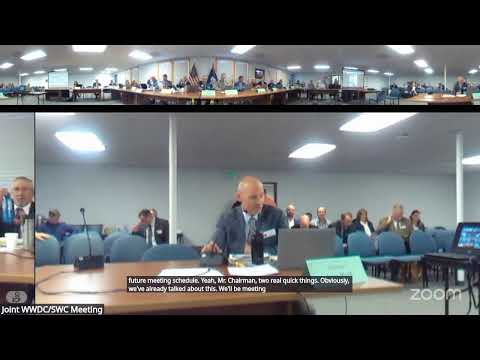
After hours of debate over how and when to count revenue from water sales to a proposed gold mine, the Wyoming Water Development Commission directed staff to implement a 2000 project agreement requiring the Cheyenne Board of Public Utilities to share net water revenue immediately.
The Wyoming Water Development Commission voted to require the Cheyenne Board of Public Utilities (BOPU) to begin sharing net water revenue immediately from sales of water taken from Crystal Reservoir, overriding earlier office guidance that payments should wait until a higher-use threshold was exceeded.
The commission’s action follows days of detailed discussion at the Select Water Committee about when sales to a proposed U.S. Gold mining project should trigger a payment obligation under a 2000 project agreement between the commission and BOPU. The commission’s motion directs the Water Development Office to implement the agreement and to treat BOPU as responsible for sharing net revenue from the sales.
Why it matters: The decision affects how fast the commission (and ultimately state coffers or program accounts) could receive tens or hundreds of thousands of dollars a year if the mine develops a long‑term water purchase. Commissioners debated whether to begin revenue sharing immediately or wait until peak use exceeded a previously discussed threshold linked to the capacity of the 30‑inch transmission line. The vote to require immediate sharing was intended to ensure the state receives compensation when municipal infrastructure supported outside commercial sales.
What the committee heard - Director Jason Mead summarized the office’s prior recommendation, which had been to delay requiring payments until the mine’s purchases pushed combined system flow above a 21 million gallons‑per‑day threshold tied to use of the 36‑inch pipeline. Mead also told the committee that BOPU had said it planned to charge outside users a base rate of about $3.55 per 1,000 gallons and to charge outside users up to 1.5 times the base rate under its outside‑user policy. Mead and staff characterized the added 1.5 multiplier as the source of what the office considered “net revenue.”
- A Cheyenne Board of Public Utilities representative told the committee the utility sets outside rates to recover its actual costs plus capital needs; the city’s practice is to add a 50 percent premium for customers outside city limits. The representative said that, averaged over the last five years, about 65 percent of the water delivered from Crystal Reservoir to the treatment plant has flowed through the 36‑inch pipeline (the line that the Water Development Commission had helped fund) and the remaining 35 percent through the older 30‑inch line. The BOPU representative described the city’s water‑rate and cost‑of‑service studies used to set the $3.55 starting price and the 1.5 multiplier.
- Commissioners and counsel pressed staff and the utility on how to measure “net revenue,” whether revenue sharing should begin immediately or only after the 21 million gallons‑per‑day threshold, and how any compact or curtailment calls would affect both city customers and a commercial buyer. Legal counsel reminded the group that the commission itself is not party to any contract between BOPU and the mine, and that phrasing of any private sale contract remains between those parties.
The vote and instructions The commission voted to find that the Cheyenne Board of Public Utilities is responsible for sharing net water revenue under the June 20, 2000 project agreement and directed the Water Development Office to implement the agreement. The commission’s action explicitly requires the utility to begin sharing net revenue immediately when sales begin rather than waiting for the previously discussed system‑capacity threshold.
What remains unsettled Commissioners and staff discussed several unresolved technical and program questions that the Water Development Office and BOPU will need to finalize as they implement the decision, including: - The precise accounting method for “net revenue” (the office and BOPU described different but related baselines: BOPU’s stated base charge of about $3.55 per 1,000 gallons and an additional outside‑user multiplier that yields roughly $5.33 per 1,000 gallons under current practice). Director Mead told the committee that the additional multiplier (about $1.78 per 1,000 gallons under the $3.55 base) would be treated as the portion that can be considered net revenue. - How to handle water curtailments tied to Colorado River compact obligations and whether contractual language will require a commercial buyer to accept curtailment in drought years if the buyer does not develop additional local supply (for example, the Bellbore well field discussed in the meeting). - Whether the buyer will take water from Crystal Reservoir infrastructure (subject to commission participation) or instead from new local wells (which would not use the state‑funded pipeline) — an outcome that would affect whether revenue sharing applies.
The commission asked the Water Development Office and BOPU to work together to implement the ruling, to calculate net revenue using agreed accounting methods, and to return to the commission with any actions or clarifications needed to finalize implementation.
Ending note: The action resolves the immediate policy question of whether revenue sharing must begin only after a specified peak threshold; the commission chose immediate application of the 2000 agreement. Technical accounting and mitigation language for drought/curtailment were left to the office and the utility to resolve while implementing the directive.