Get Full Government Meeting Transcripts, Videos, & Alerts Forever!
Get email alerts on the State Response Mmip topic
No spam. Unsubscribe anytime.
Attorney General’s office, sheriffs and advocates outline data, training and funding steps on MMIP
Summary
State Department of Justice staff, county sheriffs and tribal service providers described pilot programs, training work, forensic needs, and new state grant recipients for MMIP services; law-enforcement witnesses called for sustained DNA and lab funding and better cross-jurisdictional coordination with tribal partners.
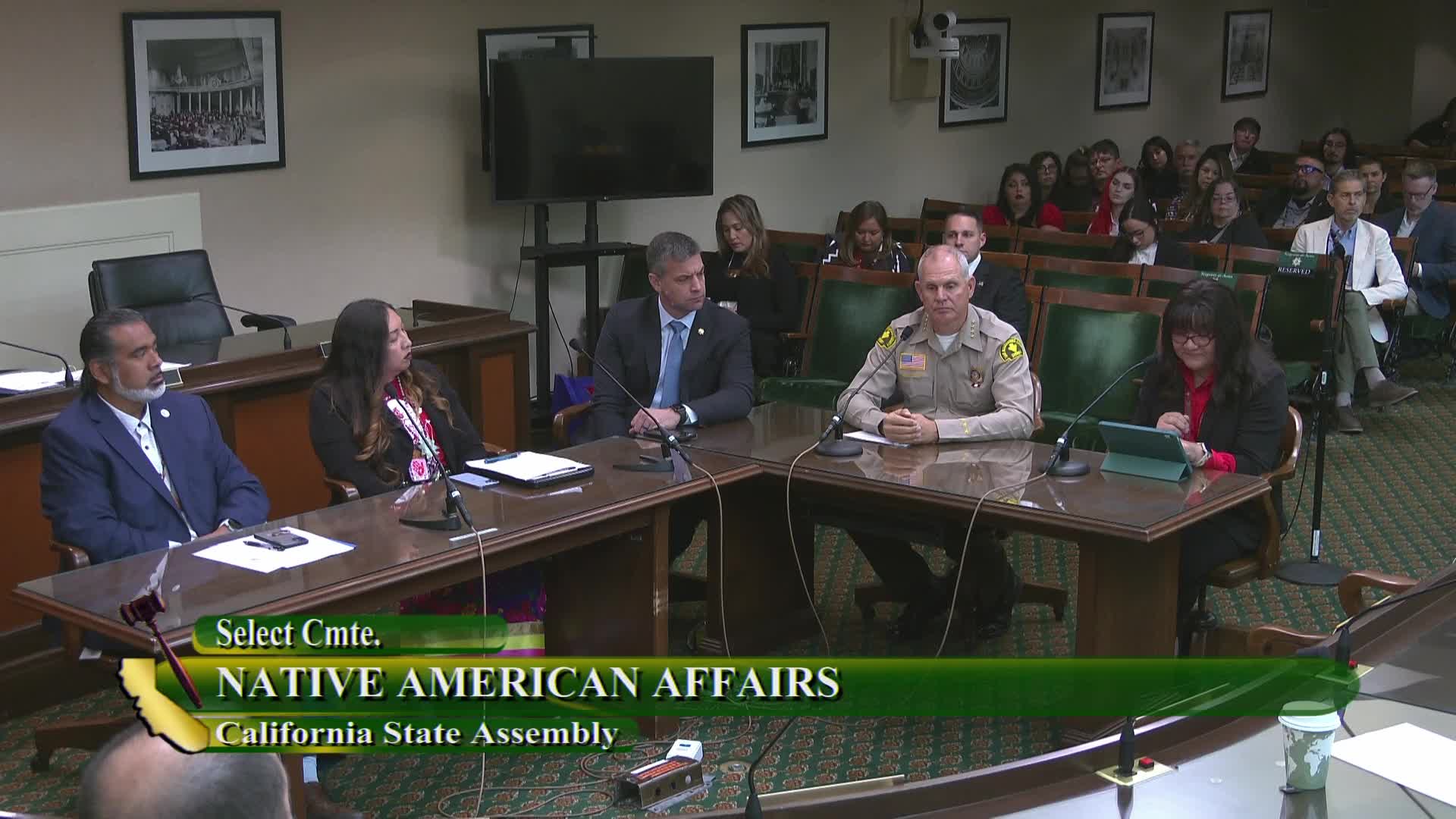
Acting Director Isaac Borges of the California Department of Justice’s Office of Native American Affairs, county sheriffs and tribal victim‑service providers testified on current and planned state actions to address MMIP, detailing training, data work and grant‑funded programs.
Borges described the department’s initiatives: regional Missing in California, Indian Country (MICIC) efforts, the Native American Marsy’s Law card for victims, a tribal community response plan pilot (“Being Prepared Together”) and the AG’s advisory council on Public Law 280, which is developing updated officer training with POST (Peace Officer Standards and Training). He said the department supports several bills moving through the Legislature and that training will be opened to tribal partners.
Humboldt County Sheriff William Hansel and San Bernardino County Sheriff Shannon Dicus addressed operational challenges. Hansel cited underfunded crime labs and said Humboldt has used familial DNA and outside labs — at roughly $10,000 per test — to solve cases when state lab capacity lagged. He urged increased state investment in DOJ forensic laboratories. Dicus emphasized the “street view”: patterns of addiction, mental illness and organized exploitation require 24/7 wraparound victim services, not just law‑enforcement response, and said many missing‑person cases can be solved by systematic collection of scene evidence, timely community reporting and victim services.
Program director Samantha Thornsberry (Cahuilla Consortium Victim Advocacy Program) described a state BSCC MMIP cohort award that funded staff and a plan to create a web hub for tribal resources (regional directories, contact points to initiate alerts and survivor supports). Thornsberry said the hub would be designed by tribes for tribes, include prevention education and remote advocacy, and be ready for rollout by fall.
April McGill, executive director of the American Indian Cultural Center (San Francisco), urged transparency in data and a city‑level model: annual reporting on unresolved MMIP cases, culturally rooted healing services, and urban shelter and housing for survivors. McGill said San Francisco ranks among cities with elevated MMIP caseloads and asked for city‑tribal partnerships to strengthen investigations, DNA testing and victim services.
Ending: Law‑enforcement witnesses and tribal advocates requested sustained state funding for forensic labs, expanded POST training for PL 280 jurisdictions, permanent support for tribal victim services and continued data partnerships between counties, the DOJ and tribal governments.