Get Full Government Meeting Transcripts, Videos, & Alerts Forever!
Get email alerts on the County Budget topic
No spam. Unsubscribe anytime.
County finance director outlines budget basics, levy limits and capital priorities
Summary
Director of Finance and Innovation presented a 'Budget 101' that explained the county's operating and capital budgets, revenue sources (property tax, sales tax, state aid), levy‑limit mechanics and a capital planning process; supervisors asked about timing, risk and fee authority.
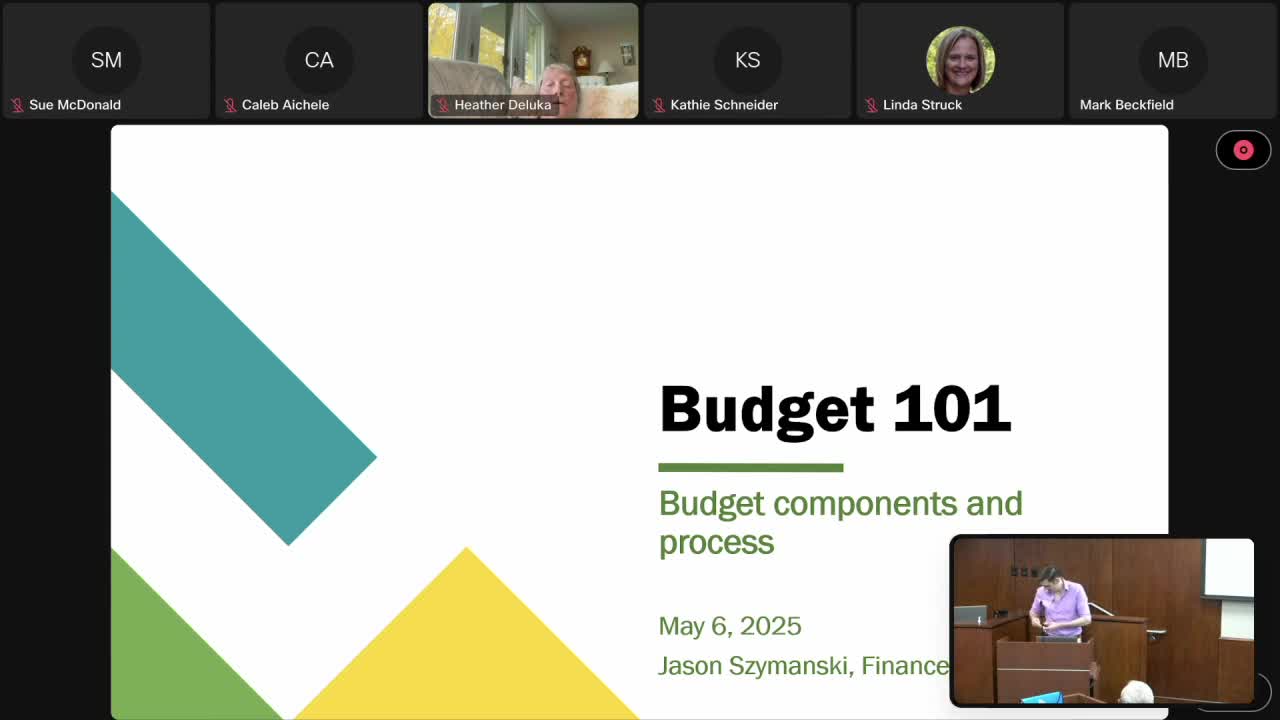
Director of Finance and Innovation Jace Schimanski gave the board a Budget 101 briefing on May 6 that explained Eau Claire County’s operating and capital budgeting processes, major revenue sources and constraints including the state levy limit.
Schimanski described the operating budget as the county’s day‑to‑day spending — funded by property tax levy, sales tax, state grants/aid and fees — and the capital budget as longer‑term investments such as buildings, major repairs and equipment funded by bonding, short‑term loans or fund balance. He said the county’s operating levy is limited by state statute and grows in two ways, principally through net new construction; he quantified that, in the county’s calculation, roughly $145 million of new construction is needed to generate a 1% increase in levy capacity.
The director said personnel costs account for the largest portion of county spending (about 53% in the county’s presentation) and that mandated services and personnel are the main cost drivers. He showed historical trends in the county levy and sales tax receipts and said that the operating levy has not kept pace with inflation and population growth — leaving a real‑dollar gap the county must manage.
Supervisors raised timing and accuracy concerns. Supervisor Hirsch asked how departments produce reliable estimates when early fiscal data are limited; Schimanski acknowledged some departments carry greater forecasting risk, especially human services, and said estimates are the best available at the time and that staff will respond if state or federal allocations change. Supervisor Wilkie asked for more historical context in the budget materials to better inform departmental requests.
On process, Schimanski described the sequence: administrator issues budget guidance to departments, departments submit requests, the county administrator compiles a recommended budget, committees review capital and operating proposals, then the county board holds a public hearing and adopts the budget (county must adopt by the statutory deadline in November). He said the county is proposing to move joint oversight meetings for department budgets to after the administrator’s recommended budget is released to focus discussion on impacts of recommended funding levels.
Schimanski said the county has benefited from increased sales tax revenue in recent years, but cautioned sales tax is a volatile funding source; he noted the county’s large reliance on intergovernmental grants and said the county gets significant federal dollars pass‑through via the state. On fees, he said some fees are discretionary but others (for example marriage license and some court fees) are set by state statute.
Why it matters: Budget choices determine service levels, staffing and capital investment across county departments and constrain what supervisors can add during the amendment process. Schimanski said supervisors may propose amendments during Finance & Budget deliberations; the administration will work with supervisors to cost out proposals.