Get Full Government Meeting Transcripts, Videos, & Alerts Forever!
Get email alerts on the Zoning Drive Throughs topic
No spam. Unsubscribe anytime.
Prosper planning commission tables proposed ban on adjacent drive‑throughs; public hearing continued to May 20
Summary
The Prosper Planning and Zoning Commission opened a public hearing on proposed zoning changes to prohibit adjacent drive‑through facilities citywide but voted 5‑0 to table the item to May 20 for further study and revisions.
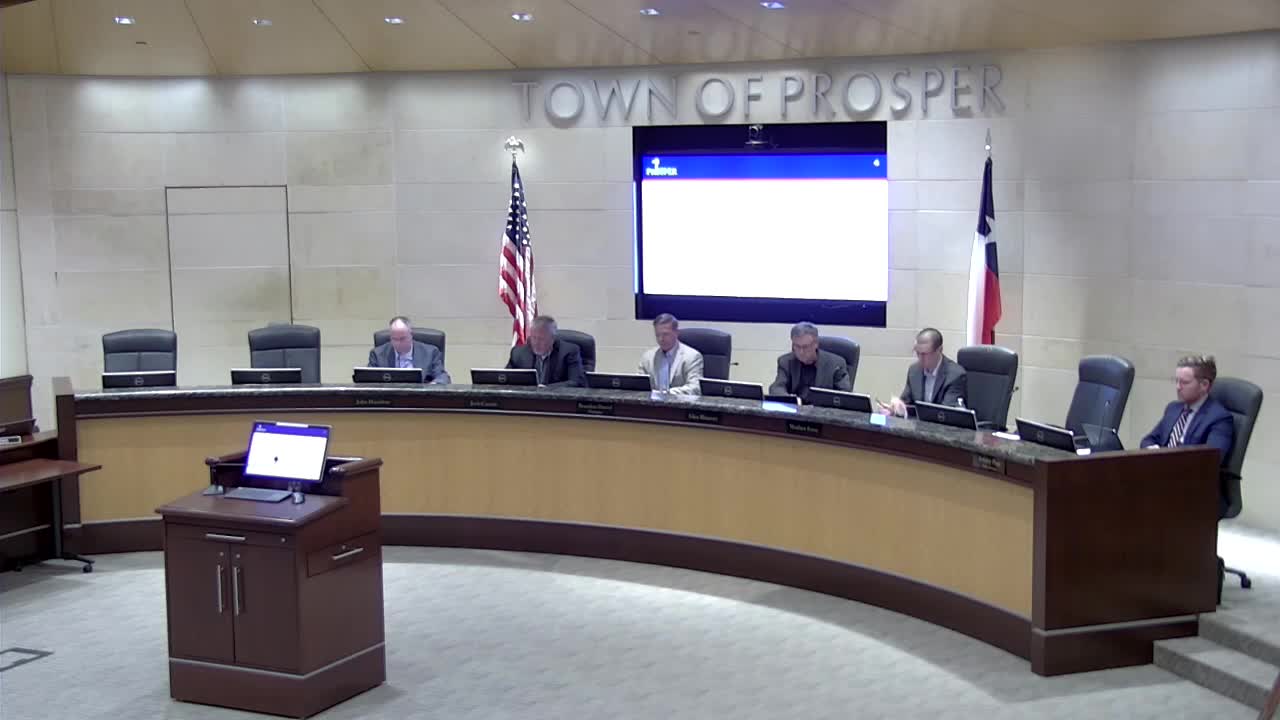
Prosper Planning and Zoning Commission members opened a public hearing May 6 on a proposed amendment to the Town of Prosper Zoning Ordinance that would prohibit buildings with drive‑throughs from being adjacent to one another and require a non‑drive‑through building between any two drive‑through facilities. After discussion, the commission voted 5‑0 to table the item and continue the public hearing to the commission’s May 20 meeting.
The amendment (CaseZoneDash25Dash0005) would modify Article 3, Division 1 (3.10.4 Conditional Development Standards) and Article 4, Division 9 (Additional and Supplemental) of the Town of Prosper Zoning Ordinance to apply adjacency limits to all drive‑through uses, not only fast‑food restaurants. Suzanne, a town planning staff member, said the proposal would "state buildings with a drive through regardless of the use or size of the drive through shall not be adjacent to each other. There shall be a building without a drive through between any two buildings with a drive through." She noted the ordinance as drafted would make some existing site layouts — including examples shown for the Quinton University Drive and Frontier Parkway areas — nonconforming.
Commissioners and staff discussed why staff recommended the broad prohibition and possible alternatives. Commissioners raised traffic and aesthetics as primary concerns. Commissioner Carson said traffic impacts — particularly stacking and backups onto public roads — are a key reason to consider limits. Commissioner Hamilton proposed using the specific‑use permit (SUP) process to retain discretion for individual cases, saying more restrictive ordinance language paired with an SUP could "allow an out" where a drive‑through is appropriate. Several commissioners suggested distance‑based separation requirements or size‑based thresholds (for example, differentiating between a bank ATM, pharmacy drive‑up and a high‑volume restaurant) as potentially more workable options.
Staff noted existing engineering standards already regulate some spacing (median openings, intersection clearances and drive separations) and that the current draft intentionally starts from a strict standard so the commission can consider easing it. Commissioners asked staff to research alternative approaches used by other communities and to present options that address both traffic (stacking) and visual quality (screening/landscaping).
No members of the public signed up to speak during the hearing. Following the discussion, Commissioner Hamilton moved to table the public hearing and continue it on May 20, 2025; Commissioner Blanstedt seconded. The motion carried 5‑0. The commission also received a brief update on recent Town Council actions including the council’s April 22 approval of a specific‑use permit related to a Chick‑fil‑A drive‑through; that council action was reported for the commission’s information and is not a decision of the P&Z commission.
Votes at a glance • Motion to approve consent agenda items 3a–3d (mover: Commissioner Carson; seconder: Commissioner Furey) — outcome: approved, vote 5‑0. • Motion to table Regular Agenda Item 4 (CaseZoneDash25Dash0005) and continue the public hearing to May 20, 2025 (mover: Commissioner Hamilton; seconder: Commissioner Blanstedt) — outcome: tabled, vote 5‑0.
The commission will take up the continued hearing at its May 20 meeting, when staff is expected to return with alternatives and comparative examples for separation distances, SUP procedures and other refinements.