Get Full Government Meeting Transcripts, Videos, & Alerts Forever!
Get email alerts on the Artificial Intelligence Liability topic
No spam. Unsubscribe anytime.
Assembly committee advances bill barring firms from blaming ‘autonomous’ AI for harms
Summary
The Assembly Privacy and Consumer Protection Committee voted to move AB 316, a bill that would prevent defendants from asserting that AI acted autonomously to avoid liability. Supporters said the change clarifies accountability; opponents warned it could remove needed legal defenses and create uncertainty.
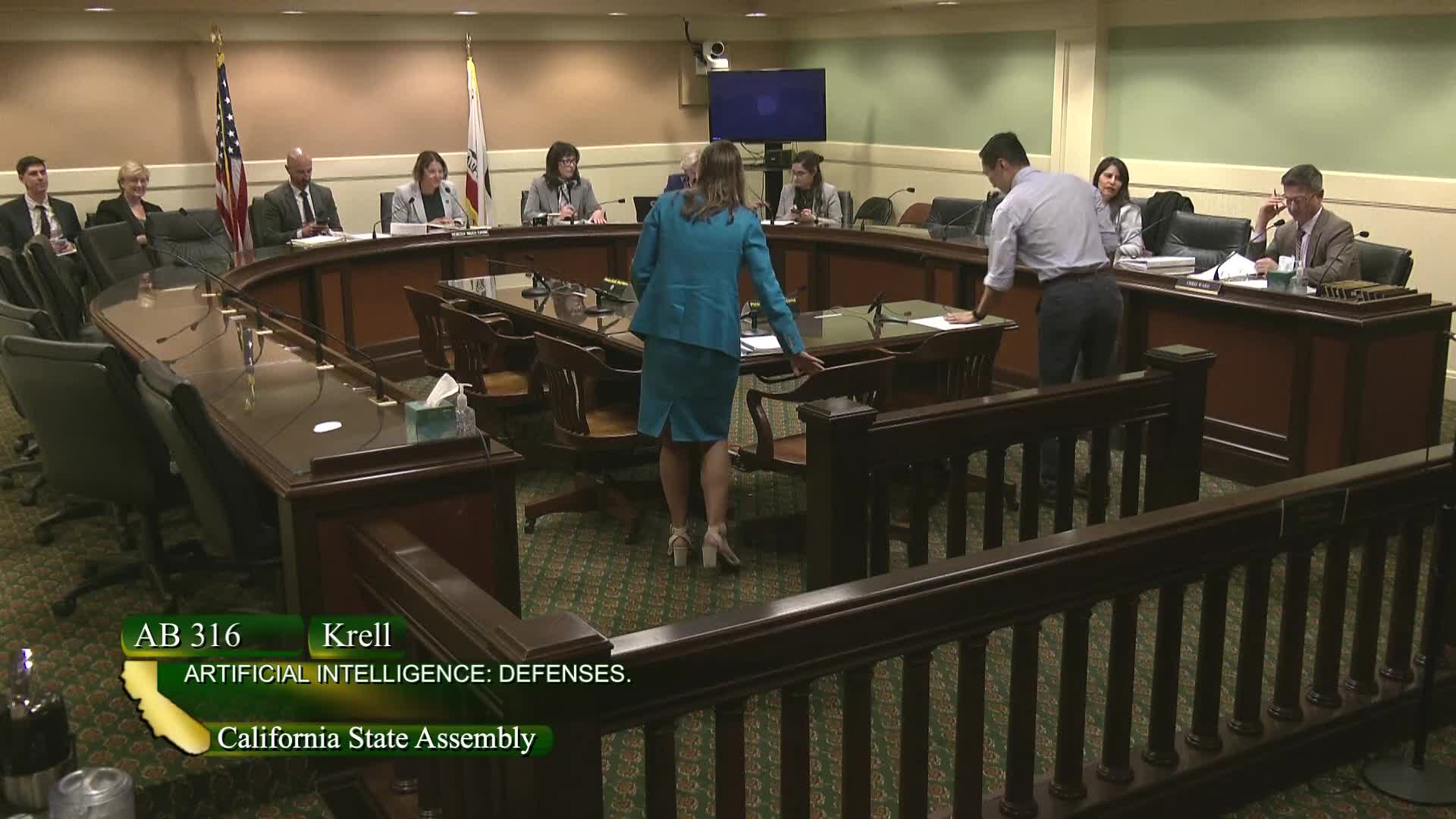
Assemblymember Krell’s AB 316, which the Assembly Privacy and Consumer Protection Committee advanced on a do-pass vote, would bar defendants from claiming an AI system acted autonomously to avoid liability for harms tied to that technology.
The bill’s sponsor told the committee the measure does not create new theories of liability but instead prevents a defendant from using the autonomous nature of an AI system as a categorical defense. “This is a modest proposal that by providing guidance and a basic framework to our courts will both help AI fulfill its potential … and prevent unnecessary litigation,” Assemblymember Krell said.
Supporters stressed that the bill preserves plaintiffs’ existing burdens of proof while denying a potential “get out of jail free” argument. Ken Wang, senior policy advisor with the California Initiative for Technology and Democracy (a project of California Common Cause), said the bill “eliminates that possible defense” and noted courts still will require plaintiffs to prove duty, breach, causation and damages. Ed Howard of the Children’s Advocacy Institute described examples in which chatbots produced harmful, explicit prompts and urged passage, saying human creators should “take responsibility and accountability” for the systems they build.
Opponents—including TechNet, the California Chamber of Commerce and the Chamber of Progress—said existing tort law already addresses accountability and cautioned that AB 316, as drafted, could foreclose legitimate defenses such as foreseeability, design diligence or comparative fault. Robert Roeboykin of TechNet said the cases cited in support are not California rulings and argued courts are best positioned to sort negligence and causation in complex multi‑actor AI ecosystems. Ronak Delami of the CalChamber echoed concerns about unclear terms in the draft that could blur distinctions between developers, modifiers and downstream users.
Committee members asked clarifying questions about whether the bill would preserve traditional defenses; the author and supporters repeatedly said it would not change negligence or products‑liability standards, only that defendants could not shift blame solely to the AI’s autonomy. After discussion, a motion to move AB 316 out of the committee passed and was recorded by roll call; the committee left the roll open for members not present at the initial call. The committee reported the bill as approved (do pass) with the recorded tally indicated by committee staff.
AB 316 will next proceed through the Assembly’s legislative process for further committee consideration and potential floor action. Advocates for the bill said it provides early guardrails for accountability as AI systems proliferate; critics said lawmakers should refine definitions and exceptions to avoid unintended legal uncertainty.