Get Full Government Meeting Transcripts, Videos, & Alerts Forever!
Get email alerts on the Zoning topic
No spam. Unsubscribe anytime.
Sawyer County ad hoc committee narrows resort rentals to RR2, doubles per‑unit lot requirements in revised zoning draft
Summary
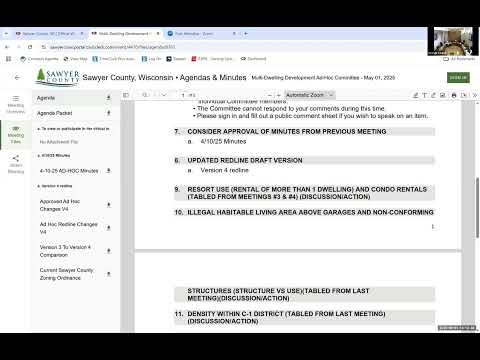
Chair Dale Olsen called the Sawyer County multi‑dwelling development ad hoc committee to order and the group voted to treat rentals of more than one dwelling — including some condominium rentals — as a "resort" use allowed in the Residential Recreational 2 (RR2) zone with a required conditional‑use permit.
Chair Dale Olsen called the Sawyer County multi‑dwelling development ad hoc committee to order and the group spent most of its meeting refining draft zoning language that would change how the county treats resorts, condo rentals and additional dwelling units across several zone districts.
The committee voted to classify the rental of more than one dwelling on a single lot — including certain condominium arrangements — as a resort use allowed in the Residential Recreational 2 (RR2) zone and subject to a conditional‑use permit. "I would move that, resort use as in rental of more than 1 dwelling and condo rentals be allowed in R R 2," Chair Dale Olsen said before the motion was seconded and carried. The committee did not record a roll‑call tally in the transcript; the motion was adopted by voice vote.
Why it matters: committee members said the change aims to give towns and county reviewers a formal review process (rezoning plus conditional‑use permit) for properties where multiple units are being rented on one parcel. Several members said the requirement is meant to give local governments the ability to attach conditions such as limits on rental duration and operations.
Committee discussion and direction to staff - Condo rentals vs. resorts: Members and staff debated whether multiple rented condominium units should automatically be treated as a resort, or whether condo associations should instead apply for a conditional‑use permit if they intend to rent multiple units. Jay (zoning department staff) summarized the compromise: the committee will view a condo plat that rents more than one unit as operating a resort and require a conditional‑use permit if the property is not already in RR2. - Rezoning and town input: The committee decided that, under the new approach, owners who wish to operate as resorts but are in RR1 would need to pursue rezoning to RR2 and a conditional‑use permit; members said towns should have a voice in those rezoning and CUP reviews. - Legal check on duplex restrictions in shoreland: The committee reaffirmed its prior motion to prohibit multifamily and two‑family dwellings in shoreland but directed staff to consult legal counsel on whether state law prevents local restriction of duplexes. If legal review finds a prohibition impossible under state law, staff were instructed to draft alternative density requirements (committee discussed 200 feet of frontage and 40,000 square feet for two units in shoreland as a contingency).
Density and lot‑area changes - Across zone districts the draft directs that each additional dwelling unit must be supported by extra lot area; Jay said the draft sets 10,000 square feet per additional dwelling on public sewer and 20,000 square feet per additional dwelling where public sewer is not available in some residential zones. For shoreland, members reiterated an intent that each additional unit requires an extra 20,000 square feet and a minimum shoreline width increment (committee discussed an additional 100 feet of frontage per unit, producing examples such as 100 feet baseline plus an extra 100 feet for two units). - The committee also voted to double the required lot area per dwelling unit in the Commercial 1 (C1) zone district when a dwelling unit is being created there (the vote passed by voice). Members said the motion was intended to limit ad hoc apartment‑style development in commercial districts while preserving motel and hotel rules (motels/hotels retain a separate per‑unit requirement — staff said motels already require an additional 5,000 square feet per unit under section 6.1).
Temporary guest quarters, habitable space above garages, enforcement - Staff briefed the group on the county's existing temporary guest‑quarters permit. Jay explained the county created a temporary‑guest‑quarters permit to address unpermitted habitable areas above garages: the permit allows less than 500 square feet of sleeping space; the county requires a signed affidavit that the space will not be rented and a UDC (Uniform Dwelling Code) inspection. "We did designate out what's known as temporary guest quarters, which allows for less than 500 square feet of sleeping space," Jay said. - Committee members and public speakers raised fire‑safety and public‑health concerns, and the difficulty of enforcing illegal interior uses when inspectors lack authorized entry. Jay noted a pending legal challenge in circuit court involving an owner who built habitable space above a garage and claimed the structure had existed for more than 10 years; staff said the county considers such uses illegal even when the structure predates zoning permits and that case may produce clarifying case law. - The committee discussed signage and inspection practices: staff said approved temporary guest quarters are being marked with a small yellow bar under the property fire number so first responders and inspectors can identify permitted guest quarters.
Public comment and related topics - Members of the Sawyer County Lakes Forum and public commenters urged careful treatment of shoreland density and cautioned about the effects of park models and camping cabins on lake water quality. Gina Jean Acola, vice president of the Sawyer County Lakes Forum, asked whether an owner could buy 400–500 feet of shoreline and place many park models or camping cabins there; staff replied that a campground requires a conditional‑use permit, minimum acreage (staff cited a 10‑acre minimum for new campgrounds), and that the draft limits the number of camping‑cabin/park‑model sites to a percentage of total permitted sites.
Next steps - Staff said they will produce a new draft (referred to as version 5) that incorporates the committee's changes — notably the RR2/resort language for condo rentals — then send it to legal counsel and the towns for review. Chair Olsen and several members requested to see the final draft before it goes to legal or, at minimum, to receive it by email so they can flag substantive concerns. Jay said the only new language to version 5 would be the RR2 conditional‑use language treating multiple condo rentals as resort use.
Ending: The committee adjourned after directing staff to finalize the redline, consult legal counsel about shoreland duplex restrictions and potential effective dates, and circulate the next draft to committee members and towns prior to zoning committee consideration.