Get Full Government Meeting Transcripts, Videos, & Alerts Forever!
Get email alerts on the Industrial Rezoning Dwtm topic
No spam. Unsubscribe anytime.
Rocky Ridge seeks industrial rezoning to continue drinking-water-treatment-material reuse; neighbors press dust and health concerns
Summary
Rocky Ridge Development asked Toledo’s Zoning and Planning Committee on May 14 to rezone three parcels around Angola and Burn roads to allow expanded reuse of drinking-water-treatment material for pit reclamation, with long-term plans to create wetlands and public parkland; the proposal prompted technical briefings and lengthy public testimony over dust, air quality and groundwater concerns.
Rocky Ridge Development and its consultants presented a multi-parcel plan on May 14 to expand beneficial reuse of drinking-water-treatment material (DWTM) at sites around Angola Road and Burn Road, a project the company says will return excavated sand to local construction markets, backfill pits with DWTM, and ultimately create publicly accessible wetlands and parkland.
Ed Moore, managing director of Rocky Ridge Development, described the project as a phased operation that would reuse city DWTM instead of landfilling it, potentially bring a projected $2.5 million in local construction stimulus and about 25 jobs to the Birmingham neighborhood, and include an option to transfer reclaimed land to the City of Toledo with deed restrictions and an endowment for ongoing maintenance. Brandon Stansley and others from the applicant team detailed logistics, and Chip Tokar, a professional geologist retained by the developer, described the material and geology.
Tokar said the treated material is a lime-rich clay byproduct of drinking-water treatment; he described it as a naturally occurring limestone-derived product that is tested for metals and other constituents. He and other speakers emphasized that the site includes a 90-foot-thick impermeable clay layer between the proposed fill and the bedrock aquifer, and said the Ohio Environmental Protection Agency (OEPA) and Ohio Department of Natural Resources (ODNR) reviewed and permitted the proposed beneficial use and reclamation plan. Tokar said OEPA requires sampling and monitoring and imposed permit conditions the company must follow.
Rocky Ridge also outlined a five-point dust-mitigation plan: perimeter air monitoring, road spray treatment using a synthetic polymer dust suppressant, concrete drive installations to reduce tire trackout, track-out mats at the site exit, and conservation easements with vegetative buffers. Moore said the company has performed baseline air sampling and has purchased equipment for on-site dust suppression; the company committed to more monitoring this summer once truck traffic increases.
Neighbors and small-business owners in the audience described recurring dust, property soiling and health impacts. Bill Hoag and others said they were troubled by potential heavy-metal dust and the history of contamination at other nearby sites; several speakers requested more frequent and ongoing air and groundwater testing and expressed skepticism about clay barriers. Some resident speakers credited the company for recent dust-control work but remained concerned about long-term impacts and enforcement.
Council members pressed the company on monitoring frequency, permit conditions, truck routes and the durability of any legal protections. Council member Komai asked the applicant for OEPA and city environmental monitoring reports; Moore and Tokar said they would provide technical reports and that OEPA and ODNR had required extensive sampling and oversight. Council member Martinez questioned how long the company had operated out of zoning compliance; Rocky Ridge said the contract with Toledo runs through 2025 with three one-year options and that the site had been used since around 2021.
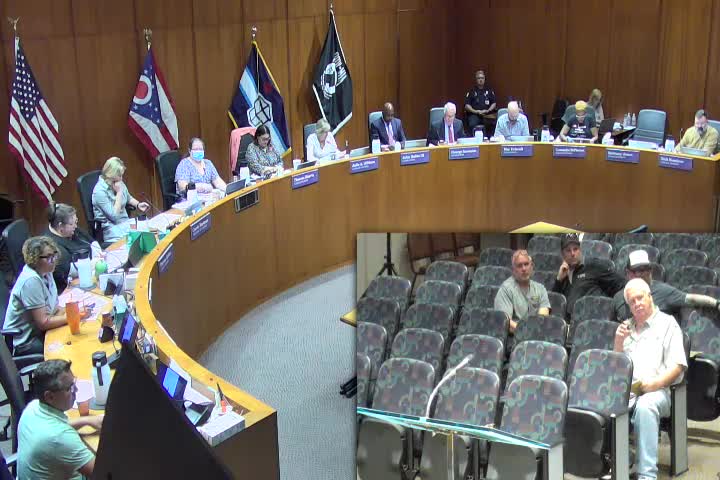
After about two hours of presentation and public testimony, several council members recommended referral of the three rezoning cases to full City Council for further review. The committee recorded referrals of cases Z25-00001 (4004 Angola Road), Z25-00002 (0 Southburn Road) and Z25-00007 (3920 Angola Road) to City Council as approved for referral; final zoning action will be at City Council. The developer offered to accept deed restrictions, an option for city purchase and an endowment to secure public use in the future; those commitments would be subject to later legal agreements and council review.
Because the OEPA permit requires annual reporting, and the company reported baseline monitoring that was largely non-detect at the property boundary, the company urged continued monitoring and the committee sought written documentation of OEPA and city environmental-service findings before Council action.