Get Full Government Meeting Transcripts, Videos, & Alerts Forever!
Get email alerts on the Transit topic
No spam. Unsubscribe anytime.
Austin Transit Partnership briefs Tourism Commission on light rail route, timeline and rider projections
Summary
Austin Transit Partnership presented plans for a 9.8-mile, 15-station Phase 1 light-rail corridor and discussed expected benefits for visitors, connections to downtown destinations and a prioritized future airport extension. Commissioners asked about timing, ridership, parking and coordination with other projects.
Austin Transit Partnership officials on May 14 briefed the Austin Tourism Commission on the agency’s plans for the city’s Phase 1 light rail project, the transit corridors it will serve and how the system could affect visitor access to downtown attractions.
Darren Lozano, senior vice president for environment and project development at Austin Transit Partnership, told commissioners the Phase 1 alignment is being advanced through environmental review and is intended to operate on city streets with a dedicated guideway. He said the initial segment will be about 9.8 miles with 15 stations serving major destinations including the University of Texas, South Congress, downtown (including a station near the Austin Convention Center) and the Hike-and-Bike Trail. "We're really excited to present our update on the Austin light rail project," Lozano said.
The presentation emphasized travel-time reliability, frequent service and station-area design intended to be people-centric, with new pedestrian and bike connections and a proposed bridge across Lady Bird Lake. Sean Berry, vice president of design and construction, described station concepts that prioritize shade, landscaping and wayfinding, and stressed integration of first-mile/last-mile connections for visitors.
Why it matters: ATP said the line is designed to reduce reliance on cars for event travel and everyday commutes, to provide more predictable travel times than buses and to support connections to hundreds of thousands of jobs along the corridor. ATP’s modeling projects about 30,000 average weekday riders for the Phase 1 corridor; the agency said similar systems nationwide have often exceeded planners’ 20-year ridership projections.
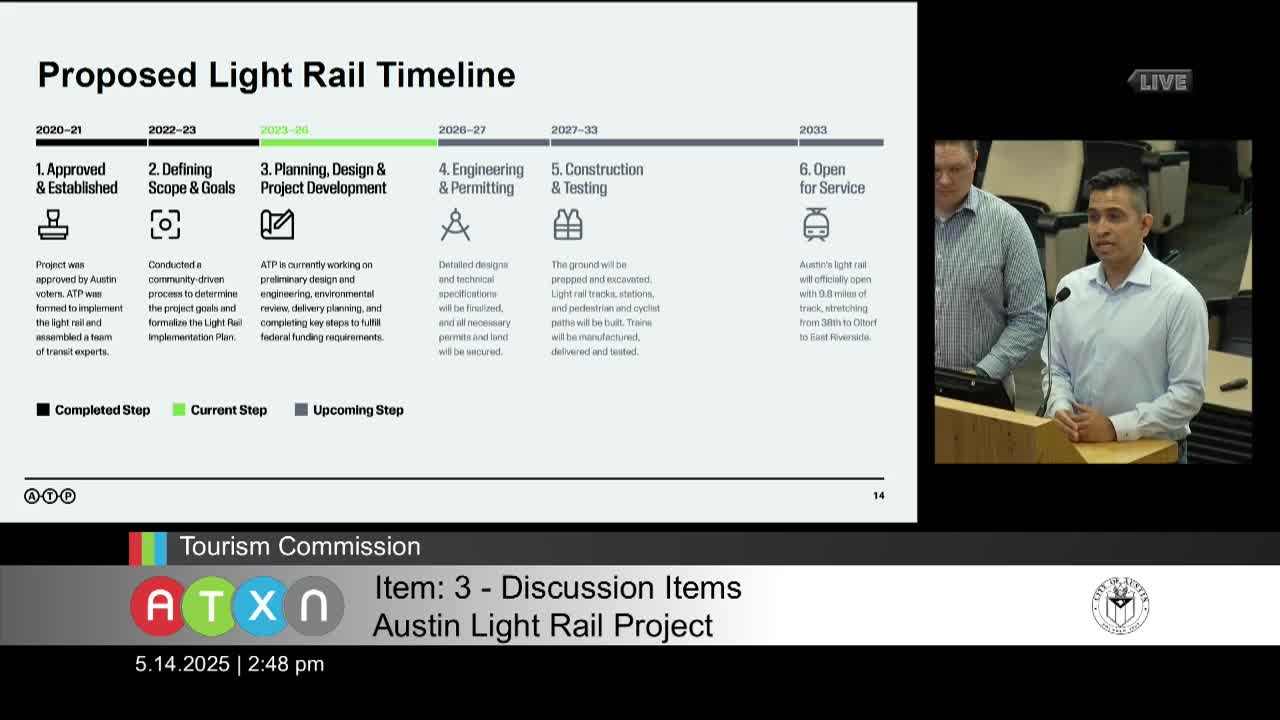
Key technical points presented - Phase 1: 9.8 miles and 15 stations (Phase 1 is the yellow line on the ATP maps shown to commissioners). - Rider projection cited by ATP: roughly 30,000 average weekday riders on the Phase 1 corridor. - Stations in the core: multiple downtown stations including one adjacent to the convention center and others near the State Capitol and downtown hotels. - Design features: a new Lady Bird Lake bridge with bike/pedestrian elements, tree‑lined corridors and pedestrianized segments (the "drag"). - Funding and approvals: ATP is seeking a Federal Transit Administration Capital Investment Grant and completed an environmental document with a public comment period that closed in March; ATP reported roughly 2,500 public comments and targets a final environmental decision later in the year. - Implementation timeline presented by ATP: the agency characterized the construction phase as a multi‑year effort and said it is planning for service opening in 2033, with a multi‑year design and construction schedule leading up to that opening.
Commissioners’ questions and ATP responses Commissioners asked about an airport extension, litigation and how the project will attract riders. ATP said the airport connection has been identified as a recommended priority extension but has no fixed timeline: the extension requires additional design, environmental work and funding. ATP acknowledged a pending bond‑validation lawsuit and said its legal counsel is engaged but that project work continues. On ridership, ATP said the corridor tracks the city’s highest‑demand north–south spine and that major events (UT football, downtown events, airport connections) will drive high ridership days; the dedicated guideway and faster travel times are expected to attract users who do not currently use transit.
Questions about station parking and neighborhood coverage ATP said three end‑of‑line stations are proposed with park‑and‑ride facilities (old Torf, 30 Eighth Street and Yellowjacket stations), while most intermediate stations are intended to emphasize pedestrian, bicycle and bus transfers rather than large parking lots. Commissioners raised East–West service needs; ATP said bus rapid transit and other bus improvements in Project Connect are intended to provide broader east–west coverage beyond the Phase 1 north–south spine.
No formal action was taken by the commission on the light‑rail presentation. ATP asked the Tourism Commission to be an advocate for the project.
Looking ahead: ATP said it will continue design development, coordinate with CapMetro, the city and the Federal Transit Administration, complete the environmental process and bring a designer/construction team on board toward the end of the year. ATP urged continued public outreach and iterative design to address rider experience for visitors and residents.