Get Full Government Meeting Transcripts, Videos, & Alerts Forever!
Get email alerts on the Transportation topic
No spam. Unsubscribe anytime.
TDOT says study warrants four‑way stop at Beechcroft and Carter's Creek; commissioners debate truck turns, sight lines and longer fixes
Summary
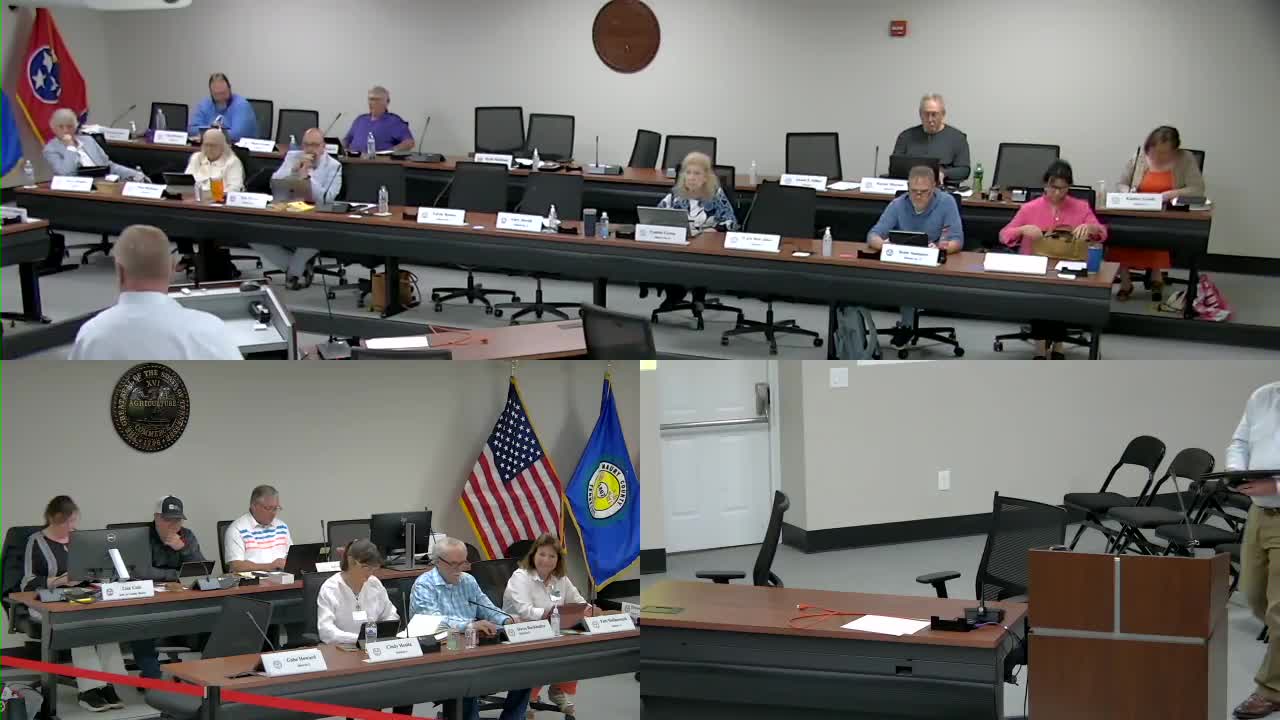
Lee Rogers, District 38 manager for the Tennessee Department of Transportation, told Maury County commissioners that a TDOT traffic review found the Beechcroft and Carter's Creek intersection warrants a four‑way stop but did not meet criteria for a traffic signal.
Lee Rogers, District 38 manager for the Tennessee Department of Transportation, told Maury County commissioners that a TDOT traffic review found the Beechcroft and Carter's Creek intersection warrants a four‑way stop but did not meet criteria for a traffic signal.
The finding follows a crash review TDOT conducted at the commissioners’ request. Rogers said the crash history and turning‑movement analysis supported a four‑way stop but that ‘‘that four‑way stop does not have to happen. We don't have to put that in. We don't have to put stop signs in on Carter's Creek itself. So if it's something that the county doesn't want and you guys don't want, then it doesn't have to happen.’’
Why it matters: Commissioners and staff said the intersection combines two separate safety problems. Many trucks use Carter's Creek as a shortcut off I‑840 and have difficulty making left turns onto Beechcroft. Commissioners said narrow roadway sections and an AT&T equipment cabinet near the corner reduce sight distance and complicate turning movements.
TDOT said its traffic operations group performed an ‘‘8‑hour signal warrant analysis’’ and that the study did not justify a signal but did justify a four‑way intersection control based on crash patterns. Rogers said the department can install stop signs, stop bars and “stop ahead” warnings and would consider temporary message boards or portable flashing beacons to alert drivers while motorists adjust to new controls.
Commissioners pushed back on a stop‑sign approach as insufficient or potentially harmful. ‘‘If we put a four‑way stop there, Beechcroft being as narrow as it is, they're gonna pull all the way up as far as they can. And if there's a truck coming and trying to turn, I think we're gonna be creating a nightmare right there,’’ Commissioner Howard said. Other commissioners raised the same concern: a stopped queue on Beechcroft could block turning trucks and create backups.
Several commissioners urged a short‑ and long‑term plan: add advance warning signage and temporary flashing lights immediately, then pursue a traffic operational study of turn lanes and intersection geometry. Rogers said TDOT can conduct follow‑up studies after a four‑way stop is installed to evaluate whether the measure reduced crashes and traffic conflicts.
Weight limits and utility obstructions were recurring themes. Commissioner Burkhalter asked the state to ‘‘post some weight limits on that road’’ and the bridges on it; Rogers said the department would need to check bridge postings and ratings before recommending permanent weight restrictions. Multiple commissioners said overweight or misrouted trucks worsened the safety problem.
Commissioners also discussed coordination with Spring Hill. Rogers noted that Beechcroft (State Route 247) lies within Spring Hill’s municipal limits while Carter's Creek is a county route; any widening or turn‑lane work at the intersection will require coordination between TDOT, Maury County and Spring Hill.
Next steps and direction: TDOT and county staff agreed to facilitate a traffic study and to involve Spring Hill and the county’s traffic‑operations manager, Zane Pannell (Traffic Operations Manager, TDOT). Commissioners directed staff to ask TDOT to evaluate turn lanes and to consider temporary flashing beacons and additional advance signage. Commissioners also asked staff to pursue contact with AT&T about relocating the cabinet that reduces sight distance at the intersection.
Clarifying details extracted from the meeting record: TDOT reported 18 crashes in the three‑year review period, nine of which were angled crashes related to turning movements; TDOT performed an 8‑hour signal‑warrant analysis that did not meet signal criteria; TDOT recommended stop signs and advanced warning signage and said an after‑installation study is possible.
Speakers quoted or referenced in this account include Lee Rogers, District 38 manager, Tennessee Department of Transportation; Ken McKee, Maury County Highway Department; and Commissioners Burkhalter, Brevetti, Howard, Hollingsworth, Hessel (Hessler), Strand and others who participated in the discussion. All direct quotations are attributed to these speakers as recorded in the meeting transcript.
The commission did not adopt a binding improvement plan at the meeting; staff and TDOT were directed to pursue a study and intergovernmental coordination and to report back to the full commission.