Get Full Government Meeting Transcripts, Videos, & Alerts Forever!
Get email alerts on the School Construction topic
No spam. Unsubscribe anytime.
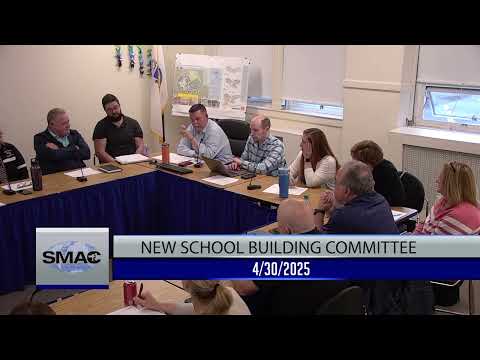
Stoughton building committee votes to pursue construction-manager-at-risk, approves design and OPM contract amendments
Summary
The Stoughton School Building Committee voted to pursue a construction-manager-at-risk delivery method, approved contract amendments with design firm DRA and owner’s project manager Vertex, and advanced the project into design development and permitting, including a likely MEPA environmental review.
The Stoughton School Building Committee on an unstated meeting date authorized the town to pursue a construction-manager-at-risk (CM-at-risk) delivery method for the new elementary school project and approved contract amendments with design firm DRA and owner’s project manager Vertex to carry the project through design development and toward construction. The committee also created subcommittees, delegated subcommittee appointment authority to the committee chair, and discussed permitting, energy systems and schedule milestones.
The approvals move the project from schematic design into the MSBA design development and construction-document phases and start permitting steps that committee members said are on the project’s critical path. The Massachusetts School Building Authority (MSBA) funding agreement and state permitting reviews, including a likely Massachusetts Environmental Policy Act (MEPA) Environmental Notification Form (ENF) and related environmental-justice outreach, were cited repeatedly as timing and approval milestones that will shape the next 6–12 months.
Tim Bonfati, project executive with Vertex, told the committee the team is working to submit a roughly 60% design-development package in October and two construction-document submissions (a 60% and a 90% set) through the winter and spring, with an eye toward beginning construction activities in the following construction season. "Our goal is to move into beginning active construction," Bonfati said. He described the MSBA process (project scope-and-budget agreement, then a funding agreement) and said the team expects a funding-agreement document from MSBA "sometime in the summer" (exact timing not specified).
Committee members and consultants emphasized permitting as a schedule risk. Carl Franceschi of DRA said the project as designed will likely exceed MEPA thresholds for new impervious area and therefore will require an ENF and additional outreach and documentation, including analysis related to environmental-justice criteria the state now applies. Franceschi said that MEPA review could take six to eight months and that the team is preparing for that timeline.
The committee voted to pursue CM-at-risk procurement so the construction manager can participate in preconstruction work and help manage complex site logistics and early trade packages, including a critical bridge over wetlands and the Route 27 access structure. Committee members said CM-at-risk also provides early cost feedback during design; the procurement will require an application to the Office of the Inspector General, an RFQ, a short-listing phase and interviews. The committee recorded the motion and approved it by voice vote; the transcript does not record a roll-call tally. No named vote counts were recorded in the meeting transcript.
The committee approved an amendment to DRA’s contract to carry the firm through design development and construction administration. The amendment amount discussed on the record was $7,818,354 plus additional reimbursable allowances (geotechnical, survey, geo-environmental testing, traffic consulting, and the MEPA consulting work). The committee also approved a Vertex amendment (amounts discussed as budgeted in the project submission) to carry Vertex's services forward and to allow Vertex to recoup a previously discounted portion of feasibility-phase work; the transcript references a recoup cap of $178,044 for previously discounted Vertex work.
On energy systems, the committee discussed keeping geothermal in the design for part of the building (wells sited in the athletic field area to serve spaces with frequent cooling needs) while noting that federal incentives under the Inflation Reduction Act (IRA) and some utility rebates were uncertain and could change the economics. "Geothermal still makes sense for a lot of other reasons," one consultant said, while acknowledging rebate uncertainty. Committee members said the base design will be all-electric, and that a diesel generator and tank will provide emergency power; no gas service will be extended to the project.
Committee chair Thomas J. (TJ) Recupero handled roll call and introduced members and consultants at the start of the meeting and said he will distribute a nonpublic contact list for committee use. He also asked members to sign up for smaller working groups (site, mechanical/electrical, interiors, permitting, finance, change orders, CM screening) to keep the larger committee efficient. The standing working groups will return recommendations to the full committee for approval.
Votes at a glance - Motion to delegate appointment of subcommittees to the chair (TJ Recupero): approved by voice vote. (Motion text presented on the record; mover/second not clearly attributed in the transcript.) - Motion to proceed with CM-at-risk procurement and related inspector-general application and RFQ process: approved by voice vote. (Motion text presented on the record; mover/second not clearly attributed in the transcript.) - Motion to approve DRA contract amendment for design-development and construction administration in the amount discussed on the record ($7,818,354) plus defined reimbursable allowances (geotechnical, survey, geo-environmental, traffic, MEPA consulting): approved by voice vote. (Exact final amendment language and allowance amounts to be formatted into the MSBA-required amendment and returned to the committee for record.) - Motion to approve Vertex amendment to continue OPM/consultant services (amounts budgeted in the MSBA submission; includes allowed recoupment of feasibility-phase discount capped at $178,044): approved by voice vote. - Motion to adjourn: approved by voice vote.
What the committee recorded as next steps: prepare and submit the MSBA funding agreement as it becomes available; continue design-development work with DRA and Vertex; assemble a CM-at-risk screening subcommittee and prepare the OIG application and RFQ; advance MEPA permitting (ENF and outreach) because that permitting is on the project's critical path; and provide monthly budget/status reports to the committee. The committee asked the project team to publish or share the schematic-design submission and the estimate in a common area for committee review.
The meeting transcript includes multiple references to budgets and contingencies; committee members noted that the construction estimate discussed was about $90,600,000 and that the overall project budget submitted to MSBA was in the range of $113,000,000. The team said they reduced the CM premium from last year's estimate by roughly $1.2 million (figures mentioned on the record varied slightly) and that market uncertainty (tariffs, material-price movement) still represents a material risk. The MSBA funding agreement timeline and the MEPA permitting schedule were the two scheduling items committee members flagged as most likely to affect project timing.
The committee’s approvals authorize the project team to move into a more detailed phase of design and permitting. The record shows discussion and several votes but does not include roll-call vote tallies in the transcript; the committee asked staff to return formatted amendment documents and the CM procurement materials for future meetings and approvals.