Get Full Government Meeting Transcripts, Videos, & Alerts Forever!
Get email alerts on the Svu Staffing topic
No spam. Unsubscribe anytime.
Supervisors hear advocates and SFPD on strained Special Victims Unit staffing; committee continues hearing to chair’s call
Summary
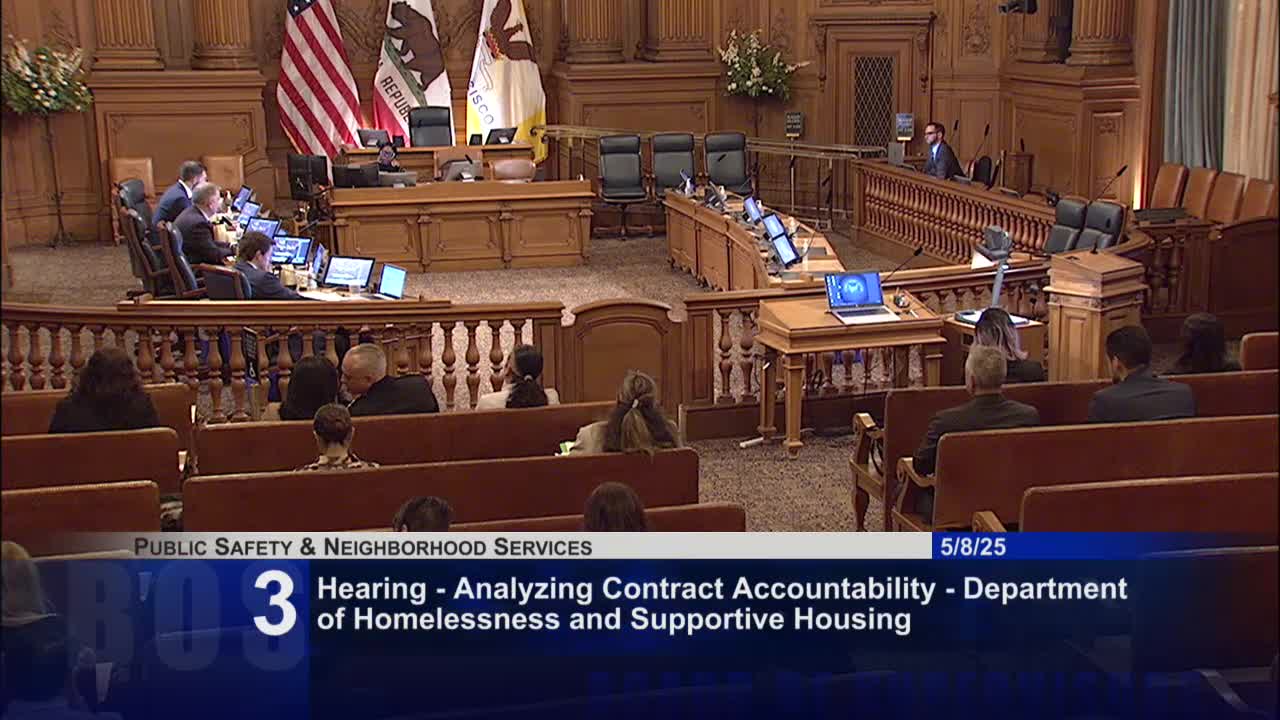
The Public Safety and Neighborhood Services Committee held a hearing on May 8 to examine staffing, policies and operations in the San Francisco Police Department’s Special Victims Unit after advocates and officials warned a steep decline in investigators has strained services for victims and survivors.
The Public Safety and Neighborhood Services Committee held a hearing on May 8 to examine staffing, policies and operational practices of the San Francisco Police Department’s Special Victims Unit (SVU). The hearing, requested by Supervisor Myrna Melgar, gathered presentations from city officials, SFPD leadership and community advocates and concluded with the committee continuing the item to the call of the chair for follow‑up.
"Four years ago, there were 70 investigators in this unit. Today, there are 29," Supervisor Myrna Melgar said in opening remarks, framing the hearing around a steep decline in SVU staffing and the impacts on victims and survivors. Melgar said the hearing seeks to “center survivors” and to explore how the city can better support investigators so cases move forward without retraumatizing victims.
Ivy Lee, director of the Mayor’s Office for Victim and Witness Rights, described the office’s role as an ombuds and urged a systems approach. Lee summarized the Family Violence Council’s findings and noted the gap between calls for service and cases that reach prosecution: "6658 DV calls to 911 ... 1,167 cases are presented to the DA; 492 cases are filed; 14 cases taken to trial," she said, characterizing those numbers as demonstrating how much of the caseload does not advance to court.
Acting Deputy Chief Rachel Moran and Acting Captain Dan Silver of SFPD’s Investigations Bureau presented the department’s staffing picture and operational adjustments. Moran said the department’s desired staffing is 2,074 sworn officers overall and reported current sworn strength at 1,466; she added that SVU investigators number 29, with 26 currently fully on duty and the remainder expected to return. Captain Silver described assignment protocols and triage criteria used to determine which reports are assigned to investigators, emphasizing factors such as severity, corroborating evidence and danger to victims. Silver said SVU shifts and on‑call responsibilities have been rebalanced to reduce burnout and that the unit is using multidisciplinary interviews and strengthened coordination with CASEARC and the District Attorney’s Office.
Survivors and advocates gave detailed testimony about gaps and failures. Penelope Van Toole, a parent who described a case involving her children, told the committee that assigned SVU officers “minimized the behavior” and were at times dismissive, and said the family had to provide evidence directly to the district attorney to prompt charges. Advocates from legal aid and victim services — including representatives from the Cooperative Restraining Order Clinic, Safe and Sound, Bay Area Legal Aid and the Survivor Restoration Program — described delays taking reports, inconsistent use of lethality assessments, problems with language access and the toll on survivors when investigations are delayed.
Clinicians and researchers recommended embedding trauma‑informed supports and peer or clinical counseling for investigators. Dr. Sarah Metz of UCSF urged ongoing, supervisor‑level trauma‑informed training and institutional supports, saying resources must pair staffing increases with sustained mental‑health and organizational supports so investigators can remain effective.
SFPD Assistant Chief David Lazar apologized for instances where victims felt poorly served and highlighted immediate operational changes the department has implemented, including opening SVU to take restraining‑order violation reports directly during weekdays and giving advocates a route to reach on‑call supervisors nights and weekends. Lazar noted the department anticipates forthcoming sergeant promotions that will enable assignment of additional investigators to SVU.
Supervisor Melgar requested the hearing remain open to the call of the chair to allow follow‑up as leadership changes and recommended exploring civilian investigators, embedded advocates in stations, expanded training, and options to reduce on‑call strain. Chair Matt Dorsey moved to continue the hearing to the call of the chair; the motion passed on a roll call with three ayes and Vice Chair Mahmood excused.
The committee did not adopt policy changes at the hearing; it recorded commitments to pursue short‑term operational fixes (expanded access for advocates to reach the on‑call lieutenant; opening SVU for restraining‑order violation reports; increased internship and civilian support) and longer‑term options (recruitment/retention, civilian investigator models, embedded victim‑service providers, sustained trauma‑informed training and wellness support for staff). The item will return at the chair’s discretion for further review and potential committee action.