Get Full Government Meeting Transcripts, Videos, & Alerts Forever!
Get email alerts on the Landfill Expansion topic
No spam. Unsubscribe anytime.
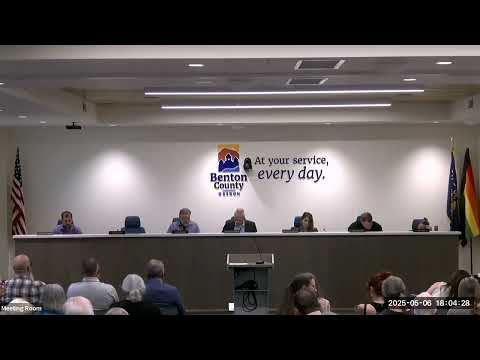
Benton County planning commission hears hours of testimony on Coffin Butte landfill expansion; hearing continued to May 8
Summary
The Benton County Planning Commission heard more than three hours of public testimony on May 6 over Republic Services’ application (LU-24-027) for a conditional-use permit to expand the Coffin Butte Landfill.
The Benton County Planning Commission heard more than three hours of public testimony on May 6 over Republic Services’ application (LU-24-027) for a conditional-use permit to expand the Coffin Butte Landfill. Speakers for and against the proposal described competing risks: proponents said expansion would avoid shifting waste long distances and preserve county revenue; opponents cited odors, methane “super-emitter” findings by the EPA, PFAS in leachate and landfill gas, water-well and arsenic concerns, traffic and wildfire risks and long-term visual impacts on the area.
The commission opened the hearing by announcing the case, LU-24-027, and explaining the proceeding is quasi-judicial and governed by Benton County development code sections 51.705–51.725. Chair Fowler and staff said testimony should address the code criteria and noted the staff report had been available a week earlier. After the applicant’s initial presentation (not part of the public testimony phase on May 6), the commission took statements from more than 70 people who had signed up to speak; roughly two-thirds of those on the roster opposed the expansion.
Why it matters: The project would change the footprint and operations at a landfill that serves the region. Opponents argued the county’s land-use standards — including the conditional-use criteria in Chapter 53 — require denial because expansion would “seriously interfere” with adjacent uses and the character of the area; proponents argued that closing the facility would increase long-haul truck traffic, raise disposal costs and shift environmental impacts elsewhere.
Most prominent points raised
- Odor and air emissions: Residents, local scientists and nonprofit advocates said odor episodes are frequent and worsening. Mason Levitt of Beyond Toxics said the landfill’s odor study used an outdated model and omitted real-time fence-line monitoring; he submitted surface-emissions-monitoring (SEM) reports and satellite overflight evidence indicating large fugitive methane plumes. Several speakers, including Dr. Shelly Hsu, a toxicologist and former EPA employee, pointed to EPA inspections that documented very high methane concentrations and termed the site a ‘‘super emitter.’’
- PFAS and toxics: Multiple speakers (Crystal Condon, Pam Castle and others) said municipal sludge accepted at Coffin Butte contains PFAS (“forever chemicals”), that PFAS are present in landfill leachate and that recent studies show landfill gas can carry PFAS off-site. Testimony said wastewater treatment plants that receive leachate (Corvallis, Salem) are not removing PFAS and that discharges enter the Willamette River.
- Groundwater and arsenic: Geologist Joel Geyer and others warned about construction impacts (large-scale excavation and blasting) and potential effects on springs and wells near Tampico Ridge. Witnesses described a cluster of wells with elevated arsenic near the existing site footprint and disputed the applicant’s explanation that those concentrations are purely natural.
- Public health, fire and safety: Several testifiers said landfill gases carry aerosols and toxicants that could affect health; others raised the risk of landfill fires and the strain expanded operations would place on emergency response and evacuation routes. Carol McClellan Fields’ written testimony (read by a ceded witness) emphasized wildfire and ember risks if operations were across Coffin Butte Road.
- Character, visual and economic impacts: Opponents said the expansion would significantly alter the rural and recreational character of the area (including views from EE Wilson Wildlife Area), reduce property values and dissuade prospective buyers. Supporters argued county residents and regional customers would face higher costs if the landfill closed and that Coffin Butte’s central location reduces hauling emissions compared with sending waste farther away.
Proponent arguments
- Jason Clifford, a Corvallis resident and electrical engineer, told commissioners “Having 6 additional years will be very beneficial” while the county develops longer-term material-management solutions and argued the county can better control emissions here than by shipping waste farther away.
- Zachary Dahl of Dahl Disposal Service said Oregon landfills use modern controls, that moving waste long distances would multiply truck trips and emissions and that increased hauling would raise costs for ratepayers.
Opposition and technical testimony
- Jeffrey Kleinman, attorney for Valley Neighbors for Environmental Quality and Safety, argued the proposal would prolong dumping and criticized Republic Services’ compliance history; he and other opponents said earlier county commitments to cap and restore portions of the site had not been carried out and urged denial.
- Mason Levitt (Beyond Toxics) and others submitted SEM reports, satellite plume imagery and a door-to-door survey from Adair Village that found many residents reporting frequent landfill odors; Levitt told the commission Coffin Butte had not monitored more than half of its surface area and that EPA inspections had documented dozens of high-concentration leaks.
- Experts and farmers emphasized construction noise and blasting for new cells and leachate ponds, potential drying of springs, and impacts on agricultural laborability and operations downwind from odors and dust.
Procedural outcome
After public testimony the commission considered procedural options and voted to continue the hearing until 6 p.m. Thursday, May 8, to allow remaining speakers and applicant rebuttal. The motion to continue passed on an aye vote; the commission did not read a roll-call tally at the time of the decision but confirmed a quorum would be available on Thursday.
What the commission must decide
The commission must determine whether the applicant has met the conditional-use approval criteria in the Benton County Development Code, including whether the proposed expansion “seriously interferes” with adjacent uses or the character of the area. Several opponents urged the commission to interpret ‘‘seriously’’ broadly; the applicant and some pro-expansion witnesses emphasized regional waste-management realities and mitigation options.
Next steps
The public hearing will resume at 6 p.m. Thursday, May 8, at the same location. The record will remain open according to the commission’s rules for the submission of additional written evidence; some opponents requested the record remain open for 14 days after the hearing to submit further materials. The commission may then deliberate and decide whether to approve the conditional-use permit, approve it with conditions, or deny it.
Reporting note: Quotations and attributions in this article come from the public hearing transcript and the witnesses listed below. The commission cautioned presenters that testimony must address the code criteria and that written materials should be submitted to county staff to become part of the official record.