Get Full Government Meeting Transcripts, Videos, & Alerts Forever!
Get email alerts on the Edenville Dam Inverse Condemnation topic
No spam. Unsubscribe anytime.
Court hears arguments over whether state authorization of Wixom Lake levels amounted to a taking
Summary
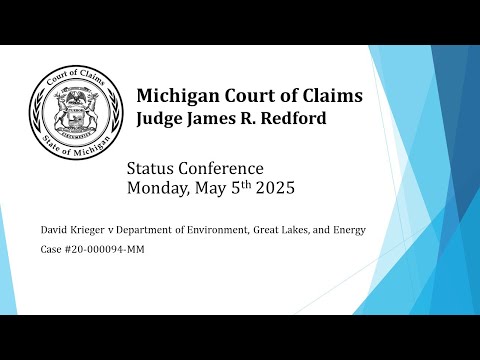
At a May 5, 2025 hearing in Grand Rapids, lawyers for property owners and state agencies argued over whether Michigan agenciesauthorized raising Wixom Lake and thereby caused the Edenville Dam failure, with the court taking the motions under advisement and promising an oral opinion May 12.
GRAND RAPIDS, Mich. — The Michigan Court of Claims on Monday heard competing arguments over whether state agencieswere constitutionally responsible for property damage after the Edenville (Wixom Lake) dam failed, a dispute that centers on engineering reports, a 2018 FERC license revocation and an April 2020 agency authorization to return the lake to its normal level.
In a roughly three-hour oral argument, defense lawyers said the state did not "condemn" the properties, did not direct operators to take actions that caused the failure, and relied on engineering reports that, at the time, recommended maintaining the lake level. Plaintiffs' counsel urged the court to treat the April 9, 2020 authorization and other affirmative steps as the sort of government action that can support an inverse-condemnation claim under Michigan law.
The dispute arises from long-running regulatory oversight and inspection records for the Edenville Dam. Counsel referenced a 2018 revocation of the dam's FERC license and subsequent state oversight under Michigan law. Defense counsel Nathan Gamble told the court the state "did not take the plaintiffs' properties for a public use" and that while significant recovery funds had been invested in the community, the issue before the court was whether the state had caused the damages alleged. "The failure to act cannot support an inverse-condemnation claim," Gamble said, calling negligence a separate tort.
Plaintiffs' lead counsel Kevin Carlson countered that, under MCL 324.315 and related case law invoked in briefing, the relevant standard for dam safety is objective and mandatory and that once a dam fails to meet the statutory spillway-capacity benchmark (one-half of the probable maximum flood), the dam is, by statute, "unsafe, structurally unsound, and hydrologically inadequate." Carlson argued that the state's later authorization to restore the lake to normal elevations after FERC's license termination was an "affirmative act" that, if it was made with knowledge of the dam's deficiencies, can satisfy the causation element of a taking claim.
Counsel debated particular pieces of evidence cited in the briefs: independent consultant inspection reports (including work by the Spicer Group), Federal Energy Regulatory Commission inspection findings and the different experts' hydrologic and stability models (plaintiffs' Dr. Williams and plaintiffs' engineer Sturtevant were cited by plaintiffs; defendants challenged aspects of those analyses). Plaintiffs' counsel asserted that models show a starting water elevation of 670 feet would have avoided triggering conditions for static liquefaction; defense counsel disputed the modeling and pointed to contemporaneous engineering conclusions that continued normal lake levels would not harm private property.
Both sides invoked Michigan precedent distinguishing ordinary permitting decisions from affirmative state acts that have been treated as takings in previous cases (plaintiffs relied on the Court of Appeals decision in this case and the framework of Mayes/Krieger; defense counsel cited permitting cases they said were distinguishable).
Judge James R. Redford did not rule from the bench. He told the parties he would issue an oral opinion by Zoom on May 12 at 3:30 p.m. and that a written order would follow. He also told counsel that if expert-discovery disputes are not resolved, he has set aside multiple days in May to require lawyers and necessary experts to appear in person with a court reporter to complete expert discovery on the record.
The court's ruling on the pending summary-disposition motions will determine whether some or all claims proceed to trial.
For the record: matters discussed included FERC inspection and license revocation in 2018, an April 9, 2020 agency authorization referenced in the briefing, Spicer Group engineering work, and competing expert hydrologic and stability modeling.
No final judicial decision was announced at the hearing.