Get Full Government Meeting Transcripts, Videos, & Alerts Forever!
Get email alerts on the Medicaid Fraud topic
No spam. Unsubscribe anytime.
Minnesota Medicaid Fraud Unit urges more staff, statute changes and data access to curb provider abuse
Summary
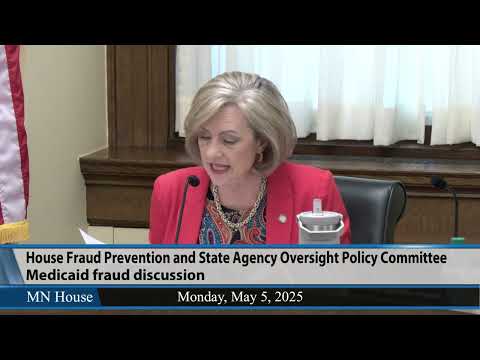
Attorney General Keith Ellison and Medicaid Fraud Control Unit Director Nick Wonka told the House Fraud, Waste and State Agency Oversight Committee the unit needs more staffing, clearer statutes and better access to data to detect and prosecute provider fraud and abuse.
Attorney General Keith Ellison and the director of the Minnesota Medicaid Fraud Control Unit told a House committee on May 5 that their investigators and prosecutors need statutory changes, more staff and better data access to stop provider fraud and abuse.
The office’s Medicaid Fraud Control Unit (MFCU) prosecutes provider fraud and cases of abuse, neglect and financial exploitation of vulnerable adults, Ellison said. "As you'll hear multiple times today, I'm sure that in Minnesota and and until and unless the legislature sees fit to expand our authority, the attorney general's office has original jurisdiction to bring a criminal case against someone in only 1 area of work, Medicaid fraud," Ellison said.
The presentation explained why committee members should consider increased resources and legal clarifications. The MFCU told lawmakers the unit is funded primarily by a federal HHS Office of Inspector General grant that pays about 75% of its costs; the state covers the remaining 25%. "Over the past 5 years, Minnesota has only spent about $5,000,000 on our medical Medicaid control unit. In that same time, the unit won 53,000,000 in restitution and recoveries," Nick Wonka, director of Minnesota's Medicaid Fraud Control Unit, said.
Why it matters: lawmakers and the MFCU said state statute and current federal grant rules limit the unit’s ability to investigate some fraud patterns quickly. Committee members and MFCU staff argued that improving subpoena authority, closing statutory gaps and expanding unit capacity could increase prevention and recovery and reduce risk to vulnerable Minnesotans.
What the unit does and its limits
Wonka described two core statutory categories the federal grant requires MFCUs to handle: provider fraud and patient abuse (abuse, neglect and financial exploitation of vulnerable adults). He said the unit has 32 staff — attorneys, investigators, analysts, nurse investigators and auditors — but that federal guidelines set an ideal staffing level tied to a state's Medicaid budget. "Based on our state Medicaid budget, our size is supposed to be 41. But it's not. It's still at 32," Wonka said.
Wonka outlined practical limits tied to the federal grant and to state law: the unit cannot investigate recipient (beneficiary) fraud with the federal grant funds, cannot use federal grant money to perform certain non-Medicaid investigations, and must remain administratively separate from the agency that runs Medicaid (the Department of Human Services, DHS). He said those rules mean the MFCU does not have real‑time, ongoing access to claims and payment data and therefore often must rely on DHS, managed care organizations (MCOs), local law enforcement or search warrants for detailed claims data.
On data and investigative tools
The MFCU told the committee there is a federal mechanism called a "data mining waiver" that some units have used to get more analytic access, but that the waiver has limits and is administered by the federal Office of Inspector General. "There’s a provision in the federal regulations for something called a data mining waiver," Wonka said. He added it "wouldn't give us identical access" to agency payment data but could let investigators request targeted analytics.
On statute and penalties
MFCU staff urged lawmakers to pass the Medical Assistance Protection Act (MAP Act), legislation they said would do three things the unit needs: 1) modernize the state medical assistance fraud charging statute so it clearly covers fraud against managed care organizations as well as the state; 2) raise penalties for medical assistance fraud so they are aligned with other theft statutes; and 3) grant increased subpoena authority when conducting provider fraud investigations. "Right now, the current version of the medical assistance fraud statute has gaps, and it has insufficient penalties when compared to other financial crimes," Wonka said.
The unit described the statutory penalty issue in detail: the existing medical‑assistance fraud statute is treated as an attempt crime and, under Minnesota law, carries a maximum sentence of 2.5 years. Wonka said that prosecutors currently use general theft statutes for large cases because those theft statutes provide greater penalties (for example, theft over $35,000 carries a statutory maximum of 20 years, and the sentencing guidelines prescribe a stayed sentence of 21 months for a first‑time offender at that level, rising with criminal history).
Examples and detection methods
Wonka gave case examples that the unit has prosecuted — home‑care agencies that billed for services not provided, therapists who billed for individual services that were actually group sessions, and cases of conservators or representative payees stealing clients' funds. He said referrals most commonly come from DHS audits and MCO special investigations units; the public, local law enforcement and other agencies also refer matters.
The MFCU described a mix of detection methods: public tips or whistleblower complaints, referrals from DHS and MCOs, targeted analytic requests to DHS, and cooperation with federal and state law enforcement. "The majority of the cases that we get come on referrals from the Department of Human Services or from Managed Care Organizations," Wonka said.
Oversight interactions and follow‑up
Committee members pressed about how the MFCU coordinates with DHS after search warrants or other investigative steps. Wonka said the MFCU routinely provides executed search warrants and related public filings to DHS so DHS can consider administrative actions such as withholding payments, but he said the decision to suspend payments rests with DHS. "We send a signed copy of the search warrant...to the Department of Human Services for them to take the action that they believe is appropriate," Wonka said. He also said the MFCU does not track how frequently DHS acts after receiving such materials.
Other policy notes from the hearing
• Staff size and funding: MFCU staff said federal matching funds cover about 75% of the unit’s budget and recommended the state increase the unit from 32 to the 41 positions the federal formula supports.
• Data improvements: committee members and MFCU staff discussed enterprise data efforts, master data management and whether an Inspector General or centralized data authority could facilitate secure data queries across agencies. Representative Tim Elkins and others described work in state technical advisory groups exploring data‑sharing options that would allow targeted, privacy‑protected queries without wholesale data transfers.
• Criminal enforcement vs. administrative action: MFCU staff emphasized the separation required by federal grant rules: the MFCU prosecutes eligible criminal conduct but cannot carry out some administrative actions (for example, blocking provider enrollment or stopping payments) that DHS might take administratively.
Ending
Wonka and Ellison urged passage of statutory changes described above and recommended investments in staffing and targeted data capabilities to speed detection and prosecution. "It's really good to have these conversations in the public and out in the open, how we can all work together to prevent Medicaid fraud and to hold the people who do defraud the system accountable in the way that they should be," Ellison said before leaving the hearing.