Get Full Government Meeting Transcripts, Videos, & Alerts Forever!
Get email alerts on the Affordable Housing topic
No spam. Unsubscribe anytime.
Planning board recommends forwarding Live Local zoning rules to commission; staff to refine language before city hearing
Summary
The board voted to forward a text amendment implementing Florida’s Live Local Act (file 25T36) to the City Commission, with staff directed to coordinate with legal to reflect pending state legislative changes effective July 1.
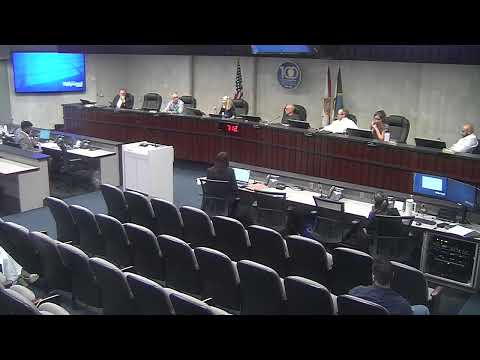
The City of Hollywood Planning and Development Board voted to forward a proposed citywide zoning text amendment to implement Florida’s Live Local Act for mixed‑use affordable housing, directing staff to work with the city attorney on minor changes before it reaches the City Commission.
A staff presenter described proposed section 4.24 as the city’s implementing language for Florida Statute 166.04151 (the Live Local Act) and related technical corrections enacted the following year. The amendment would establish procedures and development standards for qualifying “Live Local” mixed‑use, affordable housing projects. Staff told the board the statute requires municipalities to allow qualifying developments administratively if they meet statutory criteria.
Key elements summarized by staff included: a requirement that qualifying projects be mixed‑use in Hollywood (because about 9% of local land is in industrial or business uses), a residential component comprising at least 65% of total project square footage, a requirement that at least 40% of residential units be affordable at up to 120% of local area median income (AMI), a minimum 30‑year affordability covenant, and a provision allowing applicants to leverage up to 150% of the highest allowable floor‑area ratio (FAR) in some districts. Staff said the UIC district represents the city’s highest allowable density (about 126 units per acre) and noted the applicant could pursue FAR increases consistent with the statute and local review standards.
The amendment proposes urban‑design and planning justification requirements, step‑backs to improve compatibility with adjacent development, and a technical advisory committee (TAC) review. Staff emphasized that, by statute, final administrative approval would be issued by the director of Development Services (Andrea Winget) if the application meets the statutory standards. The proposed text also requires public outreach steps: notification signage within 10 days of application submission, pre‑application meetings and TAC review; staff told the board two Live Local applications are already filed with the city.
Board members asked about parking reductions and retail viability. Staff said the statute includes reduced parking allowances for properties within a half‑mile of major transit hubs and that the proposed text requires a minimum 25% nonresidential component (office, retail or other nonresidential uses) for qualifying projects. Ryan Coop, community development division manager, spoke during the discussion to explain AMI and affordability bands used by state and federal programs.
Staff recommended forwarding the amendment to the City Commission and asked to make technical updates in consultation with the city attorney to anticipate legislative changes effective July 1. The board voted to forward the amendment with that direction; the vote passed with no recorded opposition.
The City Commission will consider the amendment; final language may change in response to legal review and any commission direction.