Get Full Government Meeting Transcripts, Videos, & Alerts Forever!
Get email alerts on the Pfas Land Spreading topic
No spam. Unsubscribe anytime.
Ashland County committee probes PFAS in municipal sludge, no countywide testing program available
Summary
County land conservation staff and committee members discussed long-term land application of municipal sludge and septic septage, presence of PFAS in soils, limits on testing and remediation programs at the state level, and options for next steps. No formal policy was adopted.
The Ashland County Land Conservation Committee spent a substantial portion of its meeting examining the spread of biosolids and septage on private land and the presence of PFAS (per- and polyfluoroalkyl substances) in soils and water.
Mary Jo Gingress, director of Ashland County Land and Water Conservation, told the committee the county has two long-term municipal sludge application sites — one with at least 40 years of spreading — and roughly 50 private sites that accept septage under DNR permit. “PFAS are a polyfluoroaromatic hydrocarbon that builds up,” Gingress said, describing sources as everyday products and noting that “there is no good treatment for PFAS chemicals, so it ends up in our sludge at our wastewater systems.”
Gingress said soils on at least one property being considered for a NRCS wetland easement tested positive for PFAS and that the NRCS denied that easement application because of the land-spreading history. She told the committee she contacted DNR wastewater and public-health staff and found “there are currently no programs available in the state to do widespread PFAS well or soil testing.”
Committee member Charlie Ortman said the issue has broad implications for agricultural landowners who have accepted biosolids for decades. “Lots of people, mostly farmers or landowners who have been kind enough to help deal with the sewage we all create are going to be uniquely harmed by being, you know, having no access to federal funds for easements,” Ortman said, and said he had contacted U.S. Sen. Tammy Baldwin’s office to ask why easement decisions are being denied.
Brian Ladin, manager of the City of Ashland water and wastewater utility, told the committee the utility recently tested sludge voluntarily; results were “less than 50 parts per billion” and under state recommendations the utility uses for land application. He said the wastewater utility is not required to test for PFAS under its current permit but did so voluntarily this year. He also said the city’s raw drinking water tests were “between the LOD and LOQ,” i.e., roughly at the limit of detection or quantitation.
Committee members and staff discussed technical and funding challenges. Gingress said private-well PFAS testing costs roughly $500–$600 per well, and countywide profiling of soils or wells would likely cost tens of thousands of dollars and require grants or state funding. She said county soils — generally clay in many places — may slow leaching to aquifers, but “soils do not filter out the PFAS” and sandy areas could allow leaching to groundwater.
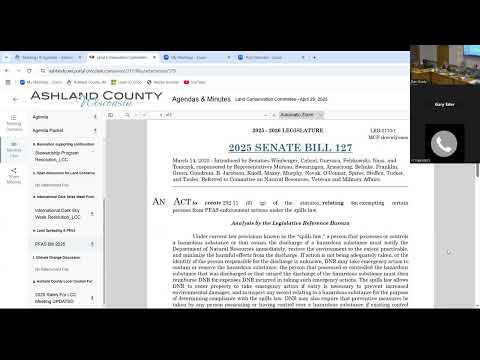
The committee reviewed recent state-level legislation packets provided at the meeting. Gingress summarized 2025 Senate Bill 127 as drafted to provide exemptions under the state spills law for parties who spread or receive biosolids if they comply with permits or allow DNR remediation; Gingress told members that many of the exemptions in that bill appear similar to existing DNR permit-based exemptions and that she had sought clarification from state legislators.
No formal motion to change county policy or to fund testing passed during the discussion. Committee members asked staff to monitor state budget proposals and possible grant funding for PFAS testing; Gingress said she is in contact with the state PFAS contact and that lawmakers have proposed research/testing funding in the coming biennium but details and program structures remain unclear.
The committee did not adopt a new rule or ban on land application of biosolids or septage. Members asked staff to draft a plan outline (scope, likely sample locations, and estimated costs) that could be used to apply for state or federal grants if funds become available. Gingress cautioned that producing a usable county PFAS “profile” would require staff time and outside funding for sampling and analysis.
The discussion highlighted three practical points: DNR permitting currently governs most land application of biosolids and septage in Wisconsin; PFAS testing and remediation options are limited and costly; and state legislation and budget items under consideration could change funding and regulatory incentives. The committee kept PFAS on the agenda and asked staff to continue tracking state policy, potential grant opportunities, and technical guidance from DNR and public-health contacts.