Get Full Government Meeting Transcripts, Videos, & Alerts Forever!
Get email alerts on the Land Use topic
No spam. Unsubscribe anytime.
Planning commission recommends District 33 PUD zoning changes for South 30th Street area
Summary
The Lincoln-Lancaster County Planning Commission voted 9-0 on May 14, 2025, to recommend approval of a planned unit development (District 33 PUD) that would rezone about 12.78 acres near South 30th Street and A Street to allow mixed commercial and increased residential density, with waivers for parking, setbacks and alcohol sales.
The Lincoln-Lancaster County Planning Commission voted 9-0 on May 14, 2025, to recommend approval of a change of zone to establish the District 33 planned unit development (PUD) covering roughly 12.78 acres near South 30th Street and A Street.
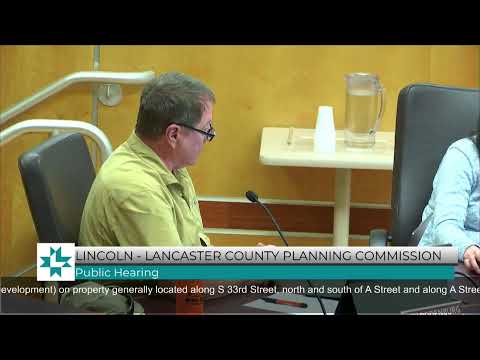
The commission's action follows a staff recommendation and a public hearing in which city planning staff, the applicant and neighborhood residents described the plan's goals and raised concerns about traffic, parking and impacts on nearby single-family homes. Eden Johnson, planning department staff, said the PUD would convert existing B-3, R-2 and O-2 zoning into B-3 PUD, R-2 PUD and R-4 PUD districts and create a layout that includes "44 lots of B3 PUD for a mixed commercial node, 16 lots for R4 PUD for higher density housing, and 2 lots for R2 PUD lower density housing." Johnson also said the proposal includes waivers to allow reduced parking minimums, modified setbacks, and both on-sale and off-sale alcohol sales where restrictions previously applied.
The nut graf: proponents say the PUD aims to revive an underused commercial corridor and support "missing middle" housing such as duplexes and triplexes while creating a walkable commercial node; opponents and nearby residents urged the commission to address traffic flow, pedestrian safety at the 30th and Normal intersection, parking spillover into neighborhoods and buffering where commercial uses abut back yards.
Applicant Terry Logge identified himself as a local property owner who has engaged with neighbors and small business owners on the proposal. "This has probably been about 18 months of engagement between the community and with the city," Logge said, describing the effort as driven by local business owners who sought zoning flexibility to grow. Johnson told the commission the PUD was developed after public meetings including a March 27 neighborhood meeting at Randolph Elementary and was revised based on feedback.
Two neighborhood residents testified about concerns. Linda Barna, who described herself as a 24-year resident, urged attention to pedestrian access and traffic safety, saying, "If we're making it walkable, we have to make sure it's safely walkable." Barna also asked for a 15- to 20-foot buffer where commercial uses would abut her backyard. Seth Whitfoth, another nearby resident, said parking and privacy are his primary concerns: "I'm very concerned about, parking is a big deal because we do have a lot of traffic issues at 30 Third and A." Staff responded to several of those points: Steve Hendrickson of the planning department said the existing commercial rear-yard setback adjacent to residential zoning is 30 feet; planning staff also said only front-yard setbacks are being modified in the B-3 PUD and that the PUD limits most residential areas to R-4 scale (duplex/triplex) with a single planning area allowing up to 45 feet in height for the main commercial hub.
On traffic, staff noted that a PUD primarily addresses zoning and that separate traffic or circulation studies are handled by other city departments; staff said reviews by transportation and engineering were part of the application process and that departments recommended approval. The planning department concluded the District 33 PUD "strongly supports" the city's 2050 comprehensive plan by encouraging walkable, mixed-use neighborhoods and enabling infill development.
The commission's recorded vote on the change-of-zone motion was unanimous; the tally reported was 9-0. Under the hearing-room instructions announced at the start of the meeting, actions other than the one item called out as final are recommendations to the city council or county board, so the PUD will proceed as a recommendation for further review.
Commissioners who spoke in support said they saw potential for neighborhood revitalization while urging continued neighborhood engagement and coordination with city departments on traffic and trails. The applicant and staff said they will continue outreach and department coordination in the coming weeks.
Next steps: the recommendation will be forwarded according to the regular review process for zoning changes; public comment and additional departmental review may occur at later steps.