Get Full Government Meeting Transcripts, Videos, & Alerts Forever!
Get email alerts on the Cultural Arts Commission topic
No spam. Unsubscribe anytime.
Committee forwards revision to Cultural Arts Commission powers to clarify duties and eligibility for grants
Summary
The committee voted 3-0 to recommend an ordinance that narrows and clarifies the Cultural Arts Commission’s powers and duties after staff said recent regulatory changes limited use of certain arts funding to physical public art.
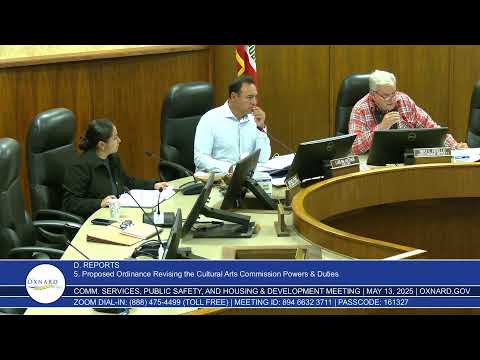
The Oxnard Community Services, Public Safety and Housing Development Committee on May 13 recommended that the City Council adopt an ordinance to revise the powers and duties of the Cultural Arts Commission.
Staff said the proposed ordinance streamlines and clarifies the commission’s responsibilities after members reported confusion over broad or ambiguous language that had contributed to meeting cancellations and project delays. The committee voted 3-0 to forward the ordinance to Council.
Why it matters: Staff and commission members said clearer duties will improve retention and help commissioners understand what they can accomplish. Julia Estrada, Culture Arts Manager and commission liaison, explained that recent revisions to the city’s arts-and-public-places fee regulations limited the use of those funds to physical public art (murals, mosaics and sculptures). As a result, the Arts in Public Places grant previously issued for emerging and legacy artists and organizations using that fund is no longer eligible under the narrower rules.
What changes were discussed: Staff described edits that reduce a long list of overlapping powers and duties to a more focused mission for the commission, intended to make expectations clearer and reduce administrative confusion. Committee members acknowledged the difficulty commissioners face when time-consuming proposals cannot be funded and encouraged clearer communication about available resources and project feasibility.
Vote and next steps: The committee voted 3-0 to recommend adoption of the ordinance. Staff said the ad hoc committee had reviewed the prior language and proposed more concise language to improve clarity and reduce cancellations of meetings and project delays.
Ending: Committee members thanked staff and commission volunteers for their work and urged continued support to ensure the commission can move approved projects forward within available funding.