Get Full Government Meeting Transcripts, Videos, & Alerts Forever!
Get email alerts on the Flood Protection topic
No spam. Unsubscribe anytime.
Springfield begins two-year feasibility study with Army Corps for 40 Second Street levee; federal cap raised to $15 million
Summary
Springfield city staff told the Budget Committee that a two-year feasibility study with the U.S. Army Corps of Engineers will assess improvements to the 40 Second Street levee, with the Corps’ federal cap recently increased to $15,000,000 and a likely 65% federal/35% local cost share.
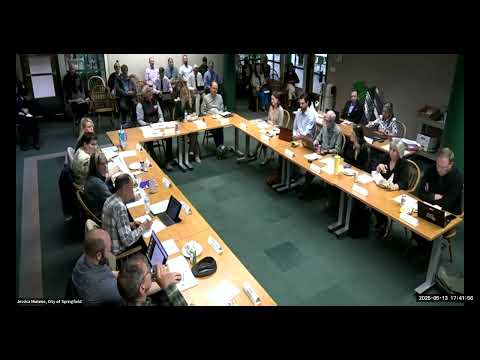
Springfield city staff told the Budget Committee on May 13 that the city has entered a feasibility phase with the U.S. Army Corps of Engineers to assess improvements to the 40 Second Street levee, a roughly one-mile berm that protects about one-third of Springfield from floodwaters.
Ken Bogany, the city’s emergency manager and the project manager for the levee effort, said the Corps is treating the work under a ‘‘small cost’’ program that was recently increased from a $10 million cap to a $15,000,000 cap. He told the committee the overall federal cost share for the eventual project would be about 65% with a 35% local match.
The feasibility phase, Bogany said, will run about two years and will include environmental permitting, predesign, and geotechnical work. ‘‘We’re hiring a contractor to go out and actually drill some holes, dig some holes, and find out what’s really there underground,’’ he said. Bogany said the city is providing part of its cost share through ‘‘work in kind’’—principally the geotechnical studies and a public-engagement plan—and estimated the city’s direct share for the feasibility study at roughly $450,000, with about $170,000 counted as work in kind.
Brian Conlon, operations director, told the committee the city already has roughly $4,000,000 set aside in stormwater capital reserves for the project.
Bogany described the levee’s footprint: it runs on 40 Second Street between Marcola Road and the vicinity of the former paper plant, contains a bicycle path on top, and was built in 1959. He said the levee ‘‘provides flood protection from the McKenzie River to roughly a third of Springfield’s land area population’’ and that it currently does not meet federal standards for certification under the National Flood Insurance Program.
If the city did not pursue improvements, Bogany said, the levee ‘‘could become designated as floodplain under the National Flood Insurance Program,’’ potentially affecting about 7,000 properties and triggering additional environmental regulations. He added the city has purchased flood-response supplies — ‘‘over 20,000 sandbags’’ and a temporary barrier system — and has secured grant funding to write an emergency action plan while the feasibility work proceeds.
Bogany said decisions about construction and final costs will come after the feasibility study identifies alternatives and more precise estimates. ‘‘The feasibility study will give us the boundaries for how much additional budgeting authority that we need,’’ he said.
Committee members asked about who owns the levee and why the city is taking responsibility. Bogany said the land and levee were conveyed to the city in 1983 and that earlier conveyances and transfers left Springfield as the current owner. He said working with the Corps made sense because ‘‘they’re the subject-matter experts’’ and congressional authorization (Water Resources Development Act of 2022 authority) enables Corps participation.
Staff said the city will return to the City Council and the public with alternatives and budget implications before construction decisions are made. Public outreach is part of the feasibility work, and staff said they will prepare maps and communications about potential impacts to help residents understand what a levee failure could mean for neighborhoods.
The committee did not take any formal action on the levee during the meeting; staff described the study timeline, funding shares, and interim protections already in place as the next steps.