Get Full Government Meeting Transcripts, Videos, & Alerts Forever!
Get email alerts on the Civil Rights topic
No spam. Unsubscribe anytime.
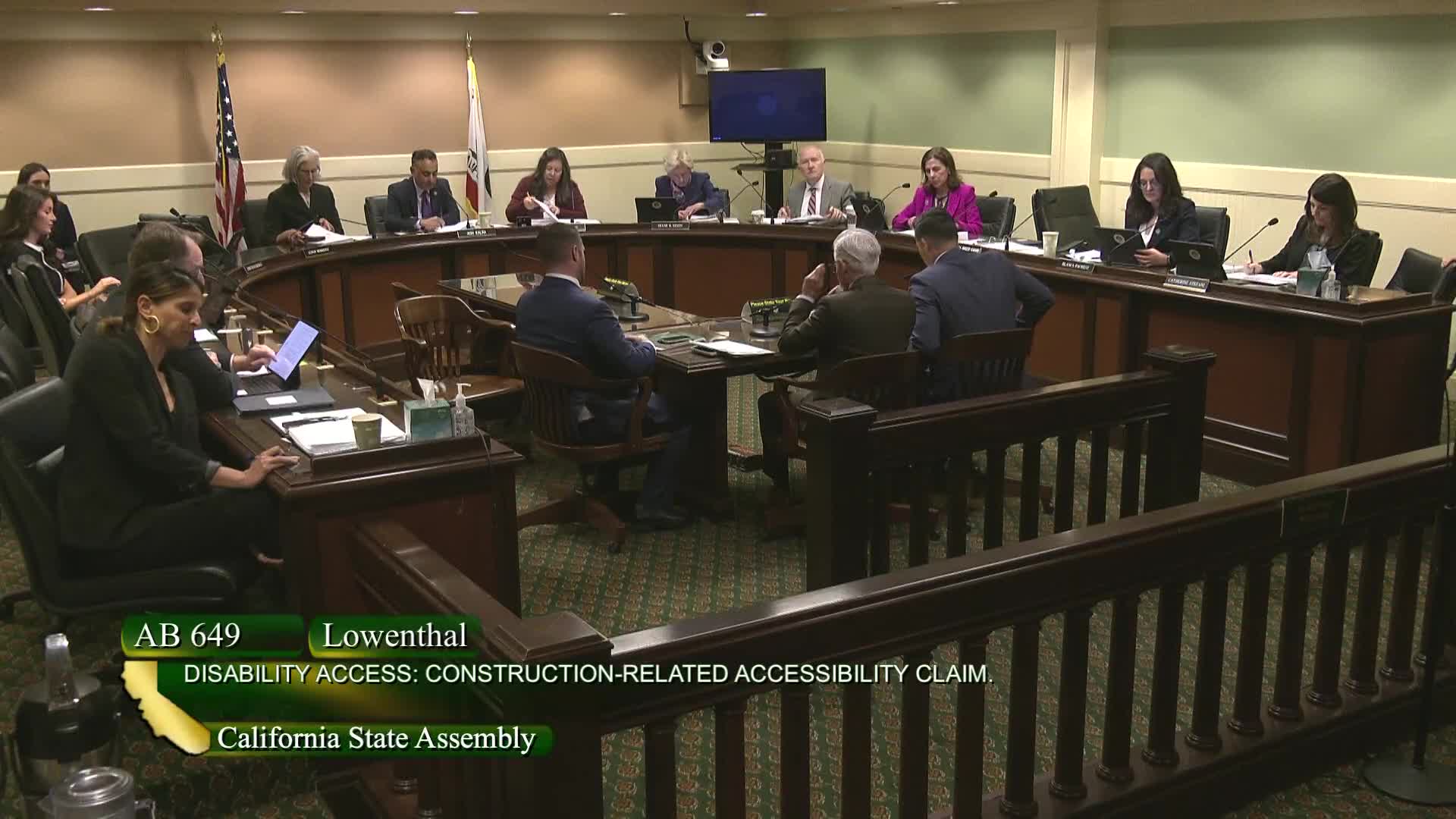
Committee approves limited 'right to cure' for businesses that obtain CASp inspections under AB 649
Summary
AB 649 would create a pilot six-year window and a 120-day cure period for businesses that obtain certified-access-specialist (CASp) inspections and correct construction-related violations, aiming to reduce exploitative high-frequency ADA litigation while preserving access rights for people with disabilities.
The Assembly Judiciary Committee advanced AB 649, intended to incentivize businesses to obtain voluntary Certified Access Specialist (CASp) inspections and remediate construction-related accessibility violations by offering limited legal protections.
Author Assemblymember Josh Lowenthal said the bill balances the rights of people with disabilities and the realities faced by small businesses, who often contend with surprise accessibility suits and settlements that do not remediate barriers. "We want more businesses to take ADA compliance seriously and proactively make their businesses accessible to all members of the public," Lowenthal said (5166.89–5205.065).
Under the bill as amended in committee, a business that obtains a CASp inspection and corrects construction-related violations would be allowed a six-year window during which, if notified of a new construction-related violation, the business would have 120 days to cure it before litigation proceeds. The bill is explicitly a pilot with a sunset, and proponents said the aim is to encourage remediation and reduce serial filings by so-called high-frequency litigants.
Supporters included business owners who said they were sued shortly after cooperating in community relief or without meaningful notice. Chris Sweeney, a restaurant owner, described receiving an ADA demand that sought several thousand dollars despite very small, fixable issues and said settlements often cost him payroll dollars and survival capital (5887.065–5991.505).
Disability advocacy groups — including Disability Rights California and the California Foundation for Independent Living Centers — testified they were neutral on the amended bill, indicating committee amendments addressed some concerns while noting the need to preserve meaningful injunctive relief to secure access. Committee staff clarified that federal ADA claims are tied to the same access violations and that remediating a violation would generally address potential federal exposure (6098.74–6116.93 and 6695.605–6733.96).
Committee discussion focused on procedural safeguards, ensuring the program does not inadvertently remove incentives for proactive compliance, and how the pilot would be monitored. Several members praised the approach as a “scalpel” rather than a sledgehammer — a narrowly tailored pilot to incentivize remediation while preserving legal remedies for noncompliance.
Outcome and next steps: The committee passed AB 649 as amended, and sponsors and disability advocates indicated ongoing work to refine implementation, recordkeeping, and data collection requirements for the pilot.
Why it matters: The bill attempts to reduce settlements that do not fix underlying access barriers by rewarding businesses that proactively identify and remediate construction-related access issues. Supporters argue it will increase actual accessibility; advocates asked for careful monitoring to ensure rights to injunctive relief and federal protections are preserved.
Next steps: The bill advances with a sunset and reporting requirements; the committee requested additional work with disability advocates and business groups on implementation details.