Get Full Government Meeting Transcripts, Videos, & Alerts Forever!
Get email alerts on the Technology Policy topic
No spam. Unsubscribe anytime.
Committee advances AB 412, requiring AI makers to disclose whether models were trained on copyrighted works
Summary
AB 412, the AI Copyright Transparency Act, would give copyright holders a right to ask model creators whether their works were used in training. Authors, voice actors and artists strongly supported the bill; tech and industry groups urged delay or federal action.
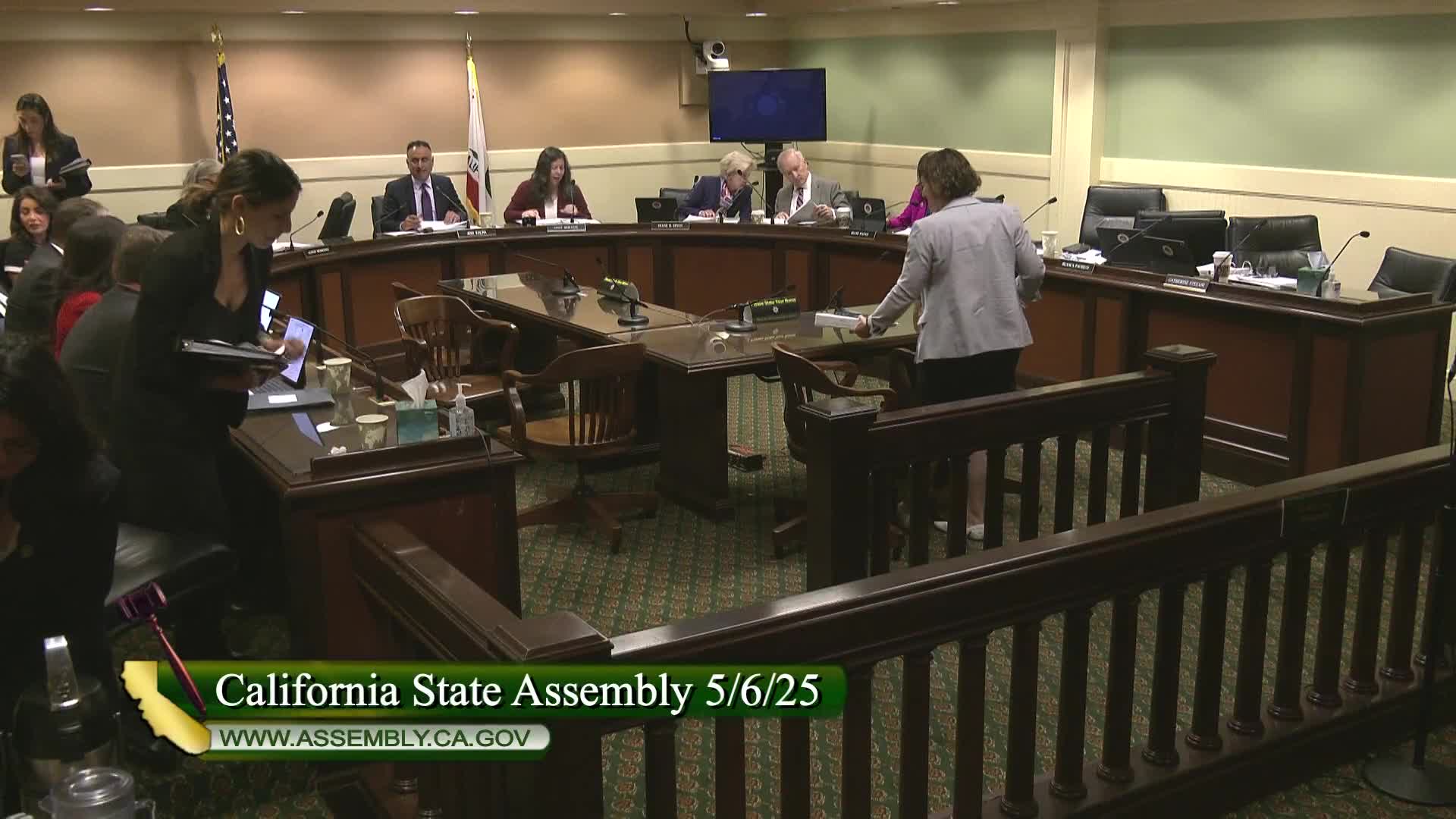
The Assembly Judiciary Committee moved forward AB 412, the AI Copyright Transparency Act, which would create a state process for copyright holders to learn whether copyrighted works were used as training data for generative AI models.
Assemblymember Rebecca Bauer-Kahan, the bill’s author, framed the measure as a narrow tool to give creators the information they need to pursue their rights: “...what are long held rights that we believe Californians have and how are those changing in the face of this modern technology,” she said (8362.06–8429.295).
Voice actors, authors, concept artists and other creators gave extensive testimony in support, saying they lack visibility into whether their work trained commercial models. Tim Friedlander, president of the National Association of Voice Actors, said AB 412 “gives copyright holders the right to know if the materials, if their materials, have been used to train generative AI models” (8525.431–8565.18). IP attorney Travis Manfredi told the committee that without a way to identify training use at the outset, many claims are dismissed before discovery: “If a rights holder cannot show at the outset that their work was included in the training data, their claim will be dismissed before any discovery can be taken,” he testified (8711.025–8762.42).
Opposition from industry groups focused on federal preemption and trade-secret concerns. The California Chamber of Commerce and technology trade associations argued that federal copyright law and ongoing litigation make the issue inappropriate for state-level legislation. Several witnesses urged the Legislature to wait for a forthcoming U.S. Copyright Office report and for court decisions in major fairness-use litigation before adopting a disclosure regime (9041.62–9170.445).
The author accepted committee amendments carving out noncommercial academic research and clarifying certain compliance timelines; those amendments prompted additional discussion from rights-holders and the recording industry, which asked the author to revisit an academic exemption that could be exploited (9396.971–9489.53).
Outcome and next steps: After extended testimony from creators and industry opponents, the committee advanced AB 412 as amended. The author and stakeholders indicated they will continue negotiations in subsequent committees on narrow points, including the academic exemption and potential preemption issues.
Why it matters: The bill aims to give creators a practical mechanism to learn whether their copyrighted works were used to train commercial generative models so they can evaluate potential legal claims or seek licensing. Opponents argue it may be preempted by federal law or reveal trade secrets.
Proponents and opponents are likely to continue discussions as the bill proceeds. The committee vote sent AB 412 to the next step with amendments and further stakeholder work.