Get AI Briefings, Transcripts & Alerts on Local & National Government Meetings — Forever.
Assembly committee advances bill to ban 'surveillance pricing' after lengthy debate
Loading...
Summary
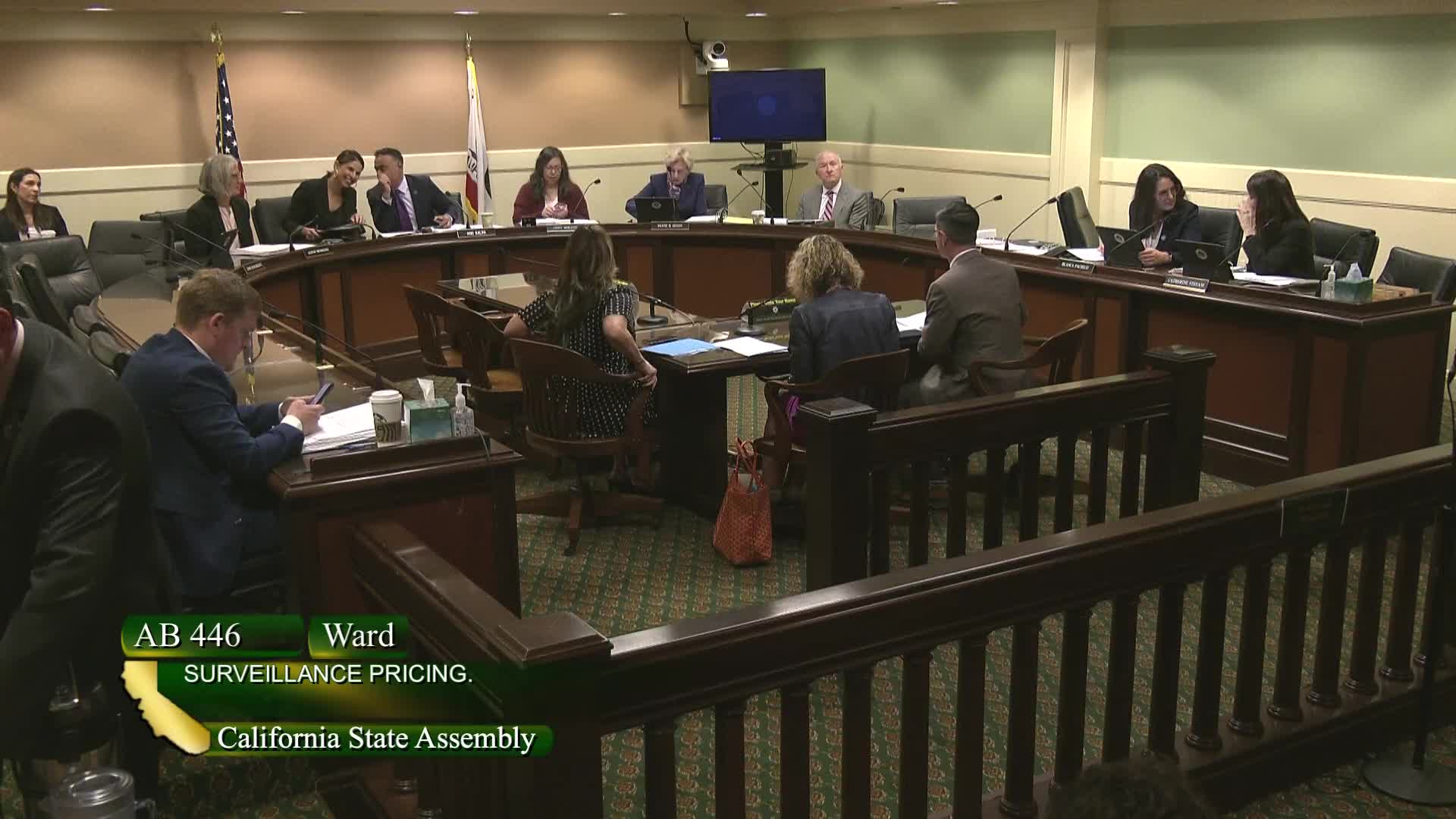
The Assembly Judiciary Committee advanced AB 446, the Surveillance Pricing Protection Act, after a lengthy hearing that split consumer and labor advocates, who called the measure necessary, from businesses and trade groups, who warned it is overly broad and could trigger litigation.
The Assembly Judiciary Committee on a voice vote advanced AB 446, the Surveillance Pricing Protection Act, which would prohibit businesses from using individualized surveillance-derived personal data to charge different prices for the same product or service.
The bill’s author, Assemblymember Jesse Ward, said the measure addresses “predatory” uses of technology that allow retailers and other businesses to raise prices for specific customers: “This is about ensuring fairness in pricing. It’s not just about economic justice. It’s about preventing a new form of digital exploitation,” Ward said during his presentation (remarks at 2929.8–3095.16 in transcript).
Consumer and labor witnesses framed the bill as a response to public reporting and company pilots that use geolocation, facial recognition and other profiling to customize pricing. Kim Stone of Consumer Watchdog, a cosponsor, told the panel, “If we don’t stop this, we’re not going to put this genie back in the bottle,” and cited examples in travel and retail pricing studies (3096.28–3140.57).
Supporters said the text includes explicit exceptions for common and accepted discounts — loyalty programs, promotional offers and price differences offered for defined groups such as veterans or students — and excludes insurance and credit pricing rules. Kristen Heidelbach of UFCW described retailers’ adoption of electronic price displays and facial analytics as a present reality that can be used to extract higher prices from shoppers (3220.23–3310.835).
Opponents, including the California Chamber of Commerce, the California Retailers Association and multiple trade groups, said the bill’s language was overly broad and risked unintended litigation. Chamber representative Robert Muthrie said the bill initially reached beyond “personal data” and could sweep in aggregate decisions and routine discounts; he warned that the private right of action in the draft could produce costly defense litigation (3395.115–3521.8).
Committee members pressed about enforcement options and the private right of action. Ward said the Legislature could explore parallel enforcement by public prosecutors or the attorney general but maintained that a private right of action helps an injured consumer recover and deters abuse (3760.2449–3824.2). Assemblymember Hari Bedi and others suggested a state enforcement alternative or a claims fund as a middle ground; Ward agreed to keep negotiating with stakeholders (4218.62–4258.9097).
Committee discussion also focused on how to protect legitimate discounts and inventory-based pricing while preventing “inflated” pre-discount prices used to disguise discriminatory targeting. Ward stressed that the bill’s goal is to stop technology-driven segregation of customers that treats similarly situated shoppers differently on the basis of surveilled characteristics (4409.405–4431.105).
Outcome and next steps: Committee members moved the bill forward; the author and stakeholders agreed to continue negotiations on the bill’s details, including the scope of exemptions, the private right of action and carve-outs for academic or noncommercial uses. The committee report and roll call show the measure was passed out of committee for the next house committee or fiscal review.
Why it matters: The bill would create a state-level guardrail against targeted pricing using biometric or behavioral surveillance, a practice supporters say disproportionately harms lower-income shoppers. Opponents contend the draft as written could chill legitimate marketing and require costly litigation to resolve ambiguities.
Votes and procedure: The committee recorded a motion and roll-call sequence and advanced the bill as amended; sponsors and opponents left open further negotiations on technical exemptions and enforcement mechanisms.