Get Full Government Meeting Transcripts, Videos, & Alerts Forever!
Get email alerts on the Redevelopment 255 Rockville Pike topic
No spam. Unsubscribe anytime.
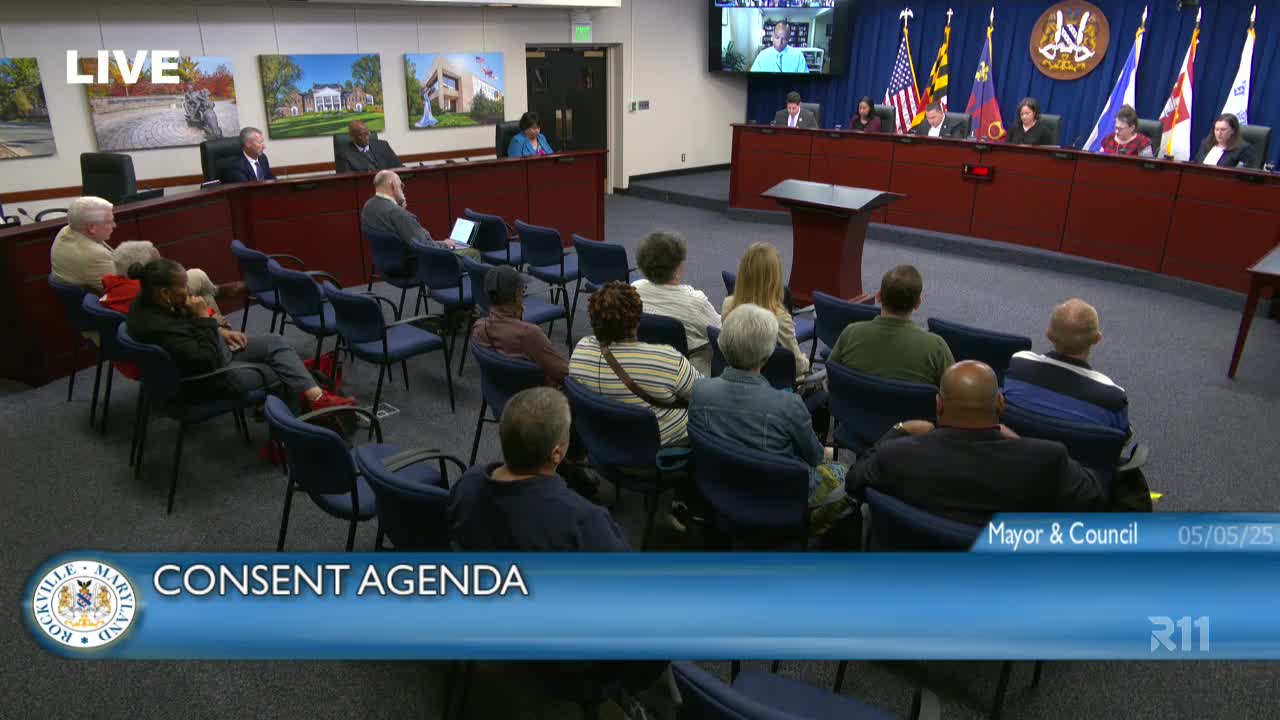
Developer briefs Rockville leaders on flexible plan for 255 Rockville Pike — up to 550 units or large retail reuse
Summary
A developer presented a project‑plan amendment on May 5 seeking flexibility to convert 255 Rockville Pike — a 2.5‑acre, long‑vacant office building in Rockville Town Center — into either phased multifamily housing (roughly 300–550 units) or an adaptive reuse for substantial retail/commercial uses.
A developer representing ownership of 255 Rockville Pike presented a project-plan amendment to the Rockville Mayor and Council on May 5 seeking flexibility to convert the former office building into either multifamily housing (up to about 550 dwelling units in two phases) or a large adaptive-reuse retail/commercial configuration.
The property, 255 Rockville Pike, is roughly 2.5 acres in Rockville Town Center and is zoned PDRCI (Plan Development Rockville Center, Inc.), with an equivalent base zone of MXTD under the town center plan. Principal Planner Kimia Zolfagarian told the council the application is a preliminary briefing and requested direction and feedback before the formal review and public hearings that follow Planning Commission review.
Bob Elliott, representing the owner, said the firm bought the long‑vacant former county permitting building at auction in March 2024 and is pursuing two delivery paths: a residential scheme that would remove two office levels, reuse three parking levels (about 440 spaces) and add five stories of wood‑frame housing for an initial phase of roughly 300 units, with a possible second-phase tower to add roughly 250 more units; or an adaptive reuse of the existing structure to allow substantially more commercial/retail area than the previously approved 40,000 square feet (the applicant cited up to about 160,000 square feet as a conceptual alternative).
“The building has been dark for years,” Elliott said. “Something needs to happen, and sooner is better. Our strong preference is residential, but market and financing conditions require flexibility.”
Staff and council members pressed for specifics the applicant does not yet have: financing plans, the likely retail trip‑generation profile if the reuse option is chosen, and whether local, county or state programs could help bridge the financing gap that makes the taller, phased residential option uncertain. Council member Valeri asked whether staff and the applicant had explored state or county programs. Elliott said he was not aware of city‑level subsidy programs but noted county pilots and tax‑increment ideas that other jurisdictions are considering; council and staff asked the city manager and planning staff to scan available programs that might accelerate adaptive reuse or redevelopment.
Council members and staff discussed transportation and stormwater coordination with Montgomery County and the State Highway Administration. Staff and the applicant said they are coordinating with county planners on future Bus Rapid Transit (BRT) station planning along Rockville Pike; the county has asked for significant stormwater capacity on or adjacent to the site. The applicant showed a concept that would shift a handful of roadway lanes to widen the sidewalk and add a traffic circle to accommodate a stormwater facility and safer fire apparatus access. Council members asked staff to convene city, county and state participants to resolve station siting, stormwater and sidewalk cross‑sections early in the review.
Council members also asked about school impacts and the traditional student‑generation analysis for new housing. Dr. Miles asked how student counts are generated; staff said they use standard municipal school‑planning generation factors and would provide the methodology during the site‑plan review.
Timeline and process: the city’s planner said the pre‑application was filed December 20, 2024; the formal project‑plan amendment and concurrent Level 2 site plan were filed March 7, 2025; the Planning Commission received a briefing April 9; the applicant’s development‑review committee (DRC) met April 24. Staff said the application review and planning‑commission recommendation would proceed through public hearings and a mayor-and‑council decision later in 2025.
No binding decision or vote took place at the briefing. The council encouraged the applicant and staff to continue coordination with county and state partners on BRT, stormwater and right‑of‑way, to scan state and county financing and incentive programs that could make residential redevelopment viable, and to keep the council informed as the project nears formal hearings.
Ending: The applicant indicated intent to continue marketing both residential and retail options and return to the council with more detailed site‑plan materials and traffic, stormwater and financing analyses during the formal review process.