Get Full Government Meeting Transcripts, Videos, & Alerts Forever!
Get email alerts on the Workforce Development topic
No spam. Unsubscribe anytime.
Prosper Portland warns proposed budget cuts would shrink workforce services; contractors raise COEP payout concerns
Summary
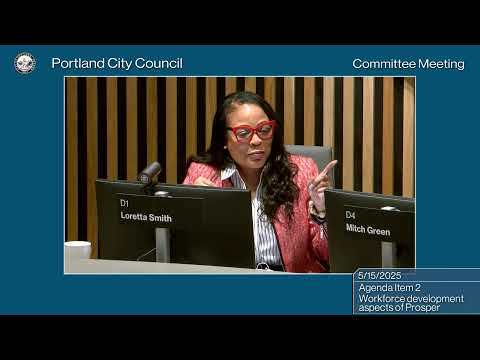
At a Portland City Council Labor and Workforce Development Committee meeting, Prosper Portland staff and their partner WorkSystems Inc. told councilors that proposed general fund cuts and related funding shifts in the mayor’s proposed budget would reduce workforce-development services and risk losing federal matching dollars.
At a Portland City Council Labor and Workforce Development Committee meeting, Prosper Portland staff and their partner WorkSystems Inc. told councilors that proposed general fund cuts and related funding shifts in the mayor’s proposed budget would reduce workforce-development services and risk losing federal matching dollars.
The presentation — led by Andrew Fitzpatrick, interim economic development director at Prosper Portland, with program details from Amy Fleck Rossetti, Robert Smith and Patrick Gehring of WorkSystems — described four Prosper-funded workforce programs, current outcomes and how a proposed $200,000 general-fund reduction for fiscal 2025–26 would ripple through other funding and reduce service capacity.
Why this matters: Committee members were shown program enrollment and outcome data that the agencies said depend on a combination of city general fund, Community Development Block Grant (CDBG) allocations and federal matches. Prosper and WorkSystems warned that cuts to the city general fund would reduce the federal match and result in fewer people served, lower program leverage and interruptions to supports such as paid internships, training scholarships and short-term housing and childcare assistance that help participants complete multi-month training.
Prosper’s presentation and outcomes
Andrew Fitzpatrick said Prosper administers four workforce programs for low- and moderate-income Portlanders: the Economic Opportunity Program (EOP) for adults, NextGen for youth, the district-based Community Workforce Navigator program, and the Community Opportunities and Enhancements Program (COEP).
Amy Fleck Rossetti said the EOP served 686 participants in fiscal 2023–24, with more than 80 percent gaining employment and an average wage increase of about 16 percent for completers. She said NextGen assisted 491 youth in 2023–24; 72 percent identified as people of color and about half as women. The Community Workforce Navigator program has served more than 500 individuals this fiscal year to date, with 147 securing employment, Prosper staff reported.
Patrick Gehring of WorkSystems described how city funds are used to unlock federal matching dollars. He said the immediate impact of the proposed city funding reduction would be 45 fewer Portlanders served in NextGen and EOP combined. “The most direct impact of the loss of city funds is 45 fewer people served through this program,” Gehring said, adding that Prosper and WorkSystems use a “braided funding” approach in which city general fund and CDBG dollars help generate about $480,000 in federal matching funds from a U.S. Department of Agriculture program (described in the presentation as a 50¢-on-the-dollar match).
CDBG restrictions and multiplier effect
Prosper staff warned that CDBG carries an administrative cap and that when that cap is reached providers cannot charge certain end-of-year management costs to CDBG. That dynamic, staff said, means city general fund dollars are required to “unlock” CDBG and federal match; Prosper’s materials estimated roughly each city dollar enables about $3 in additional program funding under current arrangements.
COEP and contractor complaints
Councilors raised a separate, but related, concern about the Community Opportunities and Enhancements Program (COEP). Robert Smith of Prosper explained that COEP is funded largely by a 1 percent set‑aside of hard construction costs on certain bureau capital projects and that the program was established by an intergovernmental agreement (IGA), code adoption and administrative rules. He said COEP has been operating under a multi‑phase pilot and that a legal petition and subsequent ratepayer decision changed eligibility and released additional dollars after amendments to the IGA.
Councilor Loretta Smith and others pressed Prosper for specifics after contractors contacted council offices saying they had not received expected COEP funds from a past project. Councilor Smith asked directly whether Prosper had returned “the $8,500,000” referenced by contractors; Prosper staff said there is confusion in the community about the program’s intent and that COEP investments are aimed primarily at pipeline and capacity building rather than project‑level payouts. Councilor Smith said some small contractors “want the money for the project that’s happening right now, not future projects,” and insisted the issue be resolved before budget votes.
Prosper’s response and follow-up commitments
Prosper staff told the committee they believe current COEP operations comply with the IGA and related code, but they acknowledged the reported confusion and agreed to follow up. Robert Smith said Prosper had prepared a memo answering some of the community questions and promised to provide that document to Councilor Smith and Vice Chair Mitch Green and to the committee. Prosper also offered to meet offline with affected contractors to try to “make them whole in alignment with the law,” but clarified the distinction between project‑specific payouts and pipeline development investments required by the program rules.
Councilor questions on the Strategic Investment Fund (SIF)
Council members pressed Prosper about use of Prosper’s Strategic Investment Fund (SIF) and whether SIF or other non‑general‑fund sources could replace general fund support for workforce programs. Prosper staff said SIF is intended as part of a longer-term financial sustainability plan for the agency and that SIF resources are finite and not a direct substitute for ongoing general fund support. Councilors sought historical and forecasted SIF figures and asked whether using SIF to backfill ongoing general fund needs would be sustainable.
Other council actions and committee business
Early in the meeting the committee approved five sets of committee minutes by unanimous vote. The committee also received a separate notification from Chair Loretta Smith about multiple electronic versions of the mayor’s proposed budget being in circulation and asked the mayor’s office and Prosper to confirm which version is authoritative.
What councilors asked Prosper to provide
Multiple councilors requested follow-up materials from Prosper Portland: a written legal and compliance analysis of COEP operations and the IGA, copies of the memo Prosper said it had already prepared, and a forecast of SIF inflows and assumptions underpinning Prosper’s five‑year projections. Councilors also asked staff to clarify whether TIF or district‑specific TIF resources could be used for particular workforce or small‑business supports in district areas.
Outlook
Prosper Portland and WorkSystems told the committee they will deliver additional documentation and meet with council members and community partners to clarify COEP distributions and the budget assumptions that drive federal matching eligibility. Councilors signaled they want those clarifications in hand before making final budget decisions.
Votes at a glance
- Motion: Adopt five sets of Labor and Workforce Development Committee minutes from earlier meetings (motion text: “motion to adopt all 5 sets of minutes for our committee meetings held since February”). Outcome: approved by unanimous vote during the meeting. (Roll call recorded Councilor Kunal present; Councilor Steve Novick aye; Councilor Mitch Green yes; Councilor Jamie Dunphy yes; Councilor Loretta Smith yes.)
Ending
Committee Chair Councilor Loretta Smith closed the session after directing Prosper Portland and WorkSystems to provide the requested memos and data. Several councilors said they plan to continue scrutinizing the mayor’s proposed budget and Prosper’s projections as the council moves toward final decisions.