Get Full Government Meeting Transcripts, Videos, & Alerts Forever!
Get email alerts on the Early Intervention System topic
No spam. Unsubscribe anytime.
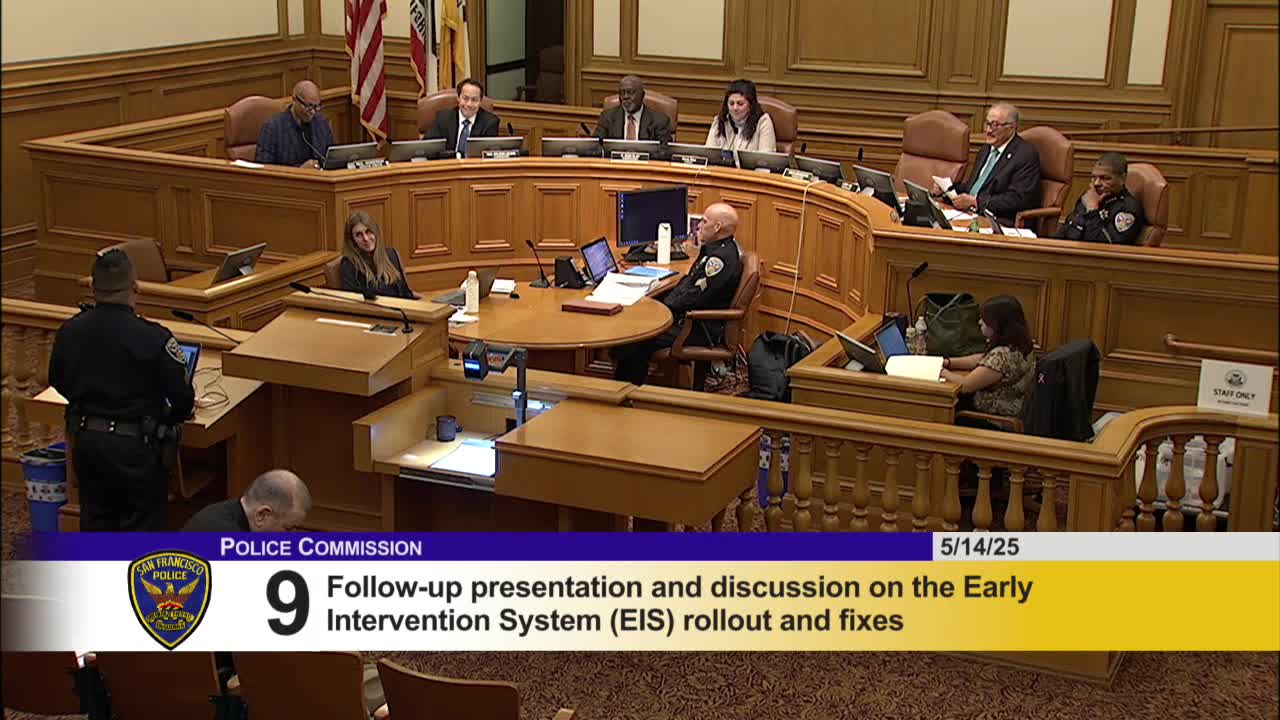
SFPD details early intervention system rollout; data gaps and vendor issues delayed automated alerts
Summary
SFPD staff described delays in automating Early Intervention System alerts after moving data sources and said the department temporarily generated alerts manually while addressing data corruption and support ticket backlogs with vendor Benchmark.
A member of SFPD's Early Intervention System (EIS) unit told the commission the department has faced data and vendor problems while transitioning from a threshold-based system to Benchmark's statistical-alert model.
Sergeant Darren (Early Intervention System unit) said the unit reverted to manually generating alerts by combining use-of-force data from the crime data warehouse and other systems because an automated pipeline could not be completed in time. For the fourth quarter of 2024, the department recorded 575 indicator points and generated 172 EIS alerts affecting 129 members; 90 members generated one alert, 35 generated two, and four generated three.
The presentation described a multi-year migration that began in October 2021. SFPD moved use-of-force data sources, which required Benchmark to remap inputs after the department changed systems. The unit reported data corruption and missing records during the transition; staff restored data from backups and validated it with legal and analyst staff.
SFPD also used Benchmark for stop-data reporting, which shifted vendor priorities and delayed EIS work. The department later began collecting use-of-force reports directly in Benchmark; pilot sites at two stations started in September and were described as successful. But the unit reported about 90 support tickets with Benchmark (some taking up to 28 business days or months to resolve), and said earlier vendor staff reductions removed institutional knowledge needed to map legacy data sources.
Sergeant Darren told commissioners the department's principal data analyst estimated roughly a year's worth of clean data would be needed to provide an accurate picture after the transition. Commissioners urged ongoing updates and noted the importance of reliable EIS data for early intervention work.
No formal decisions were made at the meeting; staff said the work continues and that systems and pipelines are under active remediation.