Get Full Government Meeting Transcripts, Videos, & Alerts Forever!
Get email alerts on the Town Manager Act Review topic
No spam. Unsubscribe anytime.
Danvers review committee finalizes recommended changes to Town Meeting and Town Manager acts
Summary
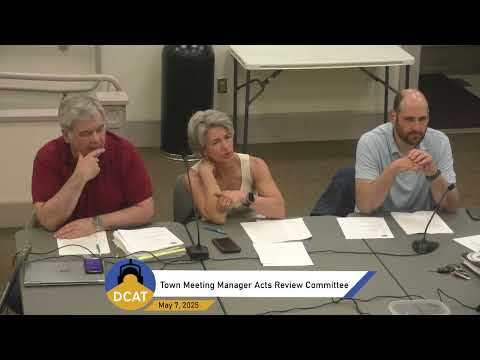
The Town Manager Acts Review Committee of the Town of Danvers met Wednesday, May 7, and approved a set of recommended edits to its draft report on changes to the Town Meeting Act and the Town Manager Act and agreed to forward the report to the town moderator and the select board for consideration.
The Town Manager Acts Review Committee of the Town of Danvers met Wednesday, May 7, and approved a set of recommended edits to its draft report on changes to the Town Meeting Act and the Town Manager Act and agreed to forward the report to the town moderator and the select board for consideration.
The committee’s revisions clarified that its work consists of recommendations to the select board and town meeting rather than enactments the committee itself is adopting. Committee members discussed and refined language across both acts, focusing on three substantive items the draft highlights: adding a recall provision, allowing the select board to have the town accountant appointed by the town manager, and removing or revising the residency requirement for the town manager.
Why it matters: The committee’s recommendations would change how Town Meeting and the select board interact with the town manager’s office, alter certain procedural requirements for candidates and town meeting members, and add or revise formal recall language. Those changes would require action by the select board and, where appropriate, town meeting before becoming effective.
Most of the meeting consisted of line-by-line review of the committee’s redline draft. The committee approved numerous wording edits (for example, changing repeated uses of “districts” to “precincts” where appropriate), added clarifying language about how minutes and supporting materials will be archived, and refined the document’s tone to emphasize that the report represents the committee’s recommendations rather than enacted policy.
On substantive policy points, the committee agreed to recommend that: - The monetary cap for select board investigations in the acts (previously stated as a static $10,000) should be replaced with a budget-indexed figure equal to 0.02% of that year’s annual town budget. The draft contains the committee’s calculation for the current year (noted in the draft as "28 8" in the transcript); the committee instructed staff to confirm and present the precise dollar figure in the final package. - Incumbent town meeting members should follow the same nomination-paper requirement as other candidates (the draft keeps the signature requirement low—10 signatures—while removing an administrative exception for incumbents). Committee members discussed tensions between encouraging participation and increasing competitiveness; the report frames the requirement as equal treatment rather than a barrier to entry. - The report will recommend formal precinct forums early in the year (the committee settled on a February timing window rather than singling out holidays) so precinct feedback can inform the annual budget and warrant development. - The draft clarifies expectations around the town manager’s presence and engagement: language removes a COVID-specific justification for remote work and instead emphasizes that the manager must be informed, involved and physically present as required to perform duties and respond to emergencies. The committee retained discretion for the select board to act if the manager were not sufficiently engaged. - On recall: the committee debated phrasing that governs grounds and process for recall petitions. The committee opted to make the recall language permissive to petitioners (the town clerk will not act as a substantive gatekeeper); petition signature counts and certification by registrars of voters remain part of the process. The committee asked staff to tighten the sentence structure so it clearly reflects that the electorate ultimately determines sufficiency of grounds through the voting process.
Committee members also discussed process-oriented items: updating the town meeting guide (dated 2002), offering an informational presentation or “town meeting school” for new members, providing childcare at trainings to increase access, and archiving submitted materials (emails and written statements) with the committee’s records rather than appending all items to a single meeting’s minutes.
The committee voted at several points to accept sections of the draft. Formal motions recorded during the meeting included accepting the April 16 minutes, accepting the agreed edits to the introductory section of the report, approving the framework of changes to the Town Meeting Act section, and approving the framework of changes to the Town Manager Act section. The committee chair said she would circulate an updated, redlined-to-clean version of the draft before the next meeting and would email the package to the town moderator, all select board members and the new town manager.
The committee agreed to be prepared to present the draft to the select board and, if requested, to appear at any subsequent finance committee or special town meeting proceedings where the recommendations are reviewed. The chair said she expects to represent the group for initial presentations but asked that as many members as possible attend review meetings to provide additional background and answer detailed questions.
The committee set a follow-up meeting for the next week to consider any further edits from members who were absent at Wednesday’s meeting and to finalize the packet for distribution.