Get Full Government Meeting Transcripts, Videos, & Alerts Forever!
Get email alerts on the Homelessness Camping Ordinance topic
No spam. Unsubscribe anytime.
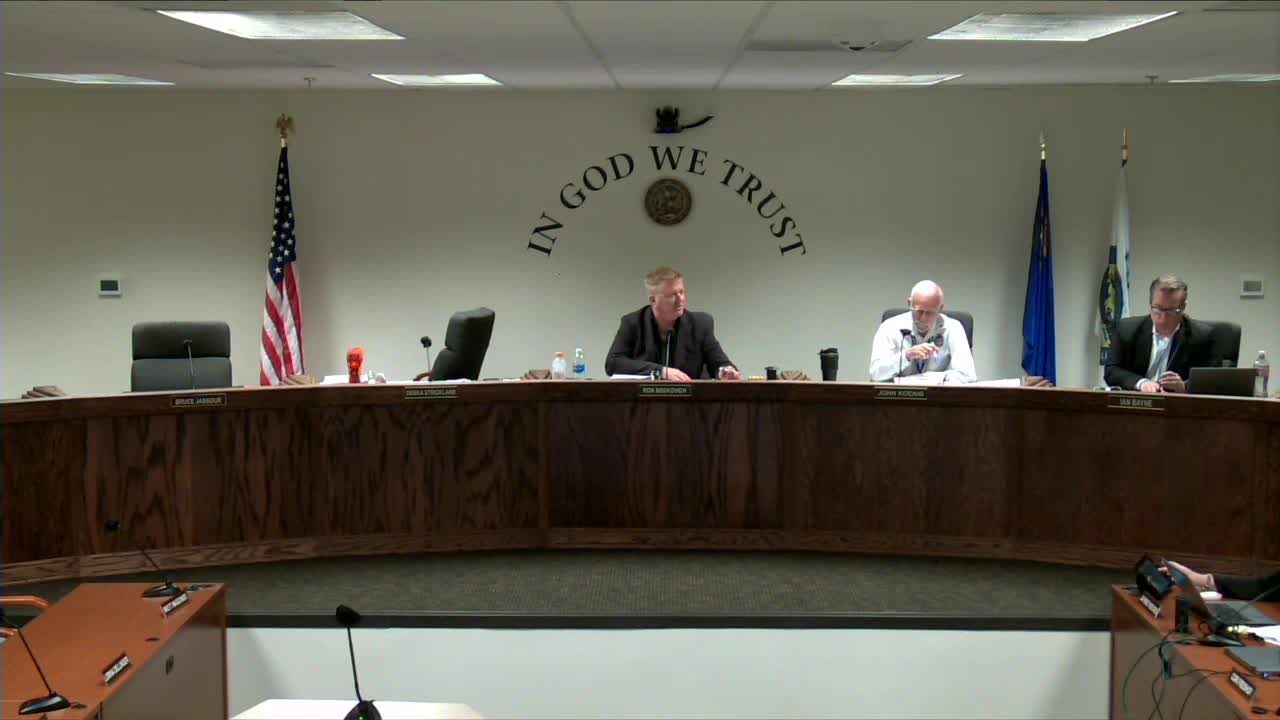
Nye County commissioners adopt Pahrump ordinance restricting camping in public places after heated public comment
Summary
The Nye County Board acting as governing body for the unincorporated Town of Pahrump adopted Ordinance (Pahrump Bill 2025‑01) to prohibit camping and storage of personal property in public places, with amendments clarifying enforcement, timing and which local body issues special-event permits.
The Nye County Board of County Commissioners acting as the governing body of the unincorporated Town of Pahrump voted 5‑0 on May 6 to adopt Pahrump Bill 2025‑01, an ordinance that bans camping and placing personal property in public places, and establishes enforcement procedures and penalties. The board approved the ordinance after several edits requested during debate and extensive public comment from residents for and against the measure.
Supporters on the dais said the measure is intended to give law enforcement a clear tool to remove tents, encampments and other personal property that obstructs sidewalks, public rights of way or public buildings. Commissioner Ian Bain (speaking for the item on the record) said the ordinance is part of “our overall effort to stop homeless crime” and to allow municipal crews to clean up camp sites and garbage in public areas.
Opponents and several public commenters urged a different approach. Multiple speakers said the county should invest more in outreach, housing supports and services before using punitive enforcement. Public commenters who identified themselves as advocates, service providers and residents described concerns about veterans, people with mental- health needs, and the difficulty people experiencing homelessness have finding shelter or services in Pahrump. Commenters asked the county to expand outreach, coordinate with Health & Human Services and community providers, and to publish clearer guidance about permitted camping sites and available services.
What the ordinance does and how it was changed The adopted text (titled “Camping, lodging and similar activities”) creates definitions for “temporary shelter,” “personal property,” and a list of prohibited conduct that includes camping, sleeping or storing personal property in public places and obstructing sidewalks. The board approved the ordinance with four principal edits made on the floor: - Enforcement timing: The board removed a 24‑hour vacate window and directed that an officer "direct the person engaged in the prohibited conduct that they must vacate the location immediately." Commissioners and the district attorney’s office discussed the need for precise language so an officer could identify a violation. - Enforcement authority: The board narrowed the list of "authorized officers" in the ordinance so that the term primarily references peace officers (other positions named in earlier drafts were removed from the definition). The board also deleted a subsection (25.5 A.3 in the draft) that had raised legal clarity concerns about who could arrest or cite people. - Local permit authority: The definition of “board” was adjusted to clarify which local body issues special-event permits that allow temporary camping (the ordinance now identifies the appropriate governing body, e.g., the Nye County Board of County Commissioners acting as the governing body for the unincorporated town of Pahrump, for permits within the town). The DA’s office agreed to a final wording that refers to the applicable local governing body when a permit is required. - Minor editorial fixes: Redundant words (for example, duplicated uses of “tarps” in the definition of temporary shelter) were removed.
During debate commissioners emphasized differing goals: some framed the change as a public‑safety and quality‑of‑life measure to clear encampments and reduce obstruction; others pressed for clearer outreach, stronger social services, and caution about criminalizing homelessness. The district attorney and commissioners worked on-the-spot to tighten language so the ordinance would be enforceable and would not create unintended authority for non‑peace‑officer staff to make arrests.
Votes and next steps The motion to adopt the ordinance as amended passed unanimously, 5‑0. The board directed staff and the district attorney to finalize the ordinance language with the agreed changes and prepare the final ordinance for adoption language to be published in the record. The board also discussed coordinating the ordinance’s rollout with Health & Human Services and law‑enforcement outreach so that public notice and resources are available when enforcement begins.
Public reaction and context Public comment at the meeting was extensive and divided. Several residents and service providers asked the county to increase outreach, cite specific service referrals (including 2‑1‑1 and local nonprofits), and ensure any enforcement is accompanied by offers of services. Other residents urged stricter enforcement of public camping, saying safety and sidewalk obstruction are pressing problems in Pahrump. Commissioners repeatedly noted the county’s limited resources and legal constraints, and several said the ordinance is one tool in a broader community response.
The ordinance codifies a local approach that the board said is permitted under U.S. Supreme Court precedent cited by staff and modeled in part on a Clark County code. The board’s action does not itself appropriate new funds for outreach or shelter; commissioners discussed funding needs separately during the meeting’s budget and departmental items.