Get Full Government Meeting Transcripts, Videos, & Alerts Forever!
Get email alerts on the Groundwater Adjudication Ab 1413 Ab 1466 topic
No spam. Unsubscribe anytime.
Kern supervisors hear competing views on bills aimed at limiting groundwater litigation; support motion fails
Summary
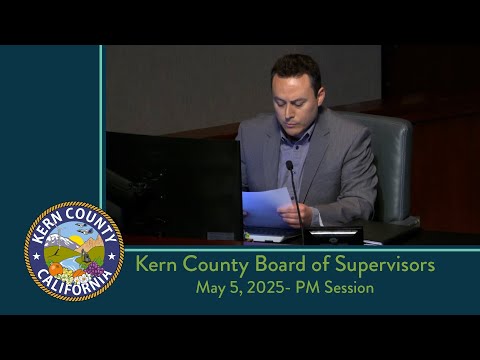
The Kern County Board of Supervisors devoted the May 5 special meeting to two state bills — AB 1413 and AB 1466 — that would change how California courts treat locally adopted groundwater sustainability plans during adjudications.
The Kern County Board of Supervisors devoted the May 5 special meeting to two state bills — AB 1413 and AB 1466 — that would change how California courts treat locally adopted groundwater sustainability plans during adjudications.
Supervisor Pete Peters, who sponsored a referral for the discussion, said the measures “simply closed the loopholes on established process that makes SGMA and groundwater adjudications work together,” and moved that the board adopt a position of support for the bills. The motion received no second and therefore failed.
The bills, both described by county staff as seeking to clarify how courts should weigh Sustainable Groundwater Management Act (SGMA) plans during adjudications, drew sharply divided public comment. Supporters from Ridgecrest and the Indian Wells Valley Groundwater Authority said the measures would protect community plans and limit expensive, protracted lawsuits in which well‑funded parties can shift costs to local ratepayers.
Scott Heyman, Ridgecrest city council member and chair of the Indian Wells Valley Groundwater Authority, asked the board: “Do you want everyone in Kern County to go through what we are going through?” He and other proponents described local litigation that they say has cost millions and raised local water rates.
Opponents drew a starkly different picture. Dr. Baines, who identified herself in remarks as an assemblymember, warned that AB 1413 would “force the courts to accept a GSA sustainable yield determination” and said the bills risked taking adjudications away from courts: “If AB 14 13 becomes law, we're saying that an unelected local agency can steal your property, and the courts are barred from even asking why.”
Representatives of farming interests, including the Kern County Farm Bureau and large growers, urged the board to oppose the bills unless amended. Rachel Nettleton, executive director of the Kern County Farm Bureau, said AB 1413 and AB 1466 “undermine due process, weaken judicial oversight, and put our local water users at risk.” Several large farm and business representatives said the proposals would limit the courts’ ability to test technical evidence.
County staff and outside counsel presented the bills’ stated intent to prevent duplicative litigation and to ensure courts defer to locally vetted sustainable‑yield findings when appropriate. Thomas Brown, the county’s chief legislative affairs officer, summarized the bills as trying to “ensure that groundwater plans are respected in legal disputes to save time, money, and help to protect California’s water resources.” Litigation counsel for local water agencies and several speakers said the bills would instead reduce judicial review and place new burdens on GSAs.
Speakers also debated technical facts and local planning choices. Commentators cited: the Indian Wells Valley GSP sustainable yield figure repeatedly noted as 7,650 acre‑feet; an estimated $14 million that Ridgecrest‑area ratepayers had been charged toward pipeline planning or litigation according to some speakers; statements that only 5 of California’s roughly 93 GSP basins are in adjudication; and a proposed amendment in AB 1466 to create an expedited form for very small pumpers (described in testimony as 5 acre‑feet or less per year).
After public comment and board discussion, Supervisor Peters moved that the board support AB 1413 and AB 1466. The motion received no second and therefore died for lack of a second. The board did not adopt a formal position on the bills at the May 5 meeting.
Votes at a glance - Motion by Supervisor Pete Peters to support AB 1413 and AB 1466: motion failed (died for lack of second). - Separately, the board continued (tabled) a different item (Item 3, a proposed agreement related to Indian Wells Valley) to the May 13 regular meeting; that continuance was moved by Supervisor Peters and seconded by Supervisor Jeff Flores and was approved.
The board’s discussion reflected sharply divided local interests — municipal officials and the Indian Wells Valley Groundwater Authority urged support for the bills as a way to preserve local plans and avoid costly litigation, while farm groups, several GSAs, and water‑rights attorneys warned the measures would curtail judicial review and due process. Board members voiced concern about state‑level fixes that could have broad, unintended consequences for varied basins across Kern County and California.
The board did not adopt a position during the special meeting. The item may return to a future agenda if supervisors or staff bring the request back for a formal vote.