
Criminal Justice Information Authority describes InfoNet’s creation, governance and uses for Illinois victim services
Get AI-powered insights, summaries, and transcripts
Sign Up Free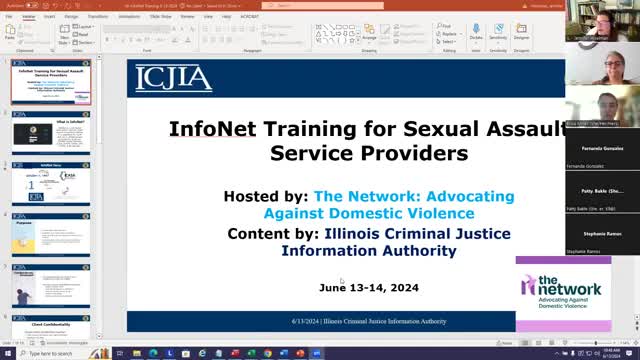
Summary
A Criminal Justice Information Authority staff member outlined InfoNet’s origins in the mid-1990s, its governance with partner funders, data-ownership rules, confidentiality safeguards and how providers and funders use the system for reporting and planning.
A staff member of the Criminal Justice Information Authority, Illinois, told attendees that InfoNet is an online data system created more than 25 years ago to standardize reporting by victim service providers across Illinois and to support grant administration.
The staff member said InfoNet was built collaboratively by the authority and partner funders — including the Illinois Coalition Against Sexual Assault (ICASA), the Illinois Coalition Against Domestic Violence (ICADV), the Illinois Department of Human Services, the Chicago Department of Family and Support Services and All Chicago (a nonprofit that administers U.S. Department of Housing and Urban Development funds) — and that the first provider began entering clients and services in an October soon after the system’s development.
InfoNet’s creation followed a substantial increase in federal grant funding for victim services in the mid-1990s, the staff member said, citing the then-recent Violence Against Women Act (VAWA) and longstanding Victims of Crime Act (VOCA) funding, which comes from the federal Crime Victims Fund. The staff member said the growth and fluctuation of those funds motivated a standardized statewide data system so the authority and providers could plan and report more consistently.
"It is an online data system. It's used by over 100 victim service providers throughout Illinois, and it's supported and maintained by our agency here at ICJA," the staff member said. They described a multi-year planning process in which provider directors and coalition representatives met monthly to define required fields, service categories, ownership and access rules and technical needs, including adapting the system to the early internet. "We wanted to build a system that could be used to comply with multiple funder requirements without having to redo counts for similar data," they said.
The staff member described InfoNet’s four primary purposes as: standardizing data collection statewide, creating a central data repository, reducing duplicate reporting to multiple funders and producing useful data for both funders and providers. They said providers retain ownership of the data they enter and that user agreements specify how the Criminal Justice Information Authority may use those data.
On confidentiality, the presenter said InfoNet does not store personally identifying information: "We never enter any personally identifying information. Every client has its unique identifier. We don't enter names, no addresses. We don't even enter date of birth. It's age at first contact." They added that the authority may use data in aggregate for research and planning and can share aggregate results publicly when they combine multiple organizations; requests for organization-level or record-level data require provider approval.
The staff member explained access rules: funders and coalitions may see aggregate organizational-level summaries for grant monitoring; InfoNet administrators (the authority’s InfoNet team) have full access for technical support but do not use identifiable records for research without provider permission. The staff member said client-level data can be used in more detailed research only with provider consent.
The staff member listed ways InfoNet is used: reporting to federal funders, assessing program performance, conducting evaluations, informing statewide victim services planning and guiding local program management. They encouraged providers to use InfoNet voluntarily for local planning, resource allocation and advocacy because local providers have community knowledge that enhances the data’s use.
The staff member summarized the scope of the system’s data and recent usage figures: InfoNet contains demographic and service information about clients and about persons who cause harm when those interactions are entered; it records interactions with police, courts, health and legal systems; and it includes prevention, training, systems advocacy and outreach activities. The presenter gave the following totals as system aggregates: over 1.25 million client records, more than 53,000 prevention services, roughly 2,000,000 non-client crisis intervention contacts, about 2,300,000 community services and nearly 24,000,000 service contacts with survivors. They also said InfoNet currently includes 64 domestic violence programs and 32 crisis centers, with a separate third version for some child advocacy centers.
The staff member said InfoNet data were a major information source for a recent statewide victim services planning process that guides VOCA and VAWA grant decisions for four-year funding cycles and that another strategic planning phase is expected to start next year. They noted ongoing work to update language in the system and emphasized that the system’s definitions and fields evolved from provider input: "When we brought provider directors to the table, they had all these other ideas that they wanted InfoNet to be used for."
The presentation ended with an invitation for questions; no formal actions or votes were taken during the session.