Get Full Government Meeting Transcripts, Videos, & Alerts Forever!
Get email alerts on the Community Projects Cib topic
No spam. Unsubscribe anytime.
Audit committee reviews Wilder Research audit of Saint Paul community project CIB; recommends clearer roles, pre‑application phase
Summary
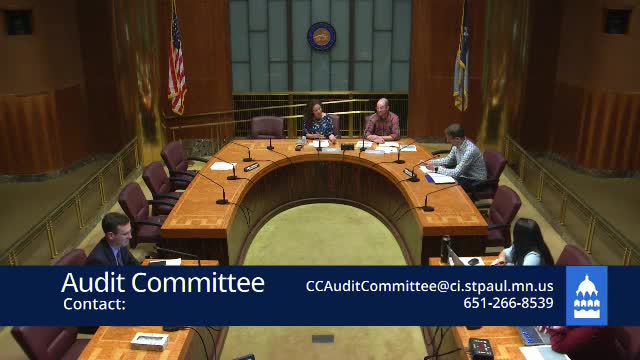
The Saint Paul Audit Committee on an unspecified date reviewed a draft Wilder Research audit of the city’s Community Investment Budget (CIB) community project process and discussed recommendations intended to improve equity, community engagement and transparency.
The Saint Paul Audit Committee on an unspecified date reviewed a draft Wilder Research audit of the city’s Community Investment Budget (CIB) community project process and discussed recommendations intended to improve equity, community engagement and transparency.
Wilder Research presented findings that the CIB community‑project process produces enthusiasm among applicants and committee members but still “feels complex and confusing” for many community applicants, especially those without prior city experience. Dr. Heather Bridal, the Wilder Research presenter, told the committee the consultant team interviewed 17 people, reviewed submitted documents and built an interactive story map of submissions across recent cycles to illustrate gaps and clusters.
The audit found three recurring problems: unclear ownership of community outreach and engagement; an application and timeline that favor repeat applicants or those familiar with city procedures; and inconsistent definitions and operationalization of “equity.” The report recommended clarifying roles and responsibilities among the mayor’s office, the Office of Financial Services (OFS) and CIB committee members; launching a short pre‑application screening phase to improve accessibility and technical assistance; and assigning a clear lead for outreach and communications.
Key findings and recommendations cited by Wilder Research and discussed by committee members included: - Process complexity and timing: Wilder researchers said the most recent cycle’s decision to reopen the proposal period created a “recency effect,” shortening timelines and increasing applicant confusion. Dr. Bridal told the committee OFS provided about “1,072 pieces of feedback” during the project’s development and that the story map pulls data from four cycles (2020–25) to help visualize submissions by ward and district council. - Outreach ownership and supports: Interviewees and the report described no consistently identified accountable office or person for public outreach. Committee members noted volunteers receive a $25 meeting stipend and limited time to function as ambassadors without templates, training or resources. - Equity and data accessibility: The report said equity is interpreted variously as equal ward representation or as need‑based investment, and that data requested in applications are not always accessible or understandable to community applicants. Wilder recommended making data and technical support easier to use and offering targeted assistance to applicants from less‑resourced neighborhoods. - Tools and transparency: Wilder demonstrated a story map that shows submissions, funded projects and neighborhood indicators such as concentrated poverty and safety data. The consultant team recommended the city consider adopting the story map and providing it as part of technical assistance for applicants.
Committee members welcomed the report’s recommendations. Audit Committee member Matt Povratzky, interim Ward 4 council member, called the work “a fantastic way for me to get my feet wet on the audit committee.” Committee members asked Wilder and OFS for draft materials that would allow staff to document the current process and to give the committee and neighborhood groups clearer guidance on outreach expectations.
The committee and Wilder emphasized that some recommendations require additional staff capacity or a conversation about resources. Several committee members and OFS staff said the finance team manages multiple large processes on a two‑year cycle and that any expansion of outreach or technical assistance will require additional resourcing or changes in ownership of tasks.
Direct quotes from the presentation included interview excerpts read by Dr. Bridal: “I felt like I was flying blind,” and “A month is not long enough” to open and close the application period. Committee members also endorsed specific changes; one member said the proposed pre‑application phase is “brilliant” because it could connect community ideas with departmental technical input before a full application.
Committee direction and next steps included a request that committee members and staff return edits and feedback to Wilder Research within one week so Wilder can finalize the report for a planned council presentation in mid‑May. Wilder and OFS plan to continue incorporating feedback into a final report and the story map ahead of that council presentation.
The audit committee discussion also touched on longer‑term ideas Wilder flagged, including a five‑year planning lens for community projects, possible adjustments to CIB program types and a proposal to consolidate or better coordinate community engagement resources across existing city engagement channels.
Wilder Research and OFS will continue to accept edits and produce a final draft for the committee’s review before the firm presents to the full City Council.