SPSA board adopts preliminary tip-fee schedule, advances FY26 budget and authorizes transfers to cover disposal shortfall
Loading...
Summary
The Southeastern Public Service Authority board approved a resolution to publish proposed fee increases and set a May 28 public hearing, advanced a FY26 budget with modest employee increases, and authorized a $1.64 million transfer to cover higher hauling and disposal costs tied to changing municipal and commercial waste volumes.
The Southeastern Public Service Authority Board of Directors on April 23 adopted a preliminary schedule of revised tipping fees, set a public hearing for May 28 and advanced its proposed fiscal year 2026 budget while authorizing a $1,642,400 transfer between budget line items to cover higher hauling and disposal costs.
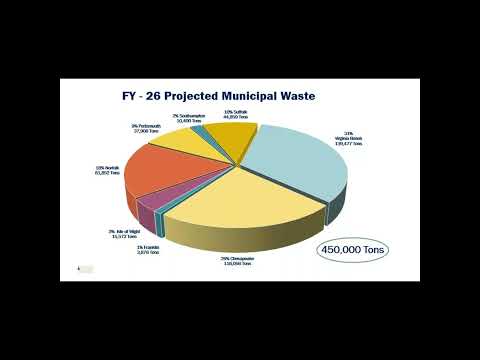
The actions came after a presentation of the authority’s proposed FY26 operating plan and a detailed discussion of shifting waste tonnages that have reduced municipal receipts while commercial volumes have risen. Dennis, SPSA’s executive director, presented the budget and said staff is managing landfill airspace, construction of Cell 7 and other capital needs while proposing modest rate and staffing changes.
The preliminary fee package the board approved for publication would: raise the contract non-municipal tip fee from $59 to $62 per ton; increase household hazardous waste per-visit charges from $37 to $39; establish a $5-per-unit commercial electronics recycling charge (with a $15 minimum); increase construction and demolition (C&D) material from $55 to $60 per ton; and raise wastewater-treatment-plant sludge from $55 to $60 per ton. The resolution adopting the preliminary schedule also instructs staff to publish notices and hold a public hearing on May 28 before the board considers final adoption.
Why it matters: SPSA officials said municipal solid waste volumes are down compared with last year while commercial waste tonnage has climbed — a pattern that leaves the authority with lower-margin revenue and higher incremental hauling and disposal costs when municipal waste must be diverted to private landfills. Dennis said the proposed FY26 budget totals about $53 million and represents a 1.8% decrease from the prior year; it includes a 2% cost-of-living allowance for employees and a plan to absorb a roughly 17% increase in health-insurance premiums rather than pass that to staff.
Board members questioned the size of the employee increase and the potential behavioral effects of fee changes. Several members asked staff to re-check comparisons to local salary actions and to consider whether the $5 commercial electronics charge could drive improper disposal; staff said the fee is intended to limit large commercial drop-offs that overwhelm sorting capacity and that the program to recycle electronics currently sends material to a contractor in Knoxville, Tenn., with no disposal returns or extra charges to SPSA to date.
Staff reported lithium-ion battery disposal costs have risen: the authority disposed of 2,353 pounds of lithium-ion batteries last year at a contractor cost of $6.50 per pound, about $15,294, compared with roughly $4,000 spent on conventional batteries.
Budget shortfall and transfer: Because the authority has been diverting more municipal tons to private landfills to conserve airspace at the regional Simpson landfill and because hauling and disposal fees from private contractors have risen, staff proposed using $1,642,400 of savings from deferred capital projects and other identified savings to cover increased hauling and disposal this fiscal year. The board authorized the transfer by voice vote.
Other items in the discussion: Dennis and staff updated the board on the wetlands permitting process for Cell 8 mitigation (awaiting a record decision from the U.S. Army Corps and a Virginia DEQ individual permit public notice), installation of a leachate evaporator (near startup), progress on the flyover/bridge work, and an aggressive schedule for Cell 7 bid documents. Staff said a draft alternative-waste-disposal contract has been exchanged with a potential counterparty and further review is under way.
Votes at a glance: The board adopted the preliminary fee resolution by roll call (unanimous “yes” votes from members present), authorized the $1,642,400 cross-object budget transfer by voice vote (motion carried), and approved the third-quarter financial report by voice vote (motion carried). The resolution sets 9:30 a.m. May 28 for the public hearing on the proposed fees.
Board and staff said they will continue to monitor tonnages and airspace daily and may adjust operations and the budget as permitting, hauling rates or waste volumes change.