Get Full Government Meeting Transcripts, Videos, & Alerts Forever!
Get email alerts on the Public Safety topic
No spam. Unsubscribe anytime.
Indianapolis officials, survivors mark memorial service, urge continued support for police
Summary
City and state officials read a mayoral proclamation and survivors described long-term impacts after line-of-duty deaths, while union leaders called on the parole board and governor to act in a decades-old murder case.
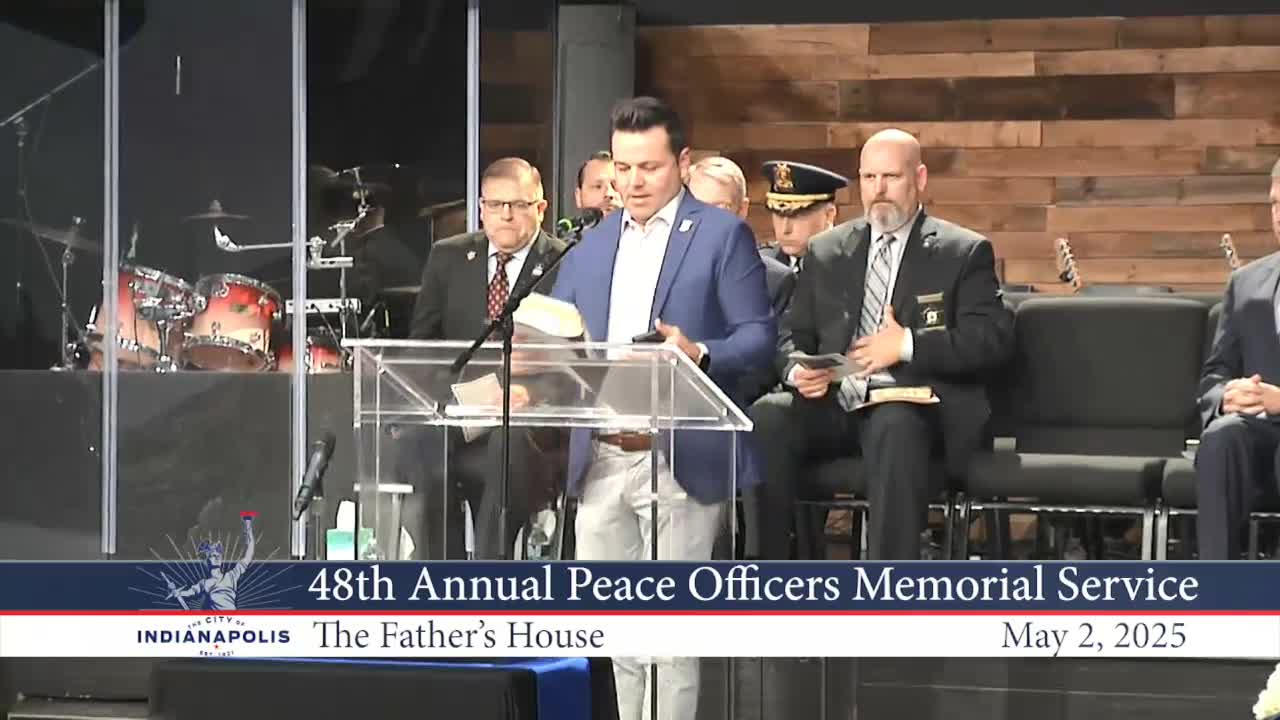
Indianapolis officials and survivors gathered at The Father’s House on May 2, 2025, for the city’s annual police memorial service, where Mayor Joseph H. Hogsett’s proclamation designating the day as a time to remember fallen officers was read and elected officials, union leaders and survivor family members urged continued support for officers and their families.
The morning included a proclamation read on behalf of the mayor by Indianapolis Chief of Police Chris Bailey: “I, Joseph H. Hogsett, mayor of the city of Indianapolis, do hereby proclaim 05/02/2025 as Police Officers Remembered Service Day in the City of Indianapolis,” asking citizens to join the observation.
The proclamation set the tone for remarks by Lieutenant Governor Mica Beckwith, Attorney General Todd Rokita and others praising police sacrifice and calling for public support. “We will always stand up to defend and not defund our police,” Attorney General Todd Rokita said, urging civilian leaders to show consistent support beyond memorial ceremonies.
Rick Snyder, president of Fraternal Order of Police Lodge 86, used his remarks to press for accountability in a long-running criminal case involving the 2000 murder of Beech Grove officer William R. Toney. “We now look to the Indiana Parole Board and our governor to uphold their responsibilities to ensure full accountability,” Snyder said, describing the family’s call for closure after appeals and final reviews concluded.
Survivors provided personal accounts of loss and recovery. Deputy Chief Tanya Terry, speaking as a former officer and a friend of the late Officer David Spencer Moore, described the immediate and long-term effects of a line-of-duty death on colleagues and families. Terry recounted returning to patrol after Moore’s death and the ongoing “hypervigilance” and triggers that can follow. She urged officers in the audience to seek help and use available supports: “Talk to someone, whether that’s a professional, a spouse, a peer, faith leader…do not hold on to your experience. It’ll eat you up.”
Terry credited peer support programs, the FOP and department wellness efforts with helping survivors and encouraged intentional physical and mental-health practices, warning against unhealthy coping mechanisms such as alcohol dependency and gambling. “We have resources available, and I am proud of our FOP, the COPS organization, and our agency for leaning into wellness,” she said.
The service also included a roll call in which the names of dozens of officers who died in the line of duty were read aloud. Names called included Officer David Spencer Moore (Indianapolis Metropolitan Police Department) and Officer William R. Toney (Beech Grove Police Department), among others. Organizers invited surviving family members to stand when their loved one’s name was read.
Organizers closed the service with music and prayer and extended an invitation to an FOP-hosted lunch at the lodge on Shelby Street. No formal votes or policy actions were taken at the memorial; the event functioned as a commemoration and a forum for officials and survivors to press for support and accountability in specific cases.
The memorial combined ceremonial remembrance with explicit public requests: elected officials asked the public to sustain support for law enforcement year-round, union leadership asked state authorities to act on a particular parole and clemency question, and survivors recommended wellness resources and peer support for coping with trauma.