Get Full Government Meeting Transcripts, Videos, & Alerts Forever!
Get email alerts on the Municipal Budget topic
No spam. Unsubscribe anytime.
Councilors press administration on vacancy savings, fund balance and cannabis revenue transparency in FY26 budget
Summary
At a May 1 committee hearing councilors questioned the administration’s use of vacancy savings (program savings), low fund balance, and the treatment and reporting of cannabis tax revenue, arguing the presentation obscured tradeoffs and local accountability.
Albuquerque — City councilors pressed budget officials on May 1 about how the FY26 proposed operating budget treats vacancy savings, fund balance levels and the reporting of cannabis tax revenue, saying the administration’s presentation made it difficult for residents to track where reductions and increases occurred.
Council budget staff said the proposed FY26 resources total about $1.5 billion across all funds and that the general fund was balanced in the administration’s proposal. City economists and the budget office said gross receipts (GRT) tax estimates rose slightly for FY26 while noting “considerable uncertainty” remained in forecasts.
Councilor questions focused on three related concerns:
1) Vacancy savings and “program savings.” Councilors asked why budget documents show “program savings” or vacancy savings—money not budgeted for positions that are unlikely to be filled—treated as an available resource. Budget staff said departments historically do not fill all authorized positions; the administration models vacancy savings into the budget to reflect that reality. Several councilors called the terminology confusing and said dollars labeled as “savings” were effectively reallocated to other priorities rather than retained as reserves.
2) Fund balance size and risk. Councilors cited a proposed fund balance that, according to administration figures, would be low relative to Government Finance Officers Association guidance. Budget staff said the administration conservatively assumed zero reversion and no department reversions when building the fund balance estimate; they also noted the budget maintains the statutory 1/12 reserve (one month of operations). Councilors raised concerns that a low fund balance could raise auditor or credit risks and argued for larger reserves.
3) Cannabis tax transparency. Councilor Rogers and others asked why the cannabis tax—now placed in its own fund—was not clearly displayed in the GRT slide used for public presentation. Budget staff said the presentation aggregated all GRT and that separate tables exist showing cannabis receipts; staff offered to include the cannabis fund numbers in the next presentation and to distribute a “fun table” with details to the public.
Budget staff and administration replied the FY26 proposal includes recurring items such as negotiated wage increases and a $30.1 million transit subsidy; non-recurring items and transfers are also shown on departmental slides. Officials offered to provide more granular tables showing transfers, risk allocation changes (workers’ comp/tort adjustments) and the underlying reasons for any net decreases in department totals.
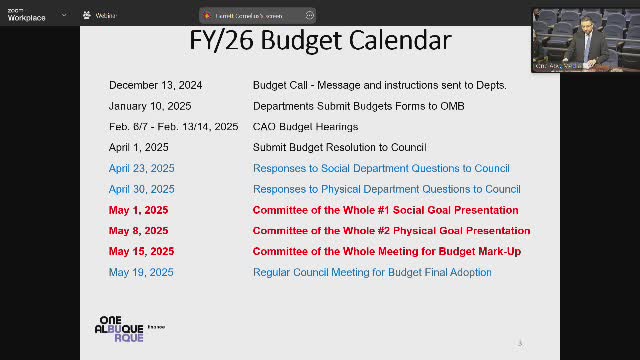
What happens next: Councilors asked for clearer line-item data and a public table showing cannabis receipts. They also signaled willingness to propose amendments to adjust reserves or reallocate funds ahead of the May 15 committee markup and the full council adoption on May 19.
Ending: The mayor’s FY26 proposal is set for additional public hearings on May 8 and May 15; budget staff said they will supply more detailed tables requested by councilors to improve transparency before the markup.