Get Full Government Meeting Transcripts, Videos, & Alerts Forever!
Get email alerts on the Workforce Reentry Firefighting topic
No spam. Unsubscribe anytime.
Senate committee advances bill to create employment pathway for incarcerated firefighters
Summary
The Senate Natural Resources and Water Committee voted to pass SB 423, which would standardize training and credentialing for incarcerated firefighters and create a transition pathway to post‑release firefighting jobs; the measure cleared the committee on a 7-0 vote and was sent to Appropriations.
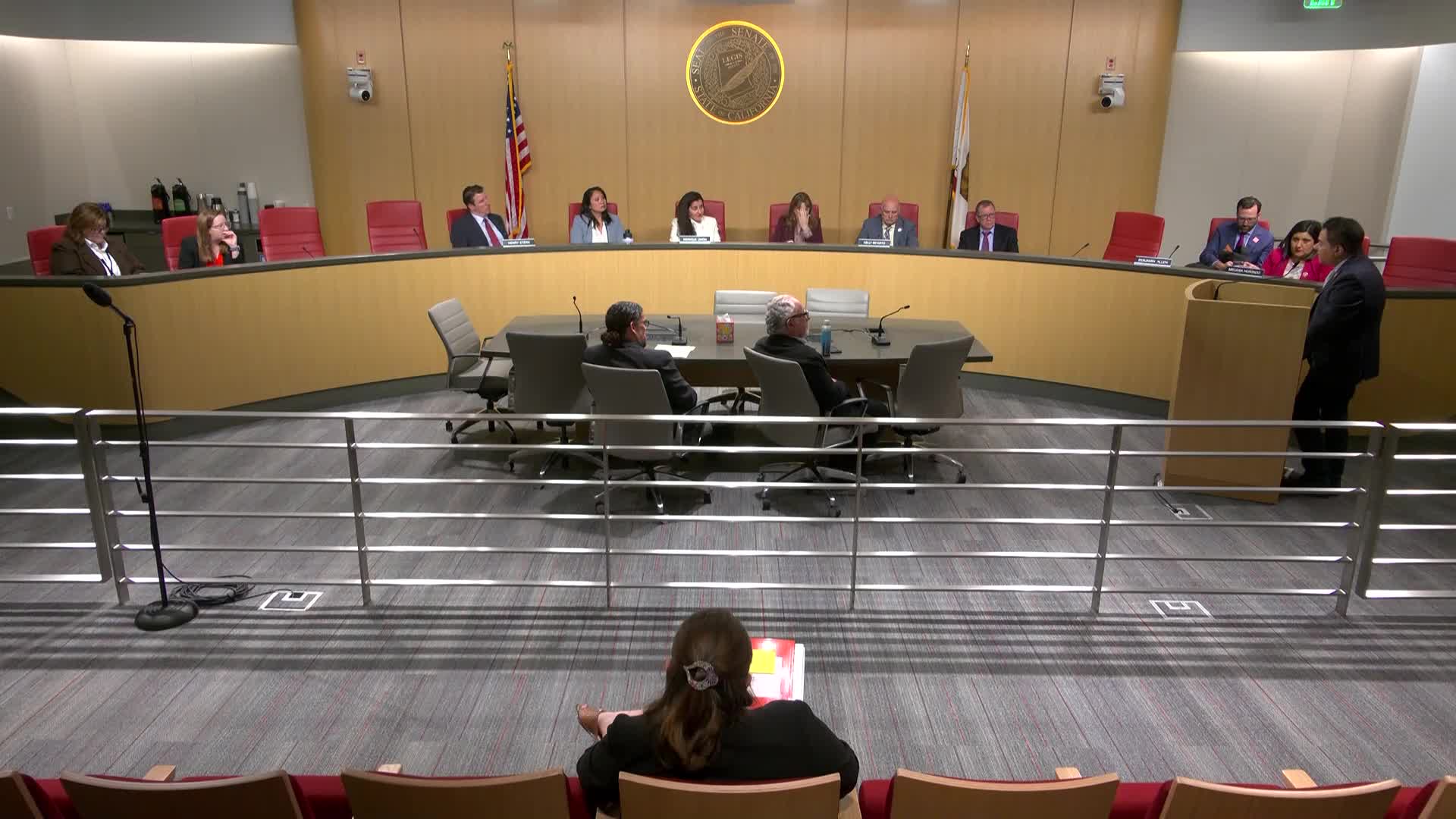
The Senate Natural Resources and Water Committee on Oct. 26, 2025, voted to pass SB 423, a bill that would standardize training and credentialing for incarcerated firefighters and create a pathway from incarceration to paid firefighting employment. The committee approved the bill, as amended, on a 7-0 voice/roll call and referred it to the Senate Appropriations Committee.
SB 423, introduced by Senator Smallwood-Cuevas, would require creation of a scalable, evidence‑based infrastructure to convert frontline service performed by incarcerated people into recognized training and credentials, encourage registered apprenticeships, and require tracking and reporting on program outcomes to the Legislature. "SB 423 would ensure that the work of our incarcerated labor force is not forgotten and upon paying their debt to our communities and serving their time, that their time be meaningful and valuable," the bill sponsor said during the hearing.
Supporters told the committee that incarcerated firefighters already provide substantial labor during California's extended wildfire seasons but face barriers to translating that experience into civilian firefighting careers. Lawrence Cox of Legal Services for Prisoners with Children, who testified as system-impacted and said he spent 17 years incarcerated, gave committee figures that proponents used to frame the problem: roughly 3,800 people on conservation camp wait lists, about 3,100 unfilled fireline vacancies statewide, and roughly 3,800,000 frontline hours contributed by incarcerated crews annually — "comparable to 1,800 full time positions," Cox said.
Anthony Pedro, chief executive officer of Future Fire Academy, said training programs can prepare candidates and that the bill will help identify qualified people. "It's our job in any academy . . . to build and bring the best out of them for the ones that qualify to be the best," Pedro said.
Several civil‑rights and advocacy groups registered support, including ACLU California Action and Legal Services for Prisoners with Children. The California Professional Firefighters association told the committee that amendments in the bill's analysis addressed its concerns and allowed the union to remove its opposition. Megan Soopers of the California Professional Firefighters said the amended language "appropriately acknowledge[s] the existing pathways and strengthen[s] them." Cal Fire Local 2881, represented by Terry McHale of Aaron Reed & Associates, expressed support while emphasizing that programs must preserve competitive hiring standards and peer acceptance within fire departments; McHale cautioned against any appearance of "line skipping" and urged that candidates still prove fitness, training and readiness.
Because the committee did not initially have a quorum, discussion included program design and concerns about post‑release competitiveness before a formal motion was made. When the committee later convened with a quorum, Senator Hurtado moved the measure. The roll call recorded Senators Limon, Seardo, Allen, Grove, Hurtado, Laird and Stern voting aye; the motion was recorded as do pass, as amended, to Appropriations (final tally recorded 7-0).
SB 423's supporters said the bill aims to reduce barriers that require formerly incarcerated firefighters to "start the process from the very beginning" despite prior frontline experience. The bill also directs reporting to the Legislature to measure whether the pathway converts frontline hours and training into successful employment outcomes.
Next steps: SB 423 advances to the Senate Appropriations Committee, where its fiscal impacts and any amendments will be considered. The author asked committee members for an "I" vote when the committee took action.